
On this page
Acquisition financing is the money a buyer uses to purchase another business instead of paying the whole price from cash on hand: usually a mix of the buyer's cash, a loan, payments the seller agrees to take later and sometimes new equity. When a SaaS founder buys a competitor, a tuck-in or a micro-SaaS, lenders size that mix on the combined company's recurring revenue, retention and cash flow, so the deal has to work for the merged business, not just for the target.
Key Takeaways
- SBA 7(a) loans of up to $5 million can fund a business acquisition, but since March 1, 2026 every owner of the borrower must be a U.S. citizen or national living in the U.S., according to the SBA.
- Under SBA's October 2026 rules, seller earn-outs are prohibited in 7(a) acquisitions, and an existing company buying another in its industry group needs at least 1.15x debt service coverage on historical EBITDA.
- 24% of private-company deals outside life sciences in 2025 included an earn-out, up from 19% in 2014, in SRS Acquiom's 2026 Deal Terms Study.
- Founderpath's term loan FAQ (November 2026) says acquisition lending is based on the combined entity's ARR, generally capped around 50% combined leverage.
- In our worked example, debt service on a $2.0M term loan at 15% plus a $500K seller note is covered 2.69x in the loan's interest-only year, but coverage falls to 1.28x when principal starts and to 1.09x if 20% of the acquired ARR churns.
What acquisition financing means for a SaaS buyer
Many of the pages that rank for acquisition financing are written for buyers of traditional businesses, where a bank can lend against buildings, equipment and inventory. A software company has almost none of that. What it has is recurring revenue, a customer list and the cash the two businesses produce once they are combined. That changes which lenders will talk to you and how they decide how much to lend.
SaaS founders usually buy one of three things:
- A tuck-in: a small product your customers already buy next to yours, folded into your app or sold as an add-on.
- A competitor: a company selling the same thing to the same buyers, bought for its customers and to remove a rival.
- A micro-SaaS: a small, often founder-run product bought for its profit and its niche.
Below is how to pay for the deal. For the deal itself (finding targets, the letter of intent, due diligence and integration), read our guide on how to acquire a startup. Buying out a co-founder or investor instead? See how to finance a partner buyout. If you are on the other side of the table, see how to sell a SaaS company and the firms that buy SaaS companies.
Seven ways to pay for a SaaS acquisition
Most deals combine several of these. The order below runs roughly from the simplest to the most expensive in ownership.
| Source | Best for | The catch |
|---|---|---|
| Cash on hand | Small deals by profitable buyers | Drains the reserve you need for integration |
| Seller note | Bridging a gap the seller will finance | Fixed payments whatever happens to the business |
| Earn-out | Targets whose future is uncertain | Disputes over how targets are measured |
| SBA 7(a) loan | U.S.-owned, profitable buyers, loans up to $5M | Strict eligibility, personal guarantees, no earn-outs |
| Bank or asset-based loan | Buyers with assets, receivables or long bank history | Software has little collateral a bank values |
| Recurring-revenue term debt | Profitable SaaS buyers with strong retention | Fixed payments and a lien on business assets |
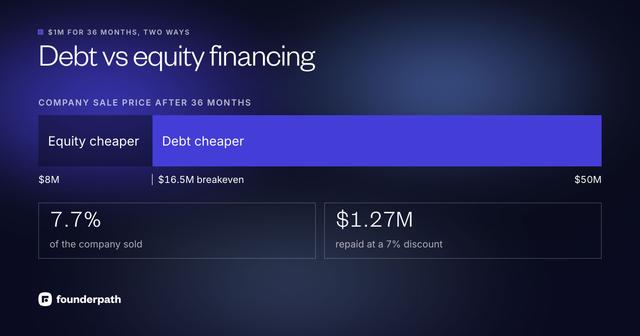
| Equity | Large or risky deals | Permanent dilution (debt vs equity) |
Source: Founderpath analysis; program rules from the SBA sources linked below.
Cash on hand
Paying from your own balance sheet is the simplest structure and the easiest to negotiate. itrinity, which buys small software companies, told us in February 2025 that it pays for each acquisition with free cash from the companies it already owns and carries no debt at all (watch at 22:48). The risk is leaving too little cash for the months after closing, when migration, support and retention work cost the most.
Seller notes and earn-outs
A seller note (also called a vendor loan or seller financing) lets you pay part of the price over time, from the cash the business produces. Tim Schumacher, CEO of SaaS Group, said seller financing saves his company interest, so it can pay a little more for a business (watch at 17:03).
An earn-out pays part of the price only if the acquired business hits targets after closing, usually revenue or ARR. Earn-outs are common: SRS Acquiom found them in 24% of the private-target deals outside life sciences in its 2025 data, up from 19% in 2014. For a SaaS buyer, an earn-out is direct insurance against churn in the acquired customer base: if the customers leave, you don't pay that part of the price. Schumacher said an earn-out shares the risk, so the buyer can pay more (watch at 16:43). Brad Miller structured his first tuck-in at AwarenessTech this way in 2016: half up front and half once revenue passed a threshold (watch at 7:03).
SBA 7(a) loans
The SBA 7(a) program lets you borrow up to $5 million to acquire a business, with a term of up to 10 years when no real estate is involved and interest capped by the SBA. It can finance intangible assets such as goodwill, customer lists and intellectual property, which matters because that is most of what a software company is worth. The rules are strict, and several of them change the math for a SaaS buyer. All of the following come from SBA's SOP 50 10 8.1, effective October 1, 2026:
- Ownership: every direct and indirect owner of the borrower, and every required guarantor, must be a U.S. citizen or U.S. national with their main home in the U.S. The rule took effect for 7(a) and 504 loans on March 1, 2026 (SBA policy notice 5000-876441), and the SBA's March 9, 2026 announcement extended it to every SBA-guaranteed loan. A company with a foreign co-founder or foreign investors doesn't qualify.
- Personal guarantees: anyone who owns 20% or more must give an unlimited personal guarantee.
- No earn-outs: seller earn-outs are prohibited in SBA-financed changes of ownership.
- Equity injection: the buyer puts in at least 10% of total project costs. When an existing business buys another in the same four-digit NAICS industry group (a "business expansion"), the lender may reduce or waive this if the buyer has enough liquidity.
- Seller notes: a seller note counts toward the 10% only if it is on full standby, with no principal or interest paid for the life of the SBA loan, and it can cover at most half of the requirement.
- Coverage: historical EBITDA must cover the combined debt payments at least 1.15x for a business expansion and 1.25x for an initial acquisition (SBA's default category, which covers a buyer that doesn't already run a business in the same four-digit NAICS industry group). The lender can't rely on your projections to meet that test.
- Due diligence: a purchase price of $3 million or more needs a quality of earnings report as well as a business valuation.
For a profitable, U.S.-owned SaaS company buying a smaller business in its own category, a 7(a) loan can be the cheapest long-term money available. For a buyer with any foreign owners or investors, or a deal that depends on an earn-out, it isn't an option. Venture-backed companies should check their whole ownership chain, because the rule covers indirect owners too.
Bank loans and asset-based lines
Banks lend against cash flow or collateral. The OCC's Comptroller's Handbook defines asset-based lending as "a specialized form of secured lending whereby a company uses its current assets (accounts receivable and inventory) as collateral for a loan". A SaaS company has no inventory, and if customers pay monthly by card its receivables are small, so the borrowing base is thin. A conventional bank loan works best for a profitable buyer with a long banking relationship and a modest amount to borrow. Brad Miller's 2010 purchase of AwarenessTech is a typical shape: he paid about $6 million, with $5.5 million of equity from himself and a financial partner and about $1 million of bank debt (watch at 3:41). Our guide to bank loans for SaaS companies covers the trade-offs.
Recurring-revenue term debt and acquisition lines
Specialist lenders lend against recurring revenue rather than hard assets: venture debt funds, business development companies and SaaS lenders such as Founderpath. They look at ARR, retention and margins, and for an acquisition they underwrite the target alongside you.
Reveleer, a healthcare data and analytics platform, is a clear case. After it turned EBITDA and cash-flow positive in 2023 (watch at 2:43), it raised over $65 million in a round led by Hercules Capital in February 2024 to pursue acquisitions. CEO Jay Ackerman told Nathan Latka the round was all debt, a facility "aligned based on ARR" that the company raised to support M&A once it understood its unit economics (watch at 17:54). It had carried less than $2 million of debt before (watch at 22:35).
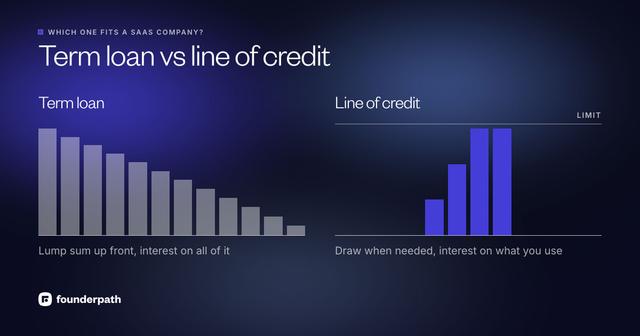
Some serial buyers arrange a standing acquisition line of credit instead of a new loan per deal (our term loan vs line of credit guide compares the two structures). SaaS Group, which buys small SaaS companies, works this way:
We actually struck some favorable deals with debt providers who've basically given us a carte blanche, so a line of credit, to tap into acquisitions as long as they're in a certain area, so SaaS and some certain metrics, then we basically just need to issue a capital call. So they don't need to be approved.
Schumacher's rule is to have that money lined up before making an offer, because a deal that falls apart over financing "makes you look like a fool" (watch at 2:45). Our guides to SaaS debt financing and venture debt explain how these lenders price risk.
Equity
Selling shares, or paying the seller in your own stock, adds no repayments, which suits a large deal or one whose payoff is far away. It is also the most expensive option if the combined company does well, because the new owners share in all of the upside, forever. Some buyers pay part of the price in instruments that can convert into their own equity, to keep the seller invested: Lemlist used convertible bonds for part of its purchase of Claap (deal recap).
How lenders size a SaaS acquisition
Whatever the source, a lender asks two questions about the combined company, and the answer to the stricter one sets your loan.
1. How much debt can the combined ARR carry? A recurring-revenue lender adds your ARR to the target's and caps total debt as a share of it. Founderpath's term loan FAQ says underwriting for an acquisition reviews the target's P&L, balance sheet, customer list and bank data alongside yours, and that lending is based on the combined entity's ARR, "generally capped around 50% combined leverage" (as of November 2026). Lenders define leverage differently, so ask exactly how yours measures it.
2. Can the combined cash flow pay for it? Every lender checks debt service coverage: EBITDA divided by the year's interest and principal on all acquisition debt, including the seller note. The SBA's floor is 1.15x for a business expansion. A buyer who wants room for mistakes aims higher, because the first year after a deal rarely goes to plan.
Both tests depend on the quality of the acquired revenue, so expect questions about:
- Retention of both books: logo churn, net revenue retention and cohorts for the target as well as for you.
- Customer concentration: a target whose top customer is 30% of ARR is riskier than one with a long tail.
- Overlap: customers who already pay both companies may expect to pay once after the deal, so that part of the combined ARR is at risk.
- Integration costs: migration, duplicate tools and the people you keep, which reduce EBITDA in the first year.
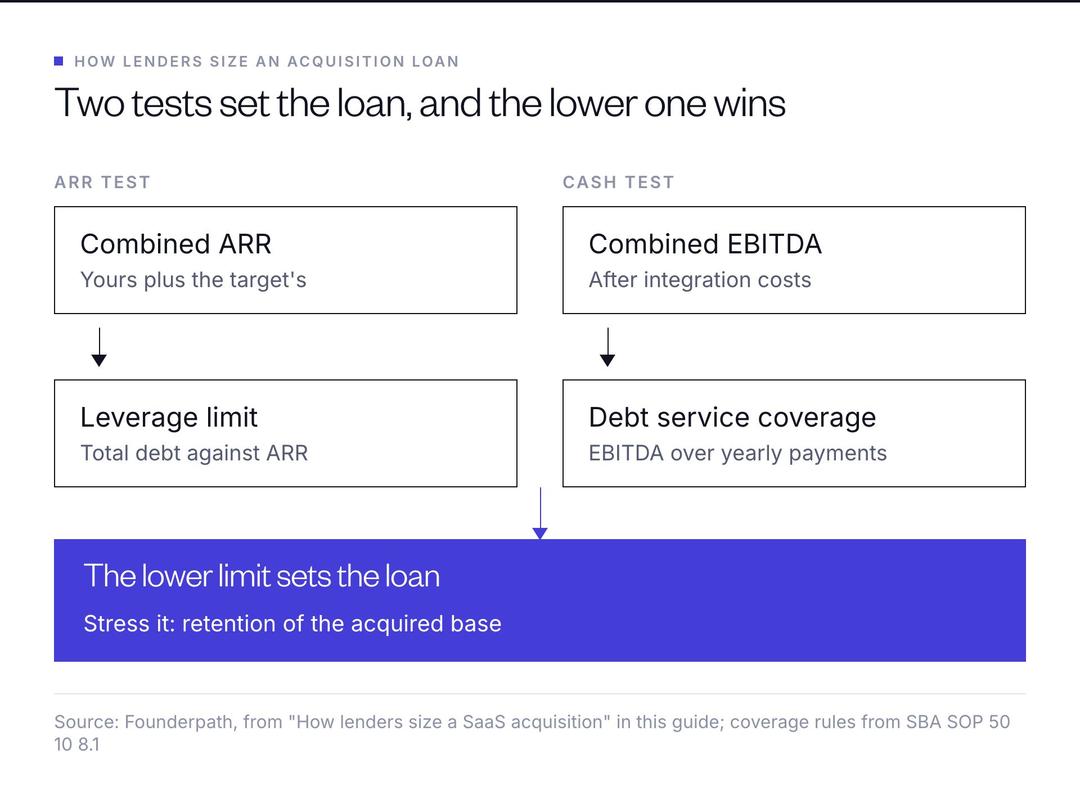
The two tests behind an acquisition loan. Source: Founderpath, from this section; coverage floors from SBA SOP 50 10 8.1
To see what your own revenue can carry before you talk to a lender, run your numbers through our SaaS debt capacity calculator.
A worked example with the arithmetic
Every number in this example is an assumption chosen for illustration, not an offer or a market benchmark. It uses the same structure as Founderpath's term loan calculator: interest only for a set number of months, then equal monthly payments over the rest of the term.
The companies:
- Your company: $5.0M ARR and $1.0M of EBITDA (a 20% margin).
- The target: a competitor with $1.2M ARR and $300K of EBITDA (25%).
- Combined: $6.2M ARR and $1.3M of EBITDA, before any savings.
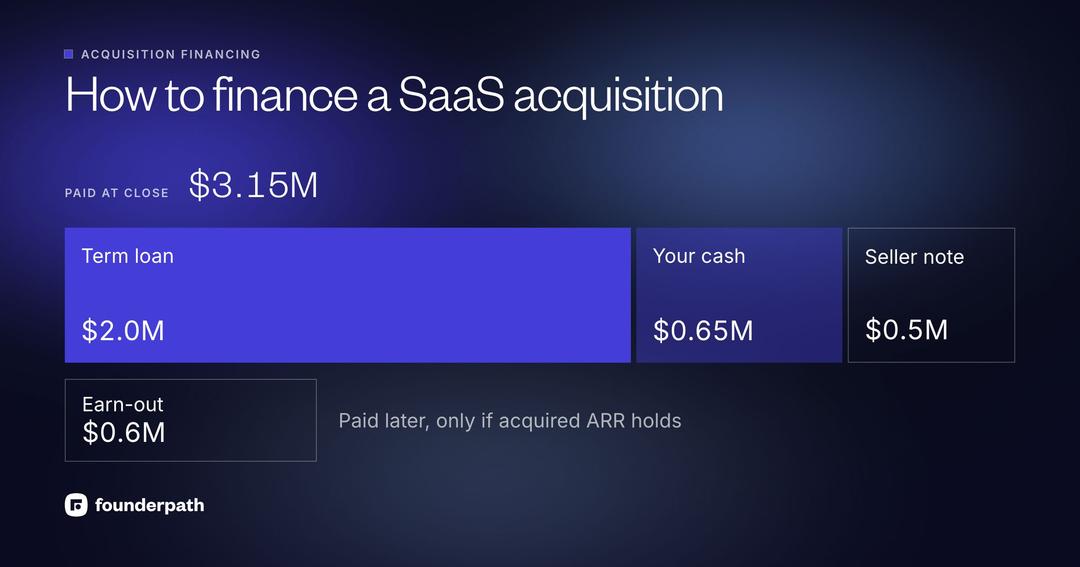
The price: $3.6M, or 3x the target's ARR. $3.0M is paid at closing and up to $600K more is an earn-out, paid at month 24 only if the acquired customers still produce at least $1.1M of ARR. With $150K of legal and diligence costs, you need $3.15M at closing.
| At closing | Amount | Terms assumed |
|---|---|---|
| Your cash | $650,000 | From the balance sheet; the rest stays as a reserve |
| Seller note | $500,000 | 6% interest, repaid monthly over 36 months |
| Term loan | $2,000,000 | 15% interest, 48 months, the first 12 interest only |
| Total sources | $3,150,000 | Price paid at closing $3,000,000 plus $150,000 of costs |
Source: Founderpath illustration; loan structure follows the Founderpath term loan workbook.
The leverage test: total debt at closing is $2,000,000 + $500,000 = $2,500,000. Divided by combined ARR, $2,500,000 / $6,200,000 = about 40%. Whether that clears a lender's cap depends on how it measures leverage, including whether it counts the seller note, so ask.
The coverage test:
- Year 1, interest only: $2,000,000 × 15% = $300,000 on the term loan, plus $15,211 × 12 = $182,532 on the seller note, for $482,532. Coverage is $1,300,000 / $482,532 = 2.69x.
- Year 2, principal starts: the term loan payment becomes about $69,331 a month, $831,968 over the year. With the seller note, debt service is $1,014,500 and coverage is $1,300,000 / $1,014,500 = 1.28x.
The stress test: suppose 20% of the acquired ARR churns in the first year, $1,200,000 × 20% = $240,000, and costs don't fall with it. At an 80% gross margin, EBITDA drops by $240,000 × 80% = $192,000 to $1,108,000. Coverage falls to $1,108,000 / $482,532 = 2.30x in year 1 and $1,108,000 / $1,014,500 = 1.09x in year 2, below the 1.15x the SBA requires at approval for a business expansion, and too thin for comfort. The earn-out helps here: the acquired customers now produce $960,000 of ARR, under the $1.1M target, so the $600,000 is never paid.
| Year 1 | Year 2 | |
|---|---|---|
| Debt service | $482,532 | $1,014,500 |
| Coverage, base case ($1.3M EBITDA) | 2.69x | 1.28x |
| Coverage, 20% of acquired ARR churns ($1.108M EBITDA) | 2.30x | 1.09x |
Source: Founderpath illustration; arithmetic shown above.
What the example teaches:
- The interest-only year is not the test. Year 2 is. Model the first full year of principal payments before you sign.
- A longer interest-only period moves the step, it doesn't remove it. With 24 months interest only, years 1 and 2 cost $300,000 a year on the term loan, but years 3 and 4 cost $1,163,680 a year. In year 3, with the seller note still running, debt service is $1,346,212 against $1.3M of EBITDA: 0.97x unless the business has grown.
- The earn-out caps what you owe if the customers leave. In the stress case the $600,000 is never paid; without the earn-out, the buyer would owe the full $3.6M whatever happens to the customers. It doesn't fix coverage, which still falls to 1.09x, and in the base case the $600,000 falls due at month 24 on top of debt service, so keep enough of your reserve to pay it.
- Smaller is often better. If the stress case worries you, borrow less and move more of the price into the earn-out.
This structure, with an earn-out, could not be financed with an SBA 7(a) loan.
Compare the full cost, not the headline rate
The rate on a term sheet is only part of the cost. Add origination or closing fees, any exit or prepayment fee, warrants and the interest you would pay if you refinance early. Jay Ackerman priced Reveleer's acquisition debt this way, including the chance that a new investor would lead the company to pay it off early:
What was most important to us is the total interest expense that we're going to pay with front end fees, back end fees, carrying fees, and straight borrowing costs.
In the example above, the term loan costs $795,904 of interest over 48 months if you hold it to maturity. Compare that with what the same $2.0M would cost in equity: the share of the company you would sell, valued at the price you expect when you sell or raise again. Our quarterly software debt benchmarks show what larger software companies pay private lenders, and the dilution calculator shows what equity would cost you.
The risks: integration, churn and covenants
Acquisitions fail more often than founders expect. A 2011 Harvard Business Review article by Clayton Christensen and co-authors noted that "study after study puts the failure rate of mergers and acquisitions somewhere between 70% and 90%." Debt doesn't cause those failures, but it removes your room to recover from them.
- Integration: the work of moving customers, systems and people falls on your team while it still runs the core business. Reveleer integrated finance and HR on day one, sales and marketing next, and product and technology last (watch at 16:03). Ackerman also warned that you can't buy a company "for financial engineering purposes" (watch at 14:43).
- Churn of the acquired base: customers who chose the target over you may not stay through a price change or a migration. Curate's CEO found that a prorated pricing transition was too complicated for his support team after he bought a competitor; our acquisition guide covers what he would change. Model churn explicitly, as in the stress test above.
- Covenants: many loans set minimum revenue, cash or coverage levels, and the SBA lets lenders add coverage covenants to loan agreements. Missing one can put the loan in default even while you make every payment. Read our guide to debt covenants for SaaS founders before you sign.
Brad Miller has seen the downside from the seller's side. In a 2022 talk, he said the buyer of AwarenessTech used heavy debt, and when revenue fell the company stopped making its bank payments:
They bought our company using a lot of debt, which was fine when we were making six million dollars a year, but not so fine when you're not making 6 million a year.
When not to use debt
Debt is the right tool when the combined company already produces the cash to repay it. It is the wrong tool when:
- The combined company doesn't make money yet. If EBITDA is negative, every payment comes out of your runway. Use cash, seller paper or equity, or wait.
- The deal only works if the stress test passes perfectly. If losing 20% of the acquired ARR pushes coverage under about 1.25x once principal starts, borrow less.
- The payoff depends on cross-sell or synergies that haven't happened. Let the seller share that risk through an earn-out instead of borrowing against it.
- The target is shrinking. Brad Miller had a term sheet to finance the full $19 million price he first negotiated for his biggest competitor; by the time the deal closed its run rate had fallen to $8 million, it couldn't meet payroll, and he paid $3.5 million (watch at 9:27). Debt sized on last year's revenue would have been far too large.
- You can't afford a bad year. Ackerman put it plainly: equity "is expensive, but it allows you to sleep better at night" (watch at 23:23).
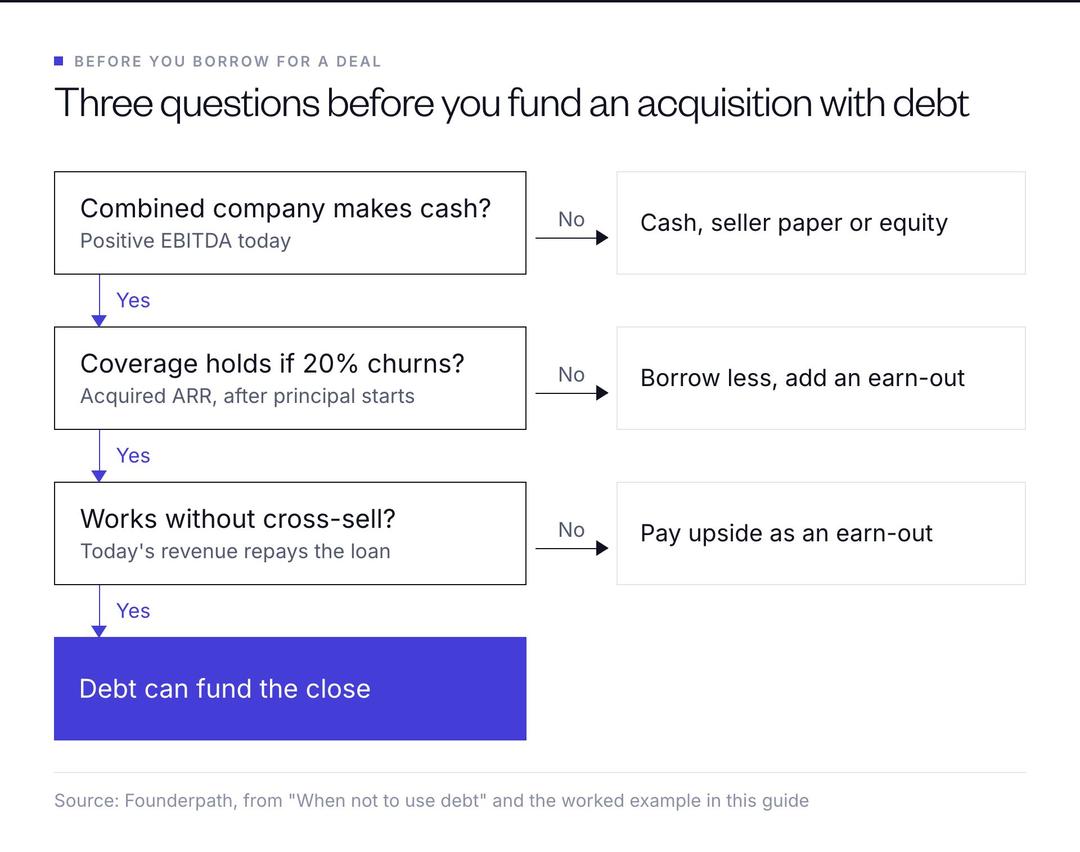
A three-question check before you borrow for a deal. Source: Founderpath, from this section and the worked example in this guide
How Founderpath term loans fit an acquisition
Founderpath term loans are non-dilutive capital for software companies with $3M+ in revenue: $500K-$10M, interest from 15%, terms of up to 4 years with up to 24 months interest only, and no warrants (as listed on the term loan page in November 2026). The product's FAQ answers the acquisition question directly: underwriting reviews the target's P&L, balance sheet, customer list and bank data alongside your own, and lending is based on the combined entity's ARR, generally capped around 50% combined leverage. There's no full personal guarantee; Founderpath takes a lien on business assets only.
You can model the payments yourself with the term loan Excel model used in the worked example. If you prefer to draw only when a deal closes, Founderpath's line of credit runs from $250K to $5M with interest charged only on the drawn balance, and its FAQ says there is no restriction on how you use a draw. For an overview of every option, see our guide to SaaS financing.
A Founderpath term loan is unlikely to fit if the acquired revenue is mostly one-off services, because the term loan page asks for recurring or subscription revenue, or if you are well below the roughly $3M of annual revenue its FAQ describes. And if the combined company is losing money, debt of any kind is hard to repay, as the section above explains. In those cases, the cash, seller-financing and SBA routes above are worth exploring first.
To see what the combined company could borrow, connect your billing, banking and accounting data at app.founderpath.com/get-started.
SaaS acquisition financing FAQ
What is acquisition financing?
Acquisition financing is the money a buyer uses to purchase another business instead of paying the full price from cash on hand. It is usually a mix of the buyer's cash, a loan, payments the seller agrees to receive later (a seller note or an earn-out) and sometimes new equity.
Can I use an SBA loan to buy a software company?
Yes, if your business qualifies. SBA 7(a) loans of up to $5 million can fund a change of ownership, including goodwill and customer lists. Under SBA's October 2026 rules, every owner must be a U.S. citizen or national living in the U.S., anyone owning 20% or more must give an unlimited personal guarantee, and seller earn-outs are not allowed. An existing company buying a business in the same industry group needs at least 1.15x debt service coverage on historical EBITDA.
How much can I borrow to acquire a SaaS company?
Two limits apply, and the lower one sets the loan. A recurring-revenue lender caps total debt against the combined company's ARR, and every lender checks that combined EBITDA covers the yearly debt payments with room to spare. Founderpath's term loan FAQ says lending for an acquisition is based on the combined entity's ARR, generally capped around 50% combined leverage.
Can a seller note count as my down payment?
For an SBA 7(a) loan, only partly. A seller note counts toward the required 10% equity injection only if it is on full standby, with no principal or interest paid for the life of the SBA loan, and it can cover at most half of the requirement. Other lenders set their own rules, so ask before you sign a letter of intent.
Is an earn-out better than a seller note?
They solve different problems. A seller note defers a fixed amount you owe regardless of results, so it is debt. An earn-out is paid only if the acquired business hits agreed targets, so it shifts some of the risk of churn back to the seller. SRS Acquiom found earn-outs in 24% of private-company deals outside life sciences in 2025.
Can I finance an acquisition without giving up equity?
Yes. Cash on hand, seller notes, earn-outs, bank loans and recurring-revenue term loans all leave your ownership unchanged, unless a lender takes warrants. The trade-off is fixed repayments, so test the deal against a drop in the acquired company's revenue before you borrow.
What is an acquisition line of credit?
It is a committed credit facility you draw on when you close a deal instead of arranging a new loan each time. SaaS Group's CEO Tim Schumacher described lenders giving it a line of credit for acquisitions that meet agreed criteria, so each deal only needed a capital call. Lines like this suit serial buyers who close several small deals.
Sources and method
Checked in November 2026. Every program rule and lender term below was read on the source page on the date of writing; terms change, so confirm them before you rely on them.
- SBA 7(a) program terms (loan size, term, rate caps, uses including business acquisition): SBA, 7(a) terms, conditions and eligibility, page updated November 2026.
- SBA change-of-ownership rules (equity injection, standby seller notes, earn-out ban, coverage floors, quality of earnings, personal guarantees, citizenship): SBA SOP 50 10 8.1, effective October 1, 2026, Appendix 15 and Section A; ownership rule also in SBA policy notice 5000-876441, effective March 1, 2026, and the SBA's March 9, 2026 announcement.
- Earn-out frequency: SRS Acquiom, earnout and milestone trends, from its 2026 Deal Terms Study.
- Asset-based lending definition: OCC Comptroller's Handbook, Accounts Receivable and Inventory Financing, March 2000.
- M&A failure rates: Christensen, Alton, Rising and Waldeck, The Big Idea: The New M&A Playbook, Harvard Business Review, March 2011.
- Reveleer's financing: Reveleer's February 2024 announcement and Jay Ackerman's March 2024 interview with Founderpath.
- Founder cases and quotes: Founderpath interviews and talks linked at each mention, with the speaker's words quoted verbatim from the transcript.
- Founderpath terms: the live term loan and line of credit pages, November 2026.
- Worked example: every company figure, price and seller-note term is an assumption for illustration. Term loan payments follow the interest-only then equal-payment structure of the Founderpath term loan workbook, at its 15% default rate, before any fees. The stress test assumes an 80% gross margin on lost revenue and no cost savings.