
On this page
A merchant cash advance (MCA) is not a loan: the provider buys a fixed amount of your future sales for a lump sum today and collects it as a share of your daily or weekly sales, priced with a factor rate instead of an interest rate. A business loan is borrowed money you repay in fixed installments with interest over a set term, so it usually costs far less, but it is slower and harder to get.
Key Takeaways
- In structure, an MCA is a sale of future receivables: an FTC business blog post on its 2020 staff perspective describes providers buying a fixed amount of future receivables and charging a factor, often 20% to 50% of the amount.
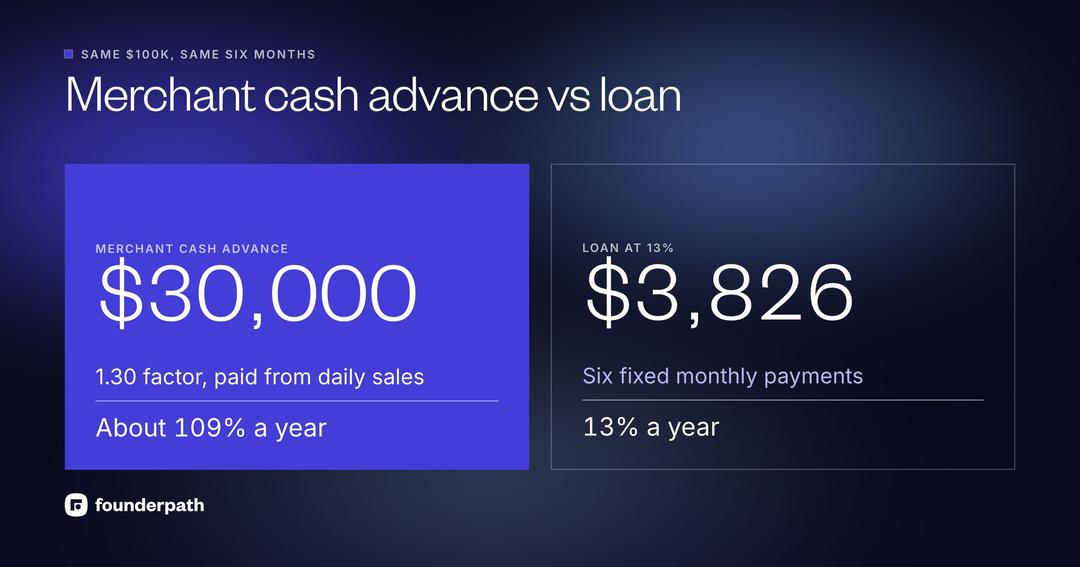
- On $100,000 for six months, a 1.30 factor collected over 130 business days costs $30,000, about 109% a year, against $3,825.71 for a loan at 13% interest, by Founderpath's calculation.
- MCAs are easier to get: in the Federal Reserve Banks' 2025 Small Business Credit Survey, 48% of MCA applicants were fully approved and 12% denied, against 37% and 28% for business loans.
- The label does not settle the law: in February 2026 a New York appeals court held that one funder's agreements styled as MCAs were loans subject to usury limits.
- California, for offers up to $500,000, and New York, up to $2.5 million, require MCA providers to disclose the cost as an annualized rate.
Merchant Cash Advance vs Loan at a Glance
| Merchant cash advance | Business loan | |
|---|---|---|
| What it is | A purchase of a fixed amount of your future sales | Borrowed money repaid with interest |
| How it is priced | A factor rate, such as 1.30 on each dollar advanced | An interest rate, shown as an APR |
| Repayment | A share of daily or weekly sales, or a fixed daily or weekly debit | Fixed installments, usually monthly |
| Term | None fixed: it ends when the purchased amount is collected | A set term and maturity date |
| Paying early | The factor fixes the total; any discount is up to the provider | Saves the interest not yet charged, unless there is a prepayment fee |
| Approval in the Fed's 2025 survey | 48% fully approved, 12% denied | 37% fully approved, 28% denied |
| What the lender looks at | Mainly recent sales and bank statements | Credit, financial statements, often collateral |
| Rules | Treated as a sale, not a loan, unless a court finds otherwise | Usury and lending laws can apply |
| Best for | A short, seasonal gap that the cash pays back fast | Planned investments with predictable cash flow |
Approval figures: Federal Reserve Banks, 2026 Report on Employer Firms. Other rows: sources in each section below.
How Each Is Priced: Factor Rate vs APR
An MCA quotes a factor rate: the multiple of the advance you repay. At 1.30, a $100,000 advance means $130,000 comes back to the provider. The FTC's 2020 staff perspective describes the factor as often 20% to 50% of the amount, which is a factor of 1.20 to 1.50.
A loan quotes an interest rate, charged on the balance you still owe, so the cost shrinks as you repay. The SBA caps 7(a) variable rates at the base rate plus 3.0% to 6.5%, depending on loan size: plus 6.0% for $50,001 to $250,000. With the bank prime rate at 7.00% on November 23, 2026 (Federal Reserve H.15), the most an SBA lender may charge on a $100,000 variable-rate loan is 13.0%.
The two numbers are not comparable until you put the factor on a yearly basis. Here is the conversion for a $100,000 advance at 1.30, collected at $1,000 a business day over 130 business days, about six months:
- Dollar cost: $130,000 minus $100,000 = $30,000, or 30% of the advance.
- Per year, if you held all the money: 30% over six months is 30% × 2 = 60% a year.
- Adjust for daily repayment: you start paying back the next business day, so on average only about half the $100,000 is in your hands. Paying the same $30,000 for half the money roughly doubles the rate.
- Exact rate: the daily rate at which 130 payments of $1,000 repay $100,000 is 0.4203%. Times 260 business days, that is 109.3% a year, the nominal method in Appendix J to the CFPB's Regulation Z.
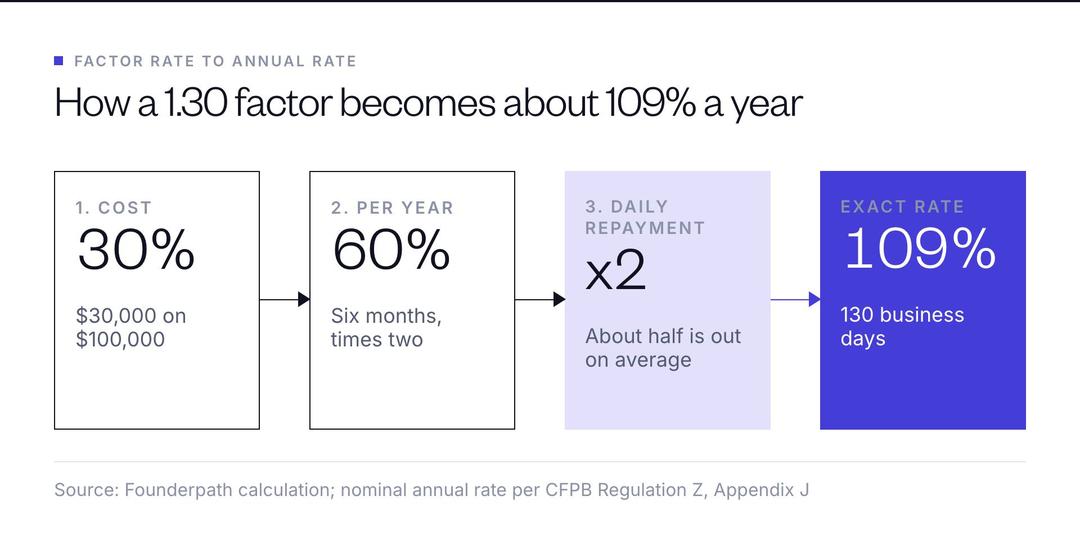
How a factor rate becomes an annual rate. Source: Founderpath calculation; nominal annual rate per CFPB Regulation Z, Appendix J
Speed changes the answer as much as the factor does. The same $130,000 collected over 65 business days works out to about 217% a year, and over 260 business days to about 55%. Our guide to MCA costs has the full table by factor rate.
Repayment: a Share of Sales vs Fixed Installments
An MCA is collected from your sales. The provider either takes a set percentage of each day's card or bank receipts, called the holdback, or debits a fixed amount from your account every day or week. New York's definition of sales-based financing covers both: payments that rise and fall with sales, and fixed payments with a reconciliation, or true-up, that adjusts them to a percentage of sales.
That is the real advantage of an MCA. With a true percentage holdback, a slow week means a smaller payment. The catch is that the total never changes: a slower collection stretches the advance out, but you still owe the full $130,000. And a fixed-debit MCA only adjusts if you ask for the reconciliation and the provider performs it. Among the FTC's four concerns about MCAs is that some providers may not conduct the promised true-ups when daily sales drop.
A loan does the opposite. The payment is the same every month whatever your sales do, which is easy to plan around when revenue is steady and hard when it is seasonal. In exchange, you know the end date, and every payment reduces a balance that is charging you interest.
Worked Example: $100,000 for Holiday Inventory
An ecommerce brand needs $100,000 in September to buy holiday stock, which it expects to sell through by March. It compares two offers over the same six months for the same $100,000, with no fees on either:
- MCA: a 1.30 factor and a 15% holdback. Card sales average about $6,667 a business day, so the holdback collects about $1,000 a day.
- Loan: 13.0% interest, the SBA 7(a) variable-rate cap for this loan size in November 2026, repaid in six monthly installments.
| MCA at 1.30 | Loan at 13% | |
|---|---|---|
| Cash received | $100,000 | $100,000 |
| Payments | About $1,000 a business day, 130 times | $17,304.29 a month, 6 times |
| Total repaid | $130,000 | $103,825.71 |
| Cost | $30,000 | $3,825.71 |
| Annualized cost | 109.3% | 13.0% |
Founderpath calculation. The loan payment is the standard amortizing formula; the MCA rate uses the method above. Both assume no fees.
The loan costs about $26,000 less. The MCA's case rests on what happens if the season disappoints. If card sales average a third less, about $4,444 a day, the 15% holdback collects about $667 a day and the $130,000 takes about 195 business days, roughly nine months, to collect. Each day's payment is smaller, and the annualized cost falls to about 73% because you keep the money longer, but the $30,000 cost stays the same. The loan still wants $17,304.29 every month.
Enter the advance, factor, fees and payment schedule from any real offer into our free merchant cash advance calculator to see its total cost and annualized rate side by side with this example.
Is a Merchant Cash Advance a Loan? Rules and Regulation
In structure, no. The FTC describes the provider as buying a fixed amount of the business's future receivables, not lending it money. Because it is a purchase rather than a loan, an MCA generally falls outside the state usury laws that cap interest rates on loans. As New York's Appellate Division put it in LG Funding v United Senior Properties of Olathe in March 2020, without a loan there can be no usury.
Courts decide by substance, not the label. New York courts usually weigh three factors to judge whether repayment is truly contingent on sales:
- Whether the agreement has a reconciliation provision that lowers payments when sales fall.
- Whether it has a finite term.
- Whether the provider has recourse if the merchant declares bankruptcy.
When those point to absolute repayment, the "advance" can be treated as a loan. In People v Richmond Capital Group, decided on February 19, 2026, New York's Appellate Division, First Department, held that the funders' agreements, although styled as MCAs, were properly characterized as loans subject to restrictions on usury, because no reconciliation was performed in practice and daily payments were fixed. It upheld the lower court's finding against the funders and sent the money judgment back for further proceedings. New York makes charging more than 25% a year on a loan criminal usury.
States have also added disclosure laws that make MCA providers show their cost like a loan:
- California: a provider of commercial financing, which includes buying a business's receivables, must disclose the total funds provided, the total dollar cost, the term or estimated term, the payment method and amount, prepayment policies and the cost as an annualized rate, under Financial Code section 22802. It applies to offers of $500,000 or less (section 22800) and exempts banks (section 22801). The DFPI's regulations took effect on December 9, 2022.
- New York: for sales-based financing, a provider must disclose the amount, the finance charge and an estimated APR calculated under Regulation Z, among other terms, under Financial Services Law section 803. Banks and deals over $2.5 million are exempt (section 802).
The APR on an MCA disclosure is an estimate, because nobody knows how fast your sales will repay it. One funder put it plainly:
Look, we have disclosures in states like California and states like New York, where at the time of origination, we have to provide a[n] APR, right? And … we do calculate this APR based on the standards that they have provided, but it's not always accurate. And … it will change because what if it takes them two years or three years?
Rules differ by state and change often. This is a summary, not legal advice.
Approval, Credit and Speed
An MCA is easier to get because the provider is buying your sales, not betting on your balance sheet. In the Federal Reserve Banks' 2026 Report on Employer Firms, based on the 2025 Small Business Credit Survey fielded from September to November 2025:
| Product applied for | Applicants | Fully approved | Partially approved | Denied |
|---|---|---|---|---|
| Merchant cash advance | 298 | 48% | 40% | 12% |
| Business line of credit | 977 | 45% | 31% | 24% |
| Business loan | 683 | 37% | 35% | 28% |
| SBA loan or line of credit | 359 | 32% | 29% | 40% |
Source: Federal Reserve Banks, 2026 Report on Employer Firms, outcomes by product, 2025 survey. A convenience sample of small employer firms.
MCAs are also the least common of the three. The same survey found that 8% of employer firms applied for a merchant cash advance in the prior 12 months, against 26% for a loan and 24% for a line of credit.
The underwriting explains the gap. A bank leans on credit scores, financial statements and collateral; an MCA provider reads a few months of deposits. FundKite's founder described the order of priorities in the same interview:
So primary for us is looking at the cash flow history of the business. Second is … credit and background in industry.
That is also why an MCA is fast and a bank loan is slow: fewer documents, and a decision based on numbers already in your bank account. The easier approval is part of what the factor rate pays for.
Stacking: How Two Advances Become a Trap
Stacking means taking a second MCA while the first is still being collected, often to cover the first one's payments. Each advance takes its own share of the same sales. A 15% holdback plus a 10% holdback takes a quarter of every sale, and the second advance brings in no new revenue to pay for either.
It gets worse in a slow season, which is usually when founders stack: sales fall, the first advance collects more slowly, and the second one adds another payment on top. Before you take any advance, check three things in the contract:
- whether it lets you take other financing while it is open, or makes that a default;
- what the UCC filing covers, since later lenders will see it;
- how you request a reconciliation if your sales drop.
If you need a second advance to make the payments on the first, the problem is the first advance. Talk to the provider about a reconciliation, or refinance with a term loan, before adding another daily payment.
When a Merchant Cash Advance Is the Right Tool
An MCA earns its cost when the money pays back within months and a fixed payment would hurt. That usually means:
- Seasonal businesses buying stock or staff ahead of a peak, where slow months follow.
- Ecommerce and card-heavy businesses, whose sales flow through a processor the provider can collect from.
- Short gaps, such as a large order to fulfil or a delayed payment, where waiting for a loan costs more than the advance.
It is the wrong tool for long projects that take years to pay back, for payroll in a month when sales are falling, and for covering the payments on another advance. If your revenue is recurring and steady, a fixed-payment loan or revenue-based financing will almost always cost less.
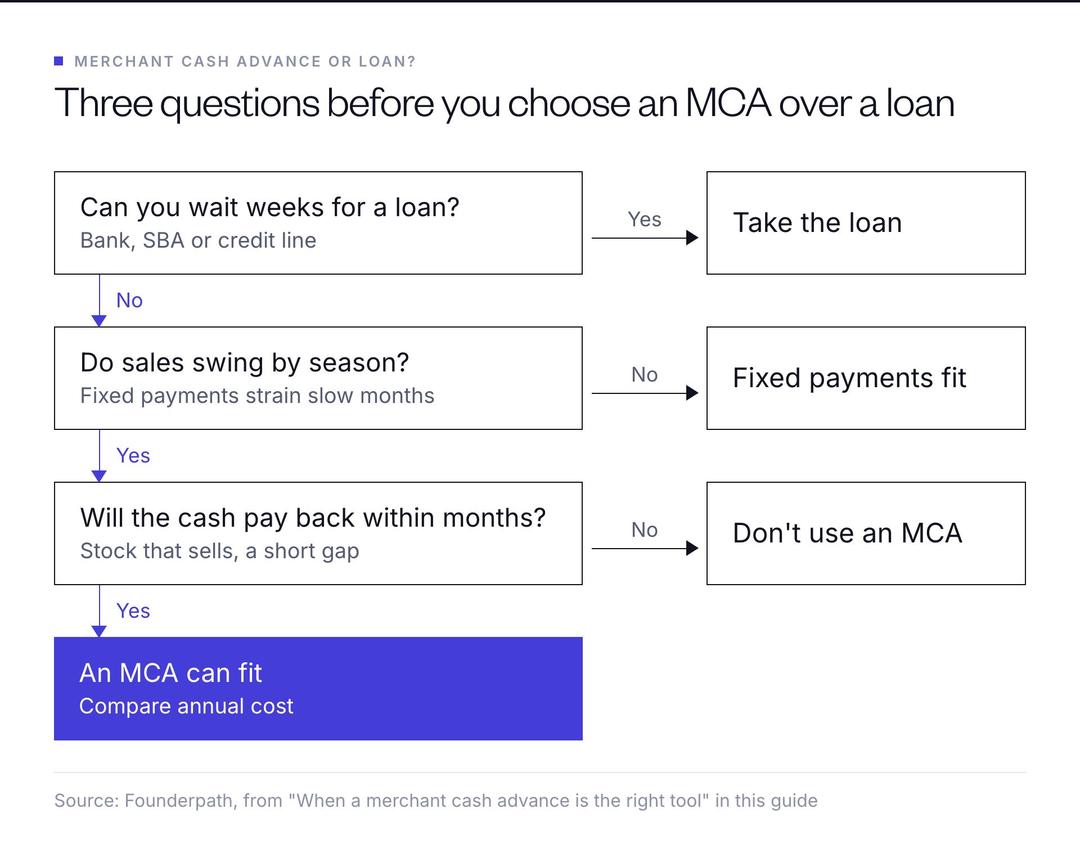
Three questions before you choose an MCA over a loan. Source: Founderpath, from this section of the guide
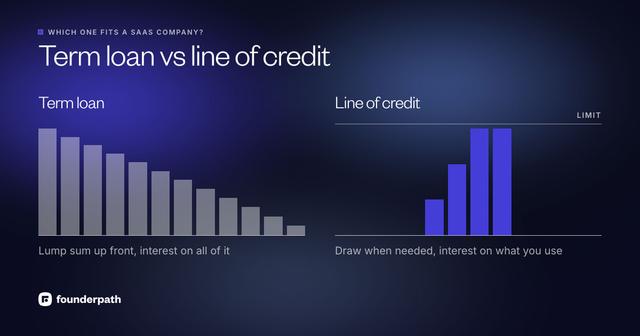
MCA vs line of credit. If you can get one, a line of credit beats an MCA for uneven working capital (our term loan vs line of credit guide covers how lines are priced): you draw only what you need, pay interest only on the drawn balance, and draw again after you repay. In the Fed's survey, 45% of line-of-credit applicants were fully approved, close to the 48% for MCAs, so it is worth applying for first.
When a loan wins. If you can wait, the loan is usually the better deal. On an episode of The Deal, Founderpath's CEO put the trade-off to a bookstore founder before offering her a $30,000 loan repaid over two years at 16% interest, which she accepted on camera:
Anyone can go out. Well, not anyone. If you're generating good cash flow, you can go to a bank. Right. And get a pretty cheap loan. But to Jaclyn's point, that takes … I mean, how long does it take?
Wooten's answer was months, with red tape and paperwork on top.
Where Founderpath Fits
Founderpath offers both structures. These are the terms on our product pages as of November 2026; every offer depends on underwriting:
- Merchant cash advance: for companies with seasonal or uneven cash flow. Advances run from $25K to $1M, and you repay a set percentage of monthly sales, from 5%. The price is one factor rate and holdback percentage disclosed up front, with no origination fees, warrants or equity. There is no full personal guarantee; we take a lien on business assets only. Most advances fund within 48 hours of connecting your billing, bank and processing data.
- Term loans: $500K to $10M for companies with $3M or more in revenue, interest from 15%, terms up to four years with up to 24 months interest-only, and closing in under four weeks.
- Revenue financing: for software companies with $1M to $3M ARR, a discount rate from 7%, up to $1.5M per round, funded in about 24 hours and repaid in fixed monthly amounts.
- Line of credit: a revolving facility of $250K to $5M, with interest on the drawn balance only.
Be honest with yourself about the alternatives. If you qualify for an SBA 7(a) loan and can wait, its maximum variable rate of the base rate plus 3.0% to 6.5% is below our term loans' starting rate. For how an MCA fits a subscription business, see our guide to merchant cash advances for SaaS.
Check what you qualify for. It takes less than 5 minutes.
Merchant Cash Advance vs Loan FAQ
Is a merchant cash advance a loan?
Not by its structure. The provider buys a fixed amount of your future receivables and collects it from your sales, so there is no interest rate and no fixed term. Courts look past the label, though: New York courts ask whether repayment is truly contingent on sales, and in February 2026 a New York appeals court held that one funder's agreements styled as MCAs were loans subject to usury limits.
Which is cheaper, a merchant cash advance or a business loan?
A loan, almost always. In our worked example, $100,000 for six months costs $30,000 as an MCA at a 1.30 factor, about 109% a year, and $3,825.71 as a loan at 13% interest, the most an SBA 7(a) lender may charge on a $100,000 variable-rate loan with prime at 7.00% in November 2026. The MCA buys speed, easier approval and payments that follow your sales.
How do you convert a factor rate to an APR?
Subtract 1 and multiply by the advance to get the dollar cost, then find the periodic rate at which the payment stream repays the cash you received and multiply it by the number of periods in a year. A $100,000 advance at 1.30 repaid in 130 business-day payments of $1,000 works out to about 0.42% a business day, or 109% a year. Our free MCA calculator does this for any offer.
Is a merchant cash advance better than a line of credit?
Usually not, if you can get the line. A line of credit lets you draw only what you need and pay interest on the drawn balance, and you can repay and draw again. An MCA delivers one lump sum with a fixed total cost. In the Federal Reserve Banks' 2025 survey, 45% of line-of-credit applicants were fully approved, against 48% for merchant cash advances, so the line is worth applying for first.
Why is a merchant cash advance easier to get than a loan?
The provider is buying your future sales, so it underwrites mainly on your recent bank or card deposits rather than your credit score and collateral. In the Federal Reserve Banks' 2025 Small Business Credit Survey, 48% of merchant cash advance applicants were fully approved and 12% denied, against 37% and 28% for business loans.
What happens to MCA payments if sales drop?
With a true percentage holdback, the payment falls with sales and the advance takes longer to collect, but the total you owe stays the same. Some MCAs debit a fixed daily or weekly amount and adjust it only through a reconciliation you have to request. A loan payment stays the same whatever your sales do.
What is MCA stacking?
Stacking means taking a second merchant cash advance while the first is still being collected, often to cover the first one's payments. Each advance takes its own share of the same sales, so two holdbacks of 15% and 10% take a quarter of every sale, without adding any new revenue to pay for them.
Sources and Method
We checked every figure in this guide against its source between November 24 and 25, 2026. Annualized costs are our own calculation: the payment-period internal rate of return times periods per year (260 business days, or 12 months), with equal payments, the first one period after funding, and no fees. That is the method of the Founderpath MCA calculator, independently recomputed on October 16, 2026. The loan payment uses the standard amortizing formula at 13.0% a year, monthly. Founderpath terms are from our live product pages, read on November 25, 2026; the MCA page lists "Personal guarantee: None" in its terms table and "no full personal guarantee" with a lien on business assets in its FAQ, and this guide uses the FAQ wording.
- FTC, Small business financing: Staff Perspective outlines issues, February 26, 2020
- Federal Reserve Banks, 2026 Report on Employer Firms, March 3, 2026 (survey fielded September 3 to November 14, 2025; 6,525 responses)
- SBA, 7(a) loan terms for lenders, read November 25, 2026; Federal Reserve H.15 selected interest rates, bank prime loan rate for November 23, 2026
- CFPB, Regulation Z Appendix J
- LG Funding, LLC v United Senior Props. of Olathe, LLC, N.Y. App. Div. 2d Dept, March 11, 2020
- People v Richmond Capital Group LLC, 2026 NY Slip Op 00990, N.Y. App. Div. 1st Dept, February 19, 2026
- New York Penal Law section 190.40; New York Financial Services Law sections 801, 802 and 803
- California Financial Code sections 22800 and 22802; DFPI, California Financing Law regulations
- Founderpath product pages for the merchant cash advance, term loans, revenue financing and line of credit, read November 25, 2026