
On this page
Debt financing means borrowing money that you repay with interest while you keep full ownership of the company. Equity financing means selling a share of the company to investors, who are never repaid but own part of every future dollar, so debt is usually cheaper for a SaaS company with recurring revenue and a spend that pays back, and equity is the better fit when there is nothing to repay from yet.
Key takeaways
- The median founding team holds about 56% of its company by the seed round and 36% by Series A, according to Carta's 2026 Founder Ownership Report on rounds raised from 2021 to 2025.
- Median dilution across seed to Series C rounds on Carta fell from about 18% to 16% in 2025, Carta's 2025 year in review reports.
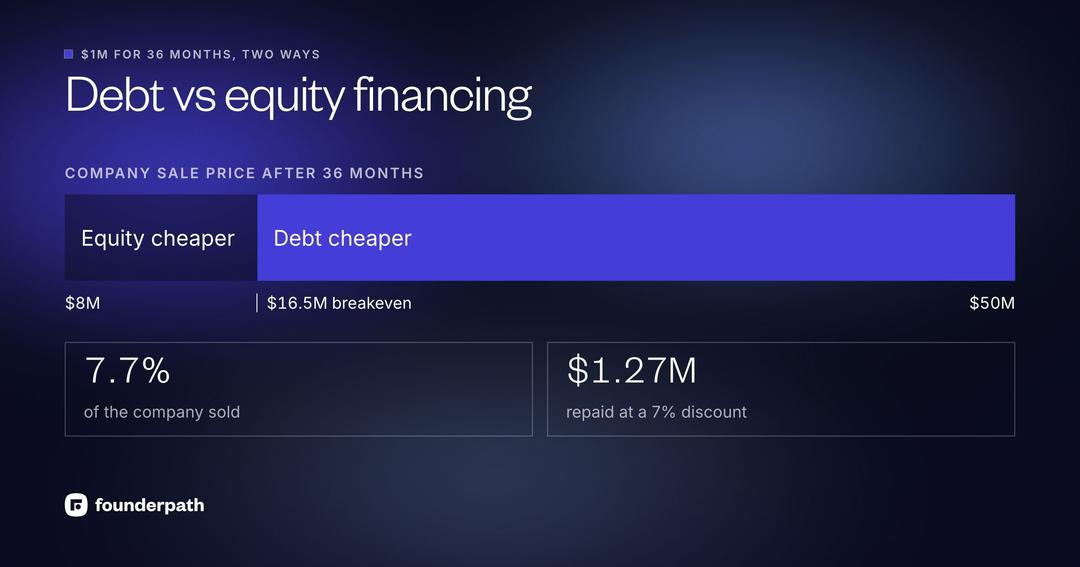
- In our worked example, $1M of 7% revenue financing over 36 months costs $265,823, and selling 7.7% for the same $1M costs more whenever the company later sells for over about $16.5M.
- SaaS lenders underwrite recurring revenue: SaaS Capital states a $250K MRR minimum with 85% retention, and Lighter Capital $200K ARR or $15K MRR, both as of November 2026.
Debt vs equity financing at a glance
The two kinds of capital solve different problems. Debt rents money for a fixed price. Equity sells part of the company in exchange for a partner who shares the risk.
| Factor | Debt financing | Equity financing |
|---|---|---|
| What you give up | A fixed repayment, plus interest or a discount | A permanent share of the company |
| Repayment | Scheduled payments, due in good and bad months | None; investors are paid when the company sells or lists |
| Cost | Known before you sign | Unknown until the exit, and largest when you succeed |
| Control | You keep it, within any covenants | Investors often get board seats and approval rights |
| Risk to the company | Default if payments or covenants are missed | No default risk, but pressure to grow toward a large exit |
| Tax | Business interest is generally deductible in the US, within the IRS limit | No deduction for the cost of equity |
| Fits best | Recurring revenue and a spend with a measurable payback | No revenue yet, or a bet that may not pay back |
On tax, the IRS explains the section 163(j) limit on deducting business interest. A company that is not yet profitable gets little from the deduction today, so treat it as a bonus, not the reason to borrow.
If you want the broader menu first, our guides cover non-dilutive funding options and the bootstrapping vs VC choice. This guide is about one decision: for a given amount of money, should it be borrowed or sold?
Which is cheaper? The dilution math at exit
Equity feels free because nothing leaves the bank account. Its price shows up later, as a share of the sale. The only fair way to compare is the same cash over the same horizon.
Take a B2B SaaS company with $2.5M ARR that needs $1M for a 36-month growth plan.
- Equity. SaaS Capital estimated a valuation multiple of 4.8x ARR for bootstrapped private SaaS companies in January 2025. At 4.8 x $2.5M = $12M pre-money, $1M buys $1M / $13M post-money = 7.7% of the company.
- Revenue financing at a 7% discount. Founderpath's published receivables purchase workbook sets the total repaid at cash / (1 - annual discount x months / 12). That is $1M / (1 - 0.07 x 36 / 12) = $1M / 0.79 = $1,265,823, or $35,162 a month for 36 months. Seven percent is the lowest rate Founderpath publishes; at 9%, the workbook's default rate, the same $1M repays $1,369,863 and the breakeven below rises to about $17.8M.
- A 36-month amortizing loan at 15% annual interest. The standard payment formula gives $34,665 a month, or $1,247,952 in total.
Now compare what each option takes out of the company by the end of the same 36 months, at different sale prices:
| Sale price after 36 months | Equity: investor's 7.7% | Revenue financing: total repaid | 15% loan: total repaid |
|---|---|---|---|
| $8M (value fell) | $615,385 | $1,265,823 | $1,247,952 |
| $13M (flat) | $1,000,000 | $1,265,823 | $1,247,952 |
| $20M | $1,538,462 | $1,265,823 | $1,247,952 |
| $30M | $2,307,692 | $1,265,823 | $1,247,952 |
| $50M | $3,846,154 | $1,265,823 | $1,247,952 |
Equity column: 7.7% of the sale price. Debt columns: total cash repaid on $1M. Nominal dollars, not discounted. Arithmetic by Founderpath, November 2026.
The breakeven is where the investor's share equals the total repaid: $1,265,823 / 7.7% = about $16.5M for revenue financing, and about $16.2M for the loan. Above that sale price, debt was the cheaper money. Below it, equity was.
That is the honest summary of the trade. Equity is cheaper only in the outcomes where the plan works poorly or not at all. If you expect the $1M to grow the company by more than about 27% over three years, from a $13M valuation to $16.5M, borrowing costs less. If you expect it might not, equity's real value is that the investor shares the loss.
Four things move the numbers, and you should model them for your own case:
- Timing. Debt is paid during the 36 months; equity is paid at the exit. Money paid later is worth less in today's dollars, which tilts the comparison slightly toward equity.
- Liquidation preferences. With a standard 1x non-participating preference, the investor takes the greater of its $1M back or its 7.7%. In the $8M row it would take $1,000,000, not $615,385.
- Later rounds. If you raise again, the investor's 7.7% is diluted with yours, which raises the breakeven sale price.
- The valuation. A lower multiple means a bigger stake for the same $1M and a lower breakeven, which makes debt look better still.
Run your own numbers in our dilution calculator, and size the debt side with the SaaS debt capacity calculator.
Nathan Latka, now Founderpath's CEO, learned this with his first company. He raised a $2M Series A at an $8.5M pre-money valuation (watch at 3:42), and by $1M ARR he was down to 38%, including 9% for a COO the closing documents required him to hire (watch at 4:26). When a buyer offered $6.5M in cash, he took it to a board that had just priced the company at $10.5M post-money, and he calls it the worst day of his life (watch at 5:32).
I learned the hard lesson that the second you take a dollar of outside capital, you have effectively given up control… Now there are situations where you are going for such a big home run, you need VC… I'm not knocking that.
How the cost of equity compounds across rounds
One round rarely ends the story. Carta's Founder Ownership Report 2026, published in March 2026 and based on rounds raised from 2021 through 2025, puts median founding-team ownership at about 56% by the seed round and 36% by Series A. By Series B the median non-AI founding team holds 21.8% (27.3% for AI teams), and by Series C founders hold 16.1%, less than the median employee option pool at 16.8%.
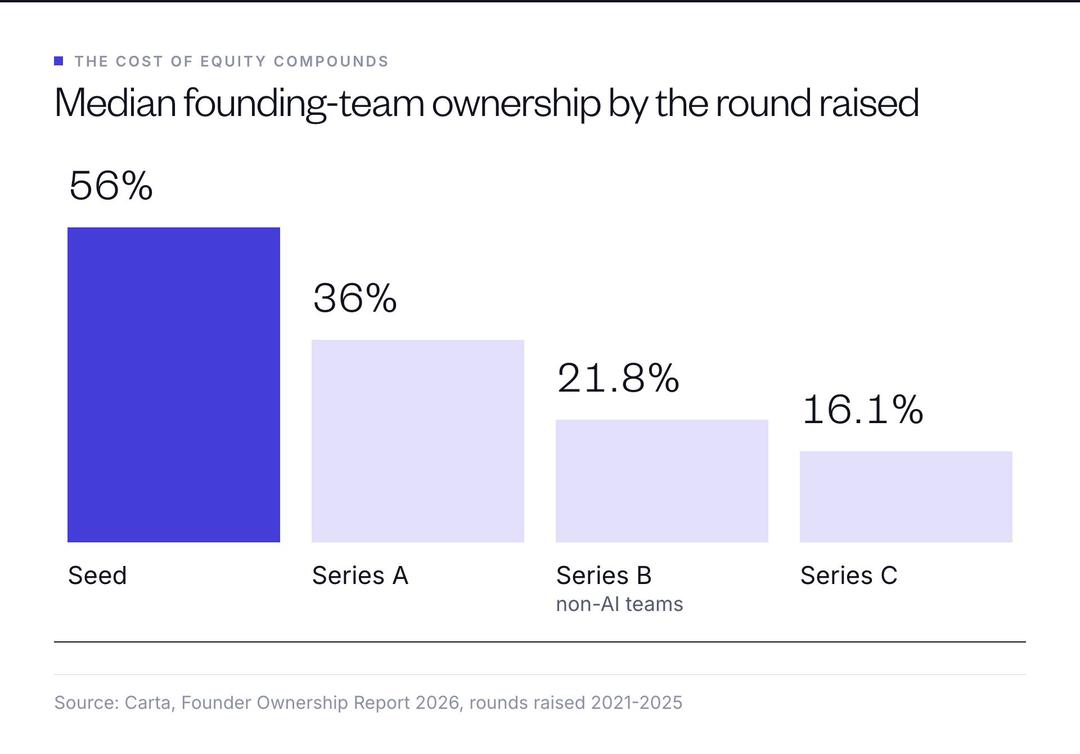
Median founding-team ownership by the round raised. Source: Carta, Founder Ownership Report 2026, rounds raised 2021-2025
Each round costs less than it used to. Carta's 2025 year in review reports that median dilution across seed to Series C rounds fell from about 18% to 16% over 2025, down from 19% two years earlier. Sixteen percent a round still adds up: four such rounds leave the existing holders with 0.84 x 0.84 x 0.84 x 0.84 = about 50% of what they owned, before any option pool top-ups.
The people running the company feel it most. Voxpopme, a UK-founded video feedback company, had raised $16.5 million by 2019, Research Live reported. When Founderpath reviewed its data room in 2024, the four to nine managers expected to drive growth held roughly 8% to 15% between them, by Latka's recollection, after rounds of outside money and two co-founder departures. Founderpath's $750,000, 24-month financing came with a condition: a board resolution creating a new option pool for that team. The full case is in how Voxpopme reset management's equity. Note what did the work there: the financing added no shares, and the new pool diluted every holder so the board could re-grant it to management.
Is debt riskier than equity?
For the company, yes. Equity has no repayment, so a slow year cannot put you in default. Debt adds payments that are due whatever happens, and often covenants that can trip even when every payment is on time.
Issuu shows both sides. Its CEO Joe Hyrkin chose debt in 2021, and about a year later the company missed a revenue covenant by about $150,000 on a $7 million quarter, then refinanced with another lender (watch at 14:25). The rate, which he put at about 12%, was not the problem; how the first lender handled the miss was (watch at 13:55). Read every covenant and model a miss before you sign; our guide to debt covenants for SaaS founders shows how a revenue test can fail.
The other risks to check are personal guarantees, liens on company assets and warrants, which turn part of a loan's price back into equity.
When equity is the right answer, and debt isn't
Debt needs a source of repayment. When there isn't one, borrowing only moves the problem forward. Equity is the better tool when:
- You are pre-revenue. There is no recurring revenue to underwrite, and most SaaS lenders won't lend. Equity, grants or customer prepayments fund this stage.
- The spend may never pay back. Research and development on an unproven product, a new market or a platform rebuild with no measured return. If it fails, a loan is still owed; an investor shares the loss.
- You can't carry the payments. If the company is burning cash and payments would only fit while growth continues, the plan has no margin for a slow quarter.
- Speed is the moat. In a winner-take-all market, the amount you can deploy matters more than its price, and equity can be raised in larger amounts than revenue can support as debt.
- You want what the investor brings. Some investors add distribution, hiring reach or credibility with enterprise buyers. That is worth paying for when it is specific, not a hope.
Be honest about the last two. Savneet Singh, PAR Technology's CEO, has sat across the table from founders as both a buyer and an investor. He warns about how founders size the opportunity:
The single greatest mistake that founders make is TAM: they overestimate how big their opportunity is, and then they go raise super dilutive venture capital money.
One test he applies, including when PAR looks at acquisitions, is ARR per share: divide recurring revenue by shares outstanding before and after the round, and check that the added ARR keeps pace with the added shares (watch at 17:07). For more on the equity route itself, see our venture capital guide.
When debt is the better choice
Debt fits when the money buys something with a payback you can name: a hire who closes a known amount of pipeline, a channel with a measured customer acquisition cost, an acquisition with revenue attached (how to finance a SaaS acquisition). Three conditions make it work:
- Recurring revenue a lender can underwrite, with stable retention.
- A payback inside the term. If the spend returns its cost in 18 months and the term is 36, the payments are covered by what the money earns.
- Room for a bad quarter. The payment should still fit if growth stalls for two quarters.
Hyrkin's reason for choosing debt was the exit math from the section above. Issuu took $20 million of debt with access to another $10 million (watch at 12:32) instead of a new equity round:
So, I wanted to make sure that we maintained our flexibility. So, instead of raising, we would have had to raise 30 million on a $250 million valuation, which meant that for everyone to feel successful, we would have had to have a billion-dollar exit, which may have happened, but I wanted to make sure I maintained flexibility around things.
A high valuation does not make equity cheap. It raises the price at which a sale works for everyone, which narrows your options later.
What lenders need for SaaS debt
SaaS lenders underwrite the business, not hard assets. Expect to show:
- Recurring revenue: MRR or ARR, usually with a stated minimum.
- Retention: low churn and stable net revenue retention, because retained revenue repays the loan.
- Growth and margins: steady growth and gross margins that leave room for payments.
- Customer concentration: no single customer large enough to sink repayment.
- Cash and runway: enough to service the payments through a slow patch.
Minimums vary widely, so check each lender's current page:
| Lender | Stated minimum | Other stated requirements |
|---|---|---|
| SaaS Capital | $250K MRR, or $3M annual revenue | 85% retention; a need for at least $1M over the next year or two |
| Lighter Capital | $200K ARR or $15K MRR | A diverse customer base; profitability not required |
| Founderpath | $10K MRR in its entry guidance; its product pages list $500K+ last-year revenue | Healthy retention and gross margins; recurring or subscription revenue |
Sources: SaaS Capital, Lighter Capital and Founderpath's revenue financing page ($500K+) and revenue-based financing guide ($10K MRR), each as the lender states it, checked November 2026.
Sizing is usually a multiple of recurring revenue: SaaS Capital, for example, states that it makes 5x to 8x MRR available. To see what your own numbers support, try the SaaS debt capacity calculator, and read our SaaS debt financing guide for the types of debt and their all-in costs.
How to decide: three questions
Run the use of the money through these in order:
- Do you have recurring revenue to repay from? If not, look at equity, grants or customer prepayments.
- Will the spend pay back within the term? If not, or if you can't say, equity shares the downside.
- Do the payments fit a slow quarter? If not, borrow less, or for longer with an interest-only period.
Three yeses point to debt. Then match the product to the move.
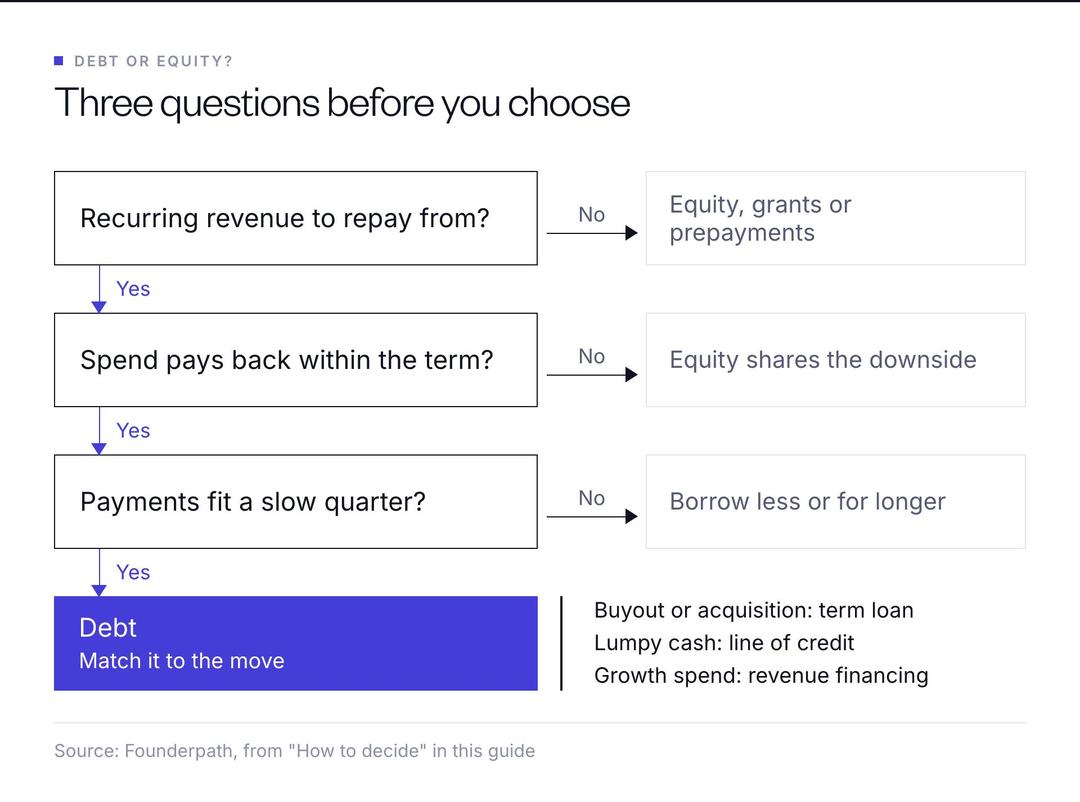
Three questions before you choose debt or equity. Source: Founderpath, from "How to decide" in this guide
Debt or equity for specific moves
| The move | Usual fit | Why |
|---|---|---|
| Buying out a co-founder or early investor | Debt, usually a term loan | The point is to concentrate ownership; selling new equity to fund it hands part of the stake to someone else |
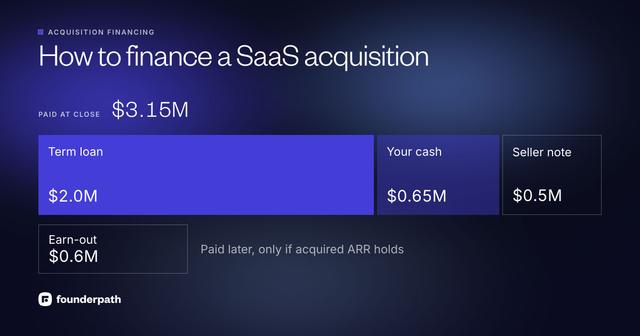
| Acquiring another company | Debt sized on the combined revenue, usually a term loan | Founderpath states it underwrites acquisitions on the combined entity's ARR, generally capped around 50% combined leverage |
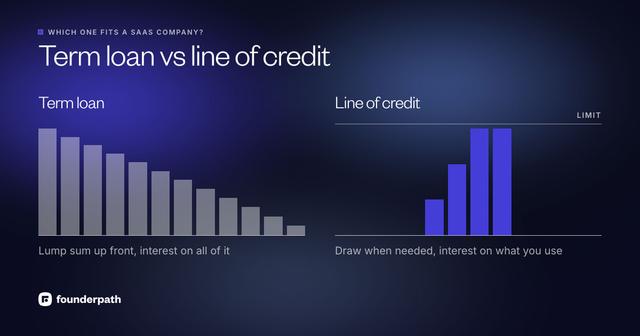
| Smoothing lumpy cash flow | A line of credit (term loan vs line of credit) | You draw only when needed and pay interest on the drawn balance only |
| A one-off growth push: a hire, a channel, a launch | Revenue financing or a term loan | A fixed amount on a fixed schedule, repaid from the revenue it creates |
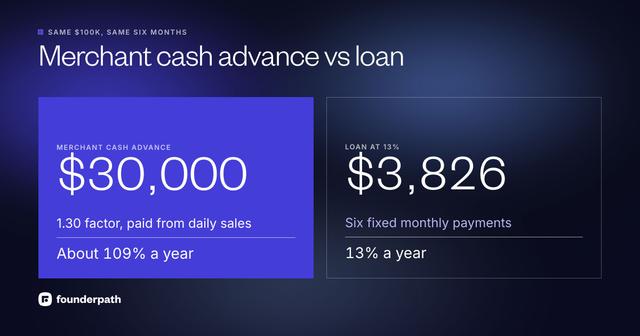
| Seasonal, non-subscription sales | A merchant cash advance, compared with a fixed loan (MCA vs loan) | Repayment flexes with monthly sales, which suits uneven revenue |
| Research and development with no revenue yet | Equity or grants | There is no revenue to repay from |
For the products named here, see Founderpath's pages on term loans, the line of credit and the merchant cash advance, and our overview of SaaS debt financing.
Where Founderpath fits
If your company has recurring revenue and passes the three questions, Founderpath provides non-dilutive capital: no equity, no warrants and no board seats, with a lien on business assets only and no full personal guarantee.
- Revenue financing: a discount rate from 7%, for companies of about $1M-$3M ARR, up to $1.5M per round on the product page (the products overview lists $100K-$5M), with fixed monthly payments. The products overview lists terms of 12-36 months. The product page says funds typically arrive within 24 hours of accepting; the products overview says within 48 hours of connecting Stripe and a bank account.
- Term loans: from 15% interest, $500K-$10M, terms of up to four years with up to 24 months interest-only, for software companies with roughly $3M+ in annual revenue (the products overview says $1M+ ARR). The page states no origination fees or prepayment penalty, while the term loan calculator it links includes a 2% origination (OID) input, so confirm fees on the term sheet.
Founderpath's own pages state two different entry points: $10K MRR in its entry guidance, and $500K or more of last-year revenue on its product pages. The workbooks on each product page show the full repayment before you sign.
Check what you qualify for. It takes less than 5 minutes.
Debt vs equity financing FAQ
Which is better, equity or debt financing?
Neither is better in general. Debt is usually the cheaper choice for a company with recurring revenue and a spend that pays back within the repayment term, because the cost is fixed and you keep your ownership. Equity is the better choice when there is no revenue to repay from, the payback is uncertain, or you need a partner who shares the loss if the plan fails.
Is debt financing more risky than equity financing?
For the company, yes. Debt adds fixed payments and often covenants, and both are due whether or not the plan works. Equity has no repayment, so a slow year cannot put you in default. For the investor it is the other way round, which is why equity investors expect a much larger share of the upside.
What are the pros and cons of debt financing?
The pros: you keep 100% of your equity and control, the cost is known before you sign, it is usually faster to arrange than a priced round, and in the US business interest is generally tax deductible within the IRS section 163(j) limit. The cons: payments are due in good and bad months, lenders may require covenants, liens or personal guarantees, and you need recurring revenue or assets to qualify.
Which is cheaper, debt or equity financing?
Usually debt, if the plan works. In our worked example, $1M of 7% revenue financing over 36 months costs $265,823, while selling 7.7% of a company valued at $13M post-money costs more than that whenever the company sells for over about $16.5M. Equity only comes out cheaper when the company is worth about the same or less when it sells.
What is the downside of equity financing?
You give up a permanent share of every future dollar, and usually some control through board seats, approval rights and liquidation preferences. Carta's 2026 Founder Ownership Report puts the median founding team at about 56% ownership by seed and 36% by Series A, so the cost compounds with each round.
How much equity do founders give up in a funding round?
Carta reported that median dilution across seed to Series C rounds on its platform fell from about 18% to 16% in 2025. A single round therefore typically costs the existing holders around a sixth of the company, before option pool increases.
Can a SaaS company use both debt and equity?
Yes, and many do. A common pattern is equity for the early, uncertain bets and debt once recurring revenue can carry payments. Issuu, for example, had raised equity rounds before it chose $20 million of debt in 2021 rather than a new round.
Is revenue-based financing debt or equity?
It is non-dilutive financing, closer to debt than to equity. You receive cash now and repay a fixed amount from revenue, and the provider takes no shares. At Founderpath it is structured as a receivables purchase priced with a discount rate, and the published workbook shows the total you repay before you sign.
Sources and method
We checked every figure in this guide against its source in November 2026. Lender terms are what each lender states on its own site at that date; confirm them in a term sheet.
- Dilution data: Carta's Founder Ownership Report 2026 (published March 12, 2026; rounds raised 2021-2025) and State of Private Markets: 2025 in Review (published February 18, 2026).
- Valuation multiple: SaaS Capital's 2025 private SaaS company valuations (January 2025), used only to set the example's valuation.
- Lender requirements: SaaS Capital, Lighter Capital, and Founderpath's revenue financing, term loan, line of credit, merchant cash advance and products overview pages. Founderpath's pages disagree on some figures (entry threshold, revenue financing size and speed, term loan stage, rate and fees); we show the product page's figure and name the others where they matter to the decision. The products overview also lists term loans from 14% APR against the product page's 15% interest.
- Tax: the IRS questions and answers on the business interest limitation.
- Calculations: revenue financing uses the formula in Founderpath's published workbook; the loan is a standard fully amortizing loan with monthly payments; the equity stake is cash divided by post-money valuation. All figures are nominal and undiscounted, on equal cash ($1M) and an equal horizon (36 months). The arithmetic is ours, not any source's finding.
- Cases and quotes: founder talks in Founderpath's resource library and our Voxpopme case. Quotes are edited only for fillers, with cuts marked, and each links to its moment in the recording.