SaaS Capital Review: APR, Warrants & Top Alternatives
If you're evaluating SaaS Capital or comparing it against other B2B SaaS financing options, this guide covers their interest rates, commitment fees, penny warrant structure, $3M ARR minimum, 6–8 week diligence timeline, and how Founderpath, Lighter Capital, and Capchase compare on pricing and contract terms.
Compared in this guide





SaaS Capital vs Founderpath: Cost Comparison
SaaS Capital minimum: $2M (requires $3M+ ARR)
SaaS Capital monthly shown all-in (interest + principal + $50,000 upfront fees, spread evenly) for fair comparison. Actual SC structure is interest-only during draw ($23,333/mo) with the full $2,000,000 principal due at end of the draw period.
See full cost calculator ↓TL;DR
What is SaaS Capital?
SaaS Capital is a U.S.-based growth lending firm founded in 2007, with offices in Cincinnati, OH and Seattle, WA. They focus on B2B SaaS and subscription AI companies and are one of the oldest dedicated SaaS lenders, having funded 150+ companies and deployed more than $375M in growth debt facilities (per saasonomics.com / Todd Gardner background).
Their product is a committed MRR credit facility — where the maximum available amount is sized as a multiple of your monthly recurring revenue (5x to 8x MRR). As your MRR grows, your facility grows with it. Per the typical structure for these facilities, interest is charged only on funds actually drawn — not the total committed amount. This is meaningfully different from a term loan, where interest accrues on the full principal from day one.
However, SaaS Capital's financing comes with several contractual obligations that many founders find restrictive: a penny warrant (an equity stake in their standard deal structure), a commitment fee of 1–1.5%, borrower-paid legal and closing costs, an in-person diligence visit, and a 6–8 week underwriting timeline. Their minimum is $3M in ARR, which limits access to growth-stage and beyond.
Founders searching for SaaS Capital alternatives typically cite the warrant requirement, the high ARR minimum, the multi-week timeline, and the cumulative fee structure as the primary reasons to evaluate other options.
How SaaS Capital's Credit Facility Works
SaaS Capital sets a total committed facility amount equal to 5x to 8x your MRR — for example, a company with $500K MRR might receive a $2.5M to $4M committed facility. During a 2-year draw window, you can draw capital as needed and repay it freely, paying interest only on outstanding drawn balances at 13–16% per year.
After the 2-year draw period, you choose to either renew for another 2-year draw period or begin amortizing the outstanding balance over an additional 3 years, for a total potential term of 5 or more years. This long commitment and revolving structure positions the product as suitable for companies that want persistent, growing access to capital rather than a one-time advance.
The process begins with an introductory call (20–40 minutes), followed by a detailed review of financial and business materials, a follow-up diligence call (45–90 minutes), term sheet issuance, and a full due diligence period that includes an in-person office visit. SaaS Capital states that the typical timeline from initial call to funding is 5 to 8 weeks.
By contrast, Founderpath underwrites entirely through automated integrations with your billing, banking, and accounting platforms. No office visits, no manual document submissions, and no multi-week underwriting window — funds arrive in under 24 hours on both its Revenue Purchase Agreement and Term Loan.
Who Qualifies for SaaS Capital?
SaaS Capital's eligibility requirements are among the most restrictive in the SaaS lending market. According to their published FAQ, qualifying companies must meet all of the following:
- •$3M minimum ARR — equivalent to $250,000 in MRR. Early-stage companies below this threshold do not qualify.
- •85%+ revenue retention — companies with high churn are disqualified.
- •B2B SaaS or subscription AI — B2C SaaS and non-subscription models are generally not eligible.
- •Headquartered in the US, Canada, or UK — companies in other markets do not qualify.
Founderpath starts at $100,000 in annual revenue, serves companies worldwide, and evaluates total annual revenue across all recurring revenue models — not just pure B2B SaaS.
Why Founders Look for SaaS Capital Alternatives
- 1.Penny warrants.SaaS Capital's standard structure includes a penny warrant — the right to purchase shares in your company at $0.01 per share. While far less dilutive than venture equity, this is a real equity instrument. If you raise a future funding round or sell your company, the warrant holder participates. Founderpath is 100% non-dilutive with no warrants of any kind. (Source: saas-capital.com/our-approach/)
- 2.$3M ARR minimum locks out early-stage companies.SaaS Capital's $3M ARR threshold means the vast majority of bootstrapped and early-stage SaaS companies cannot access this capital at all. Founderpath serves companies from $100K in annual revenue.
- 3.6–8 week diligence timeline.In many financing situations — closing a hiring window, responding to competitive pressure, capitalizing on a growth opportunity — time is critical. SaaS Capital's 6–8 week timeline is a real constraint. Founderpath funds in under 24 hours. (Source: saas-capital.com/our-approach/)
- 4.In-person office visit requirement.SaaS Capital's standard diligence process requires an in-person visit to your office. For remote teams, internationally headquartered companies, or founders who simply prefer an efficient process, this is a meaningful friction point.
- 5.Commitment fee plus borrower-paid closing costs. On top of the 13–16% interest rate, SaaS Capital charges a 1–1.5% commitment fee. Borrowers also pay their own legal and closing costs, which for venture debt facilities of this size commonly run in the tens of thousands of dollars. On a $3M facility, the commitment fee alone is $30,000 to $45,000 before a single dollar of interest accrues. Founderpath charges no commitment fee and no closing costs. (Source: saas-capital.com/our-approach/)
- 6.Term-sheet covenants.SaaS Capital states their facilities have "few, if any covenants" and explicitly do not include balance-sheet or liquidity covenants. The 85% revenue retention threshold appears as an underwriting minimum; whether and how it appears as an ongoing covenant in their credit agreements would be specified in your individual term sheet. Founderpath imposes no covenants of any kind. (Source: saas-capital.com/our-approach/compare/)
- 7.US, Canada, UK only. SaaS Capital does not serve companies outside these three markets. Founderpath funds SaaS companies worldwide — see which SaaS lenders fund which countries.
Top 5 SaaS Capital Competitors and Alternatives in 2026
The main companies founders compare with SaaS Capital include Founderpath, Lighter Capital, Capchase, Espresso Capital, and Clearco. Below we compare the key factors: pricing, speed, and requirements.
# | Company | Best For | Min ARR | Funding Speed |
|---|---|---|---|---|
1 | Founderpath | SaaS & subscription, worldwide | $100K annual revenue | Under 24 hours |
2 | Lighter Capital | B2B SaaS (US) | ~$200K ARR | 3–4 weeks |
3 | Capchase | B2B SaaS, short-term advances | $150K ARR | 3–5 business days |
4 | Espresso Capital | SaaS & tech (US & Canada) | ~$1M ARR | 2–4 weeks |
5 | Clearco | Ecommerce, DTC, SaaS | Varies | Days to weeks |
Pros and Cons of SaaS Capital
Pros
 Credit line grows with MRR.As your monthly revenue increases, the available facility amount increases automatically — you don't need to apply for a new facility.
- Interest-only during draw period. You pay interest only on amounts drawn, not on the total committed facility. Monthly cash outflow is lower than a fully amortizing loan during the draw window.
- Long potential term. A 2-year draw window with an optional 3-year amortization gives a total potential facility life of 5+ years — longer than most SaaS lending products.
- No board seat, no operating control. SaaS Capital explicitly does not take a board seat or participate in governance decisions — pure lender relationship.
- Longest track record in SaaS lending. Founded in 2007, SaaS Capital has more years of SaaS-specific lending experience than any other firm in this market.
Cons
 Penny warrants in every deal. SaaS Capital takes an equity stake via penny warrants on every financing. Founderpath is 100% non-dilutive with no equity component.
- $3M ARR minimum. The high revenue floor excludes the majority of bootstrapped and early-stage SaaS companies. Founderpath starts at $100K in annual revenue.
- 6–8 week diligence timeline. Requires an introductory call, detailed financial review, follow-up call, in-person office visit, and formal due diligence before funding. Founderpath funds in under 24 hours.
- Commitment fee + borrower-paid closing costs. A 1–1.5% commitment fee on the committed facility, plus borrower-paid legal and closing costs, stack on top of the 13–16% annual interest rate. On a $3M facility, the commitment fee alone is $30K–$45K before any interest accrues.
- Term-sheet covenants.SaaS Capital states their facilities have "few, if any covenants" and explicitly do not include balance-sheet covenants. Specific operational covenants — if any — vary by deal and are not publicly disclosed.
- US, Canada, UK only. International SaaS founders outside these three markets are not eligible. Founderpath funds companies worldwide.
SaaS Capital Pricing Explained
SaaS Capital does not publish a public rate card. Pricing is disclosed during the application process. According to their Our Approach and FAQ pages (saas-capital.com/our-approach/, saas-capital.com/funding-solutions/faqs), the published components of SaaS Capital pricing are:
| Fee Component | Rate |
|---|---|
| Interest rate (on drawn funds) | 13% – 16% per year |
| Commitment fee | 1% – 1.5% |
| Penny warrant ($0.01 strike) | Part of standard structure |
| Legal & closing costs | Borrower pays own (amount not disclosed)* |
| Origination fee | Not disclosed by SaaS Capital |
| Prepayment terms | Not disclosed by SaaS Capital* |
* Closing costs and prepayment terms are not disclosed on SaaS Capital's public website. For context only: venture debt facilities of this size commonly carry $15K–$50K in legal/closing fees (per Fiscallion industry data) and may include early-repayment fees in the 1–3% range stepping down over time (per Kruze Consulting). These are industry norms, not SaaS Capital-specific terms. Verify all terms directly with SaaS Capital before signing. Interest rate, commitment fee, and warrants are confirmed at saas-capital.com/our-approach/.
The key insight on SaaS Capital's pricing is that the commitment fee is charged on the total committed facility — not just the amount you draw. If your facility is $5M but you only draw $2M, you still pay the commitment fee on the full $5M. At 1.5%, that is $75,000 in commitment fees before any interest accrues.
Founderpath charges no commitment fee and no closing costs. The only cost is the flat discount fee on your Revenue Purchase Agreement (starting at 7%) or the stated APR on your Term Loan (starting at 14%).
Is Founderpath Cheaper Than SaaS Capital?
On a total cost basis, Founderpath is typically less expensive than SaaS Capital for the same principal amount. The comparison below uses a $2M draw (SaaS Capital's minimum) held for 24 months:
| Cost item | SaaS Capital | FP RPA | FP Term Loan |
|---|---|---|---|
| Principal | $2,000,000 | $2,000,000 | $2,000,000 |
| Interest / fee | $560,000 14% × 24 mo (interest-only) | $140,000 7% flat over 24 mo | $626,000 14% APR over 48 mo |
| Commitment fee (1% on $2M) | $20,000 | $0 | $0 |
| Legal & closing costs* | ~$30,000 | $0 | $0 |
| Total repayment | $2,610,000 | $2,140,000 | $2,626,000 |
Founderpath rates start from 7% flat fee (RPA) and 14% APR (Term Loan); actual rate depends on ARR, term, and deal size. * SaaS Capital legal & closing costs are paid by the borrower and not disclosed on their public website — figure shown is an industry benchmark for venture debt facilities of this size (Fiscallion). Verify all terms directly with SaaS Capital before signing.
Founderpath's RPA is the clear winner on total cost over 24 months — saving roughly $490K vs SaaS Capital. Founderpath's Term Loan is roughly cost-equivalent to SaaS Capital but spreads the repayment over 48 months (lower monthly payment), eliminates all upfront fees, takes no warrants, fully amortizes the principal (no balloon at the end of a draw period), and allows early prepayment with no penalty.
SaaS Capital vs Founderpath Cost Calculator
Enter your draw amount and SaaS Capital terms to compare total repayment against Founderpath. Interest rate and fee ranges sourced from saas-capital.com/our-approach/ and saas-capital.com/funding-solutions/faqs.
SaaS Capital Facility Inputs
Adjust the draw amount and terms to compare total cost of capital
Draw Amount ($)
Legal & Closing Costs ($)
Cost of Capital Comparison
Total fees + interest paid above principal over 24 months
SaaS Capital (24 mo draw)
$610,000
$2,610,000
$23,333/mo
$108,750/mo
$50,000
Founderpath RPA (24 months, 14% total fee)
$280,000
$2,280,000
$95,000/mo
None
Founderpath Term Loan (48 months, 16% APR)
$720,667
$2,720,667
$56,681/mo
None
$330,000
by choosing Founderpath RPA over SaaS Capital (over 24 months)SaaS Capital vs Founderpath: Full Contract Comparison
Side-by-side comparison of contract terms. Items marked (*) are not confirmed on SaaS Capital's public website — see sources below the table.
Feature | SaaS Capital | FP Revenue Purchase Agreement | FP Term Loan |
|---|---|---|---|
Financing structure | Committed MRR credit facility (sized to MRR) | Purchase of future receivables (not a loan) | Senior secured term loan |
Equity / warrants | Penny warrant ($0.01 strike) part of standard structure | None — 100% non-dilutive | None — 100% non-dilutive |
Minimum ARR | $3M ARR ($250K MRR) minimum. Also requires 85%+ revenue retention. | $100K annual revenue | $3M+ ARR |
Interest / financing rate | 13–16% per year on drawn funds (per saas-capital.com/our-approach/) | Flat discount fee from 7%; ~13% effective APR at 12 months (varies by term) | 14–25% APR on outstanding balance |
Commitment fee | 1% to 1.5% (per saas-capital.com/our-approach/) | None | None |
Closing costs | Borrower pays own legal fees (typical for venture debt; SaaS Capital does not disclose specific amount)* | None | None |
Funding speed | 6–8 weeks from intro call to funding (per saas-capital.com/our-approach/) | Under 24 hours | Under 24 hours |
Diligence process | In-person office visit required as part of underwriting | Fully automated — connects to billing, banking, and accounting | Fully automated — connects to billing, banking, and accounting |
Covenants | "Few, if any covenants" per their own site; no balance-sheet/liquidity covenants. Specific operational covenants vary by deal. | No covenants | No covenants |
Personal guarantee | "Usually" not required (per saas-capital.com/funding-solutions/faqs) | Never required | Never required |
Yearly audit | Not required (per saas-capital.com/our-approach/) | Not required | Not required |
Monthly reporting | Monthly financial reporting required (industry-standard for venture debt)* | Automated through platform integrations | Automated through platform integrations |
Prepayment terms | Not publicly disclosed — venture debt commonly includes early-repayment fees* | Full fee applies (no savings on early exit) | No penalty. Save on remaining interest by repaying early. |
Geographic availability | US, Canada, and UK only (per saas-capital.com/funding-solutions/faqs) | Worldwide | Worldwide |
Max funding amount | $2M to $15M (5x–8x MRR) | Up to $5M+ | Up to $5M+ |
Term length | 2-year draw window + optional 3-year amortization (5+ years total potential) | 12 to 36 months | 12 to 48 months |
Board seat | No board seat taken | No board involvement | No board involvement |
Eligible company types | B2B SaaS and subscription AI companies (per saas-capital.com) | SaaS, subscription businesses, any recurring revenue model | SaaS, subscription businesses, any recurring revenue model |
Sources
- SaaS Capital, "Our Approach." saas-capital.com/our-approach — interest rate (13–16%), commitment fee (1–1.5%), penny warrants, no personal guarantee (usually), 85%+ retention covenant, no audited financials required, in-person diligence visit, 6–8 week close timeline.
- SaaS Capital, "Funding Solutions FAQ." saas-capital.com/funding-solutions/faqs — minimum $3M ARR ($250K MRR), geographic availability (US, Canada, UK).
- SaaS Capital, "What to Know About Stock Warrants." saas-capital.com/blog-posts — penny warrant mechanics, strike price at $0.01, typical industry coverage of 5–20%.
- SaaS Capital, "Compare to Other Lenders." saas-capital.com/our-approach/compare — "few, if any covenants," no balance-sheet covenants, non-renewal creates "no refinancing crisis."
- SaaSonomics — Todd Gardner background. saasonomics.com/about-us — founder Todd Gardner; SaaS Capital deployed $375M+ across 110+ clients (later updated to 150+ companies on SaaS Capital's own FAQ).
- Third-party SaaS-finance blog review — corroborates 1–1.5% facility fee, 6–8 week application-to-funding timeline, prepayment and closing cost references.
- "SaaS Capital vs. Ratio," Ratio Tech. ratiotech.com/blog/saas-capital-vs-ratio — independently corroborates in-person diligence visit and 6–8 week close timeline.
- "Venture Debt for Startups," Fiscallion. fiscallion.io/blog/venture-debt-for-startups — industry benchmark for legal/closing costs in venture debt facilities ($15K–$60K range depending on size). Not SaaS Capital-specific; used as context only.
- "A Guide to Warrants in Venture Debt," Flow Capital. flowcap.com — industry context for venture debt warrant coverage and dilution math. Not SaaS Capital-specific.
- "Venture Debt Pre-Payment Penalties Explained," Kruze Consulting. kruzeconsulting.com — standard prepayment penalty structures in venture debt (3-2-1% over 3 years). Not SaaS Capital-specific; used as industry context for prepayment terms.
SaaS Capital Funding, Valuation & Investors
SaaS Capital is structured as a series of closed-end LP funds rather than as a venture-backed operating company. Total disclosed LP commitments across confirmed funds: ~$255.5M (Funds I, II, III, V). The company's “$375M+ committed in growth debt facilities to 110+ clients” figure refers to lifetime credit deployed to portfolio companies, not LP fundraising. SaaS Capital is a private fund manager — no equity valuation applies, and no outside equity investment in the GP entity has been disclosed.
Fund | Size | Closed | Notes |
|---|---|---|---|
Fund I | $22.5M | May 2012 | Founded 2007; first institutional fund. LPs not publicly named. |
Fund II | $58M | Jan 2015 | Announced via BusinessWire March 5, 2015 |
Fund III | $75M | Sep 2018 | "Substantially oversubscribed" per Founder Todd Gardner; capped deliberately |
Fund IV | Undisclosed | ~2020–2022 | Confirmed to exist via Fund V press release; size not publicly disclosed |
Fund V | $100M | Oct 2025 | Press release by Rob Belcher and Randall Lucas |
SaaS Capital's closed-end fund cadence (2012 / 2015 / 2018 / 2025) and deliberately capped fund sizes are unusual in the SaaS-financing peer set: Lighter Capital is venture-backed + warehouse-financed; Decathlon raises far larger LP funds. SaaS Capital's posture maps to its $2M–$15M ticket range and 5×–8× MRR underwriting — small and disciplined rather than scale-driven. Steady fund cadence with strong LP re-up rates (Fund III noted as oversubscribed; Fund V at $100M closed October 2025) suggests durable institutional demand for the strategy.
Founderpath vs SaaS Capital: Which Is Right for You?
SaaS Capital is best suited to established B2B SaaS companies with $3M+ ARR that want a committed credit facility sized to and growing with their MRR. Their draw structure keeps monthly payments low during the draw period, and the 2-year draw window with renewal flexibility can suit companies that want long-term committed access to capital.
However, SaaS Capital's combination of penny warrants, a $3M ARR minimum, 6–8 week diligence, an in-person office visit, a 1–1.5% commitment fee, and borrower-paid legal/closing costs makes it a poor fit for:
- Founders who want 100% non-dilutive capital with no equity component whatsoever
- Companies below $3M ARR — Founderpath serves from $100K
- Founders who need capital quickly — Founderpath funds in under 24 hours
- Remote or international teams — Founderpath is available worldwide
- Companies that want to minimize total fees — Founderpath charges no commitment fee and no closing costs
- Founders who may want to repay early — Founderpath's Term Loan has no prepayment penalty
Founderpath offers two products: a Revenue Purchase Agreement (12–36 months, fixed payments, flat discount fee from 7%) and a Term Loan (12–48 months, 14–25% APR, optional interest-only periods, no prepayment penalty). Both products are available worldwide, require no warrants, no covenants, no office visits, and fund in under 24 hours.
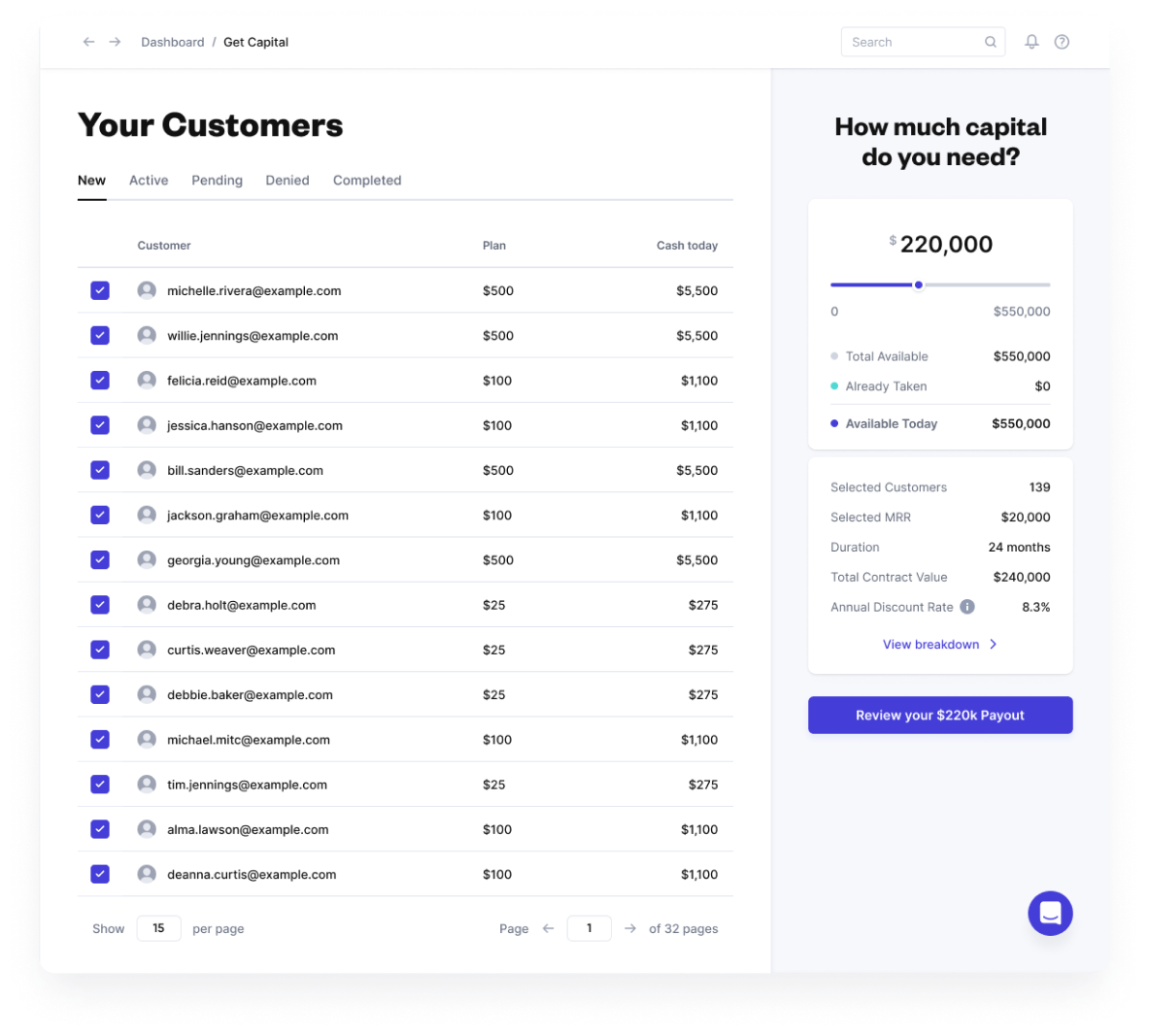
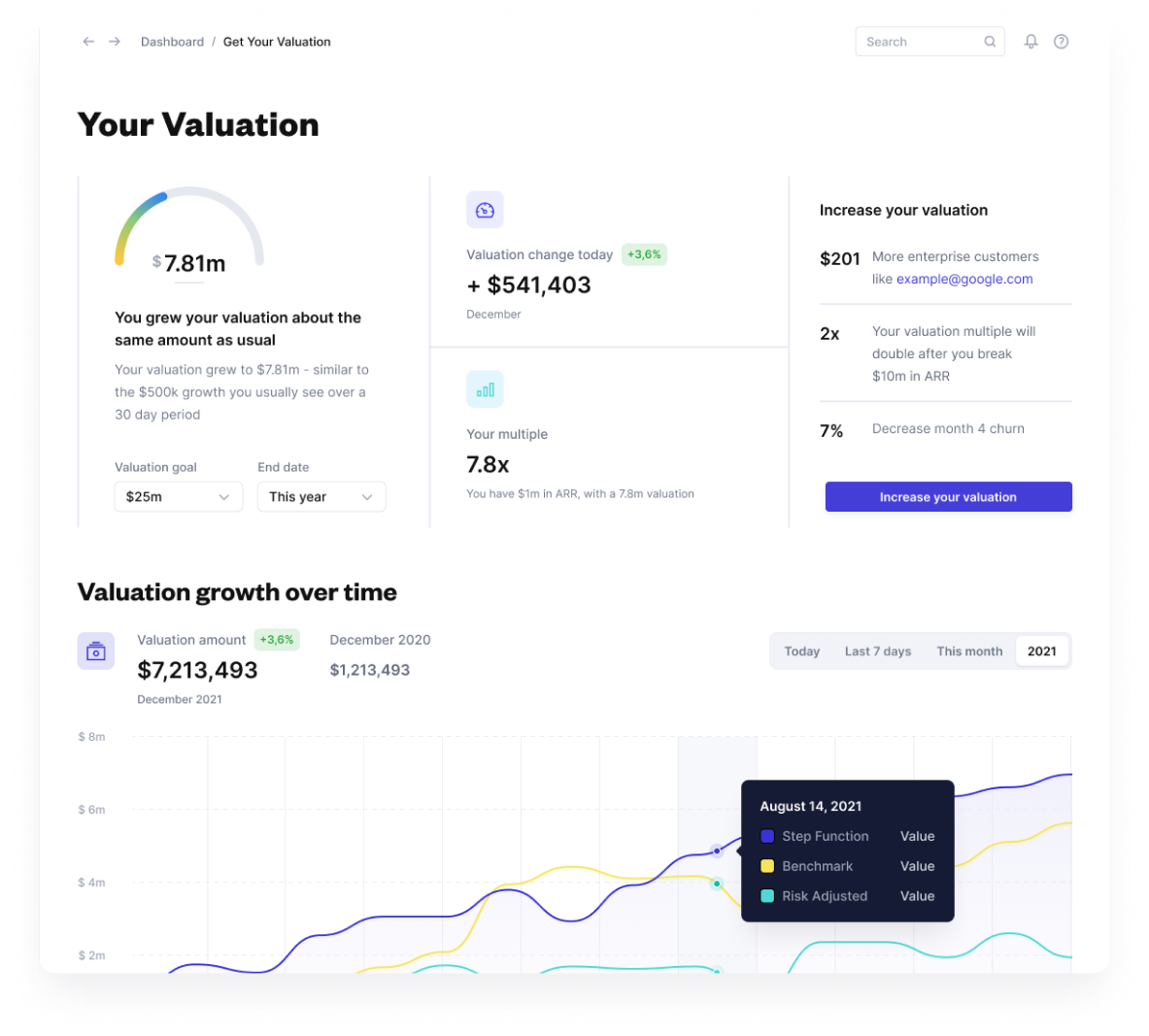
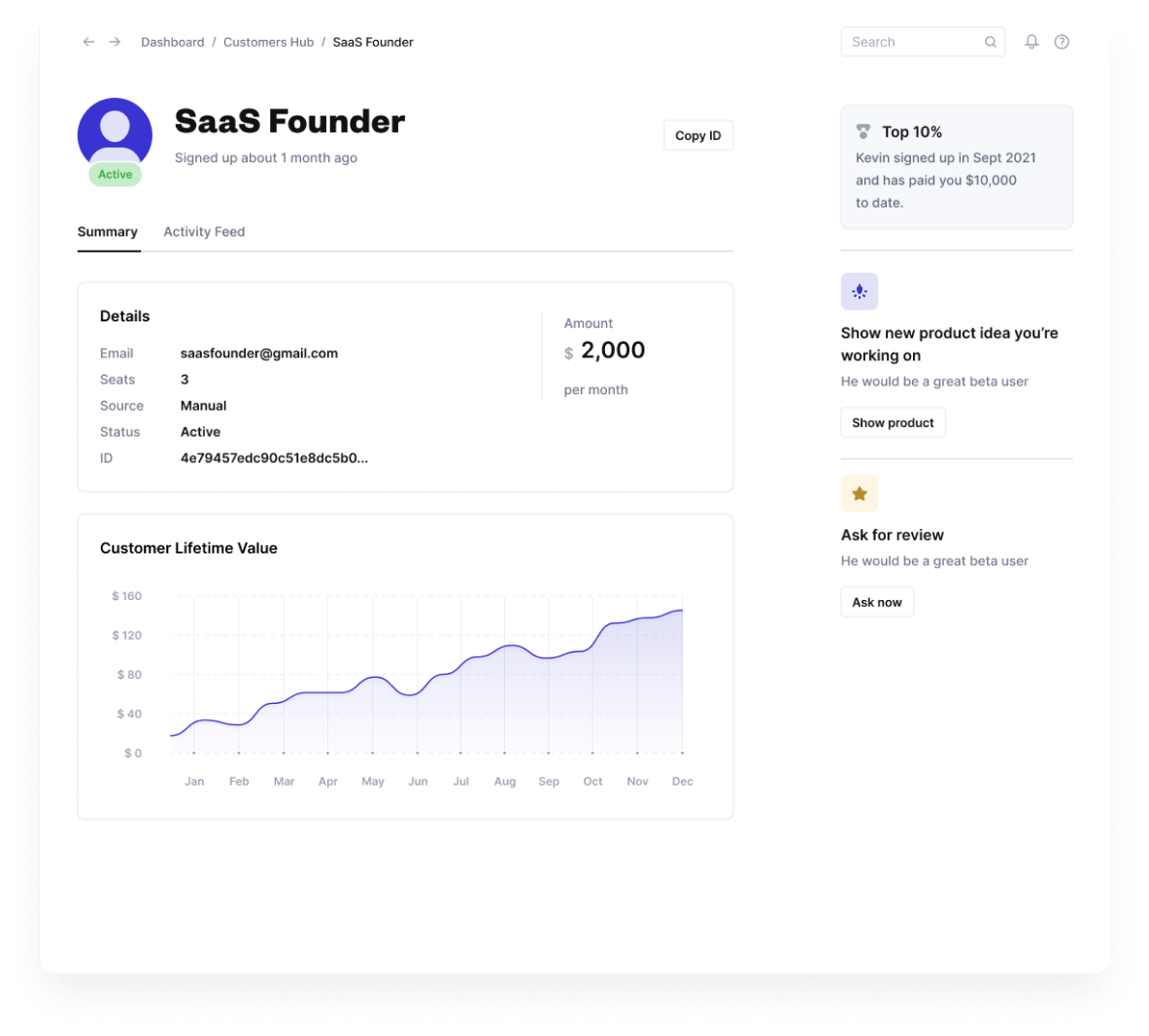
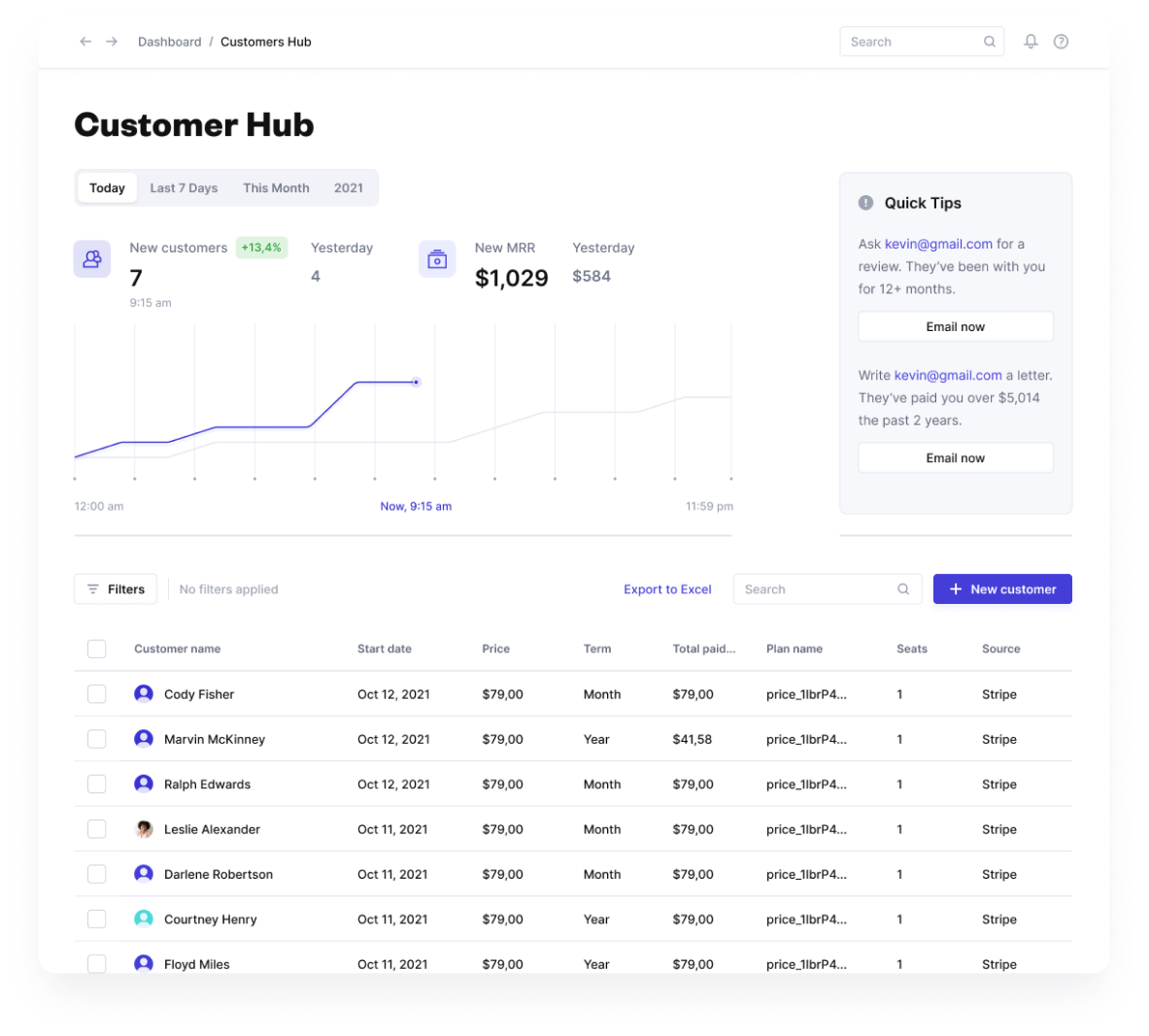
Founderpath is the Fastest Growing SaaS Capital Alternative
Frequently Asked Questions About SaaS Capital
Pros: 17+ year operating history, SaaS-specialist underwriting, no balance-sheet covenants, no audit requirement, typically no personal guarantee, and a committed line sized to MRR (5x–8x).
Cons: penny warrants (not fully non-dilutive), 13–16% interest plus 1–1.5% commitment fee, borrower-paid closing costs, $3M ARR minimum, 6–8 week diligence with in-person visit, US/Canada/UK only, and undisclosed prepayment terms.
Get a Founderpath Offer in Under 24 Hours
Connect your integrations, get a real offer with no commitment, and see your monthly payment before you decide. No warrants, no commitment fee, no in-person diligence — and a $100K ARR minimum vs SaaS Capital's $3M floor, funded in under 24 hours instead of 6–8 weeks.
Get Your OfferKeep comparing
More Founderpath comparisons
Tired of one-at-a-time comparisons?
Enter your amount and term once — see all 24+ lenders ranked by total cost and effective APR.
Capchase
6–12 mo·ARR advance (flat fee)PG: VariesARR-based advances with shorter 6–12 month payback; Founderpath offers up to 48 months.
Read comparison →
Clearco
6–12 mo·Merchant cash advanceNo PG50% daily revenue sweep on Cash Advance, 5–8% flat Invoice Funding fees; no early-payoff discount.
Read comparison →
Pipe
6–12 mo·MCA via partnersPG: VariesRecurring-revenue marketplace pivoted to merchant cash advance via Stripe and Shopify partners.
Read comparison →
Wayflyer
3–9 mo·Merchant cash advancePG: VariesEcommerce-focused MCA with daily revenue percentages; Founderpath funds SaaS at lower disclosed rates.
Read comparison →
Lighter Capital
3–5 yr·Revenue-based financingPG: VariesRevenue-based financing with monthly variable payments tied to top-line revenue.
Read comparison →
Arc Tech
Varies by lender·Capital marketplace (since 2024)No PGPivoted in 2024 from direct ARR advances to a capital marketplace that routes founders to third-party lenders.
Read comparison →


© 2026 Founderpath, Inc. All Rights Reserved.