
On this page
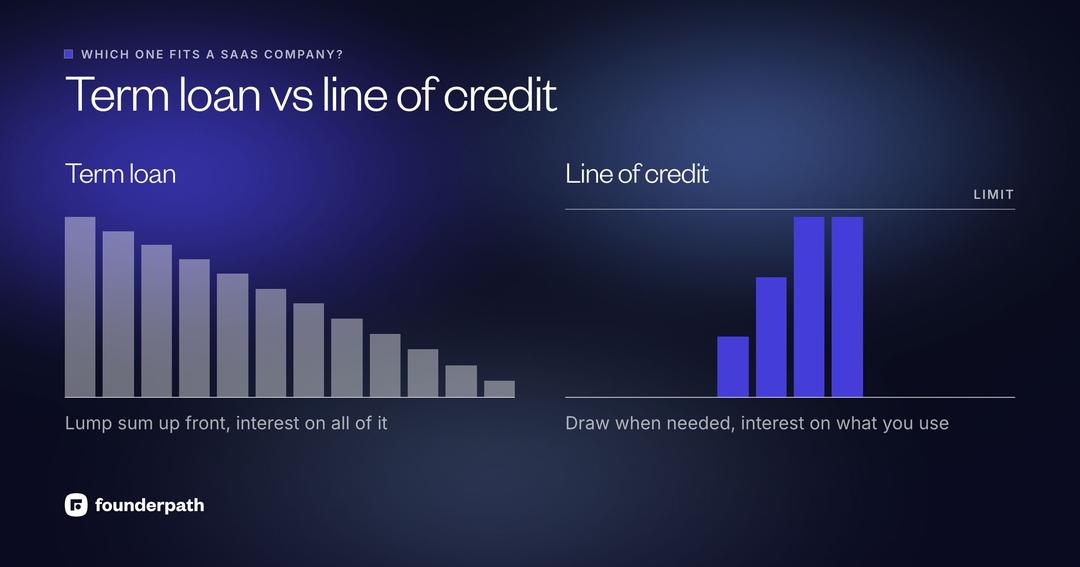
A term loan gives you a lump sum up front that you repay on a fixed schedule, with interest charged on the full amount from the day it is funded. A line of credit lets you draw cash up to a limit when you need it, repay it and draw again, paying interest only on what you have drawn. Use a term loan for a one-off investment that pays back over years, and a line of credit for short-term gaps in cash flow.
For a SaaS company, recurring revenue sharpens that rule. Subscriptions make cash flow predictable enough to borrow against, but annual contracts make it lumpy: most of the year's cash can arrive in one quarter. So the question isn't which product is better. It's which of your moves is a one-off investment and which is a timing gap.
Key Takeaways
- A line of credit is the product small firms apply for most: 43% of applicants in the Federal Reserve's 2025 Small Business Credit Survey sought a business line of credit, against 32% for a business loan.
- Lines were also fully approved more often in that survey: 45% of business line of credit applicants, against 37% of business loan applicants.
- In this guide's worked example, covering a four-month $600K cash gap costs $24,750 on a line and $49,860 in interest on a 12-month term loan, at the same illustrative 15% rate.
- SaaS lenders size both structures on recurring revenue: SaaS Capital states it lends 5x to 8x MRR on its committed facility, as of November 2026.
- SBA rules say anyone who owns 20% or more of a business generally must guarantee an SBA loan, so an SBA loan or line usually puts the founder on the hook.
Term Loan vs Line of Credit at a Glance
| Term loan | Line of credit | |
|---|---|---|
| How you get the money | All of it on day one | Draw any amount up to a limit, when you need it |
| Interest charged on | The full outstanding balance from funding | Only the balance you have drawn |
| Rate | Usually fixed | Often variable, and usually higher per dollar |
| Repayment | Fixed payments over a set term, sometimes interest-only first | Repay and redraw; payments follow the drawn balance |
| Typical fees | Origination fee, sometimes a prepayment fee | Annual, draw, inactivity or commitment fees |
| Best for | One-off investments that pay back over years | Gaps that refill: renewals, seasons, payroll timing |
| Main risk | Paying for cash that sits idle | The lender can shrink or call it when you need it most |
Sources: Washington Trust Bank, Chase, PNC and OnDeck guides (2025-2026); SaaS Capital terms page (November 2026). Links in the sections below.
Lines are also the more common request. In the Federal Reserve Banks' 2025 Small Business Credit Survey, 43% of firms that applied for financing sought a business line of credit and 32% a business loan, and 45% of line applicants were fully approved against 37% of loan applicants. The survey covers small employer firms of every kind, not SaaS companies specifically.
How Each One Is Priced
A term loan charges interest on everything you borrowed, from day one. The lender wires the full amount and your balance only falls as you repay principal. If half the money sits in your bank account for six months waiting to be spent, you still pay interest on it. Term loans usually carry a fixed rate, so the payment is known for the whole term, and PNC notes that the rate and payment amount are set up front. Chase lists an origination fee as the usual extra cost.
A line of credit charges interest only on the drawn balance. Undrawn capacity costs no interest, but it isn't always free. Chase names annual maintenance, draw and inactivity fees as possible line costs, and PNC also warns about draw fees and ongoing account fees. Growth lenders often charge for the commitment itself: SaaS Capital states that its MRR-based committed facility carries 13% to 16% interest on borrowed funds, a 1% to 1.5% commitment fee and a nominal penny warrant (as of November 2026).
Per dollar, a line is usually the more expensive product. Both Washington Trust Bank and Chase say line rates tend to be higher than term loan rates. It wins on total cost only when you use part of it for part of the time.
The more you can match your spend with the money that you're bringing in, the lower your ultimate cost of capital is going to be, because you're holding the money in your bank account for less time. So, you know, in a perfect world, you do a little loan every month for whatever you're paying for.
A Worked Example: Same Rate, Two Different Bills
Take a SaaS company that bills most customers annually and collects the bulk of its cash in the first quarter. By May the bank balance runs low, and until renewals land in September it needs up to $600K to cover payroll and vendors. Here is what that gap costs under each structure, using the same illustrative 15% annual rate (1.25% a month) on both, so only the structure differs. The rates are assumptions for the arithmetic, not a quote from any lender.
Line of credit, $600K limit. The company draws $200K in May, $400K in June and $600K in July and August, then repays everything from renewals in September.
- Interest: ($200K + $400K + $600K + $600K) x 1.25% = $1,800,000 x 1.25% = $22,500
- An illustrative unused-line fee of 0.5% a year on the undrawn limit: the undrawn amount adds up to $5,400,000 over the year (8 months x $600K, plus $400K in May and $200K in June), and $5,400,000 x 0.5% / 12 = $2,250
- Total cost: $24,750
Term loan, $600K for 12 months, amortizing. The company borrows the full amount in January so the cash is there when the gap opens.
- Monthly payment: $600,000 x 0.0125 / (1 - 1.0125^-12) = $54,155
- Total repaid: 12 x $54,155 = $649,860, so interest is $49,860
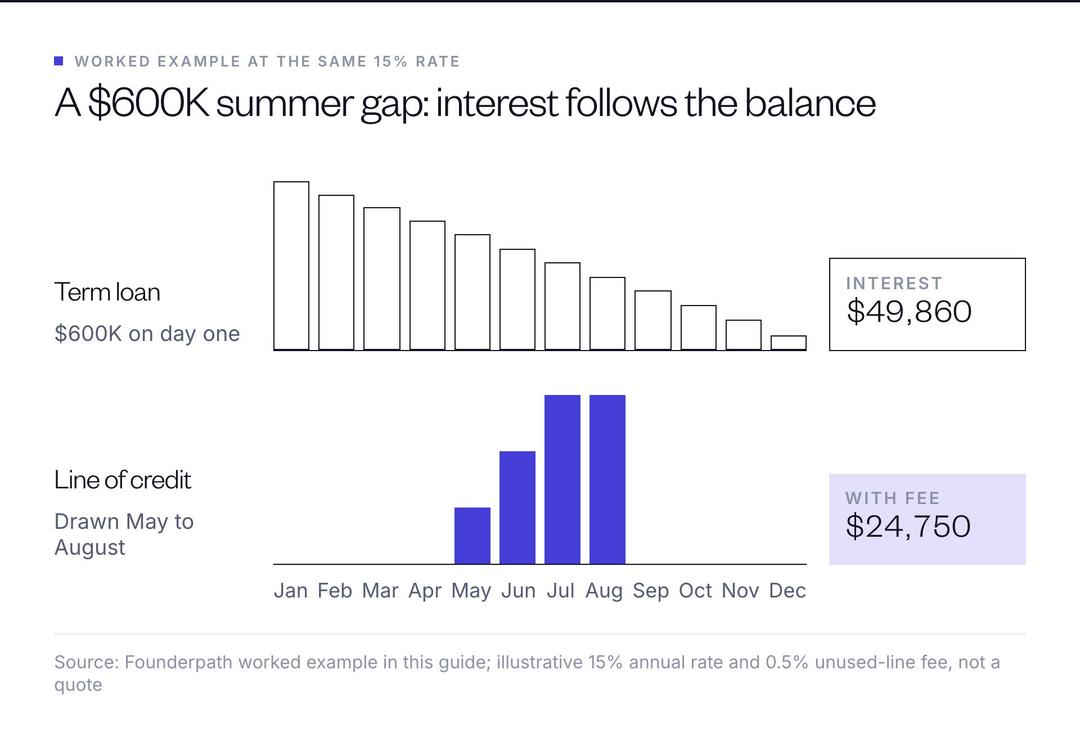
Outstanding balance by month under each structure. Source: Founderpath worked example in this guide; illustrative 15% annual rate and 0.5% unused-line fee, not a quote
The line costs about half as much here because the company carries a balance for four months instead of twelve. The bigger difference doesn't show in the total: the term loan asks for $54,155 every month starting in February, including the summer months when cash is tightest. Those four summer payments add $216,620 to the gap, so the company would really need to borrow more than $600K, which only widens the difference. If you add an origination fee, add it to both sides before you compare.
Now flip the use. Say the same company wants $1.5M to hire a sales team that should pay back over about two years. That money is drawn on day one and stays drawn, so a line charges interest on the full balance just like a term loan: $1,500,000 x 15% = $225,000 a year either way. The line's advantage disappears, and you've used up the buffer you'd want for the next summer gap. A term loan with an interest-only period fits better: at 15% with 24 months interest-only and 24 months of amortization, you'd pay $1,500,000 x 1.25% = $18,750 a month for two years, then $72,730 a month for the next two, by which time the team should be paying for itself. Our SaaS debt capacity calculator shows how much of that payment your revenue can carry.
Which Growth Moves Fit Which Structure
The rule of thumb: match the structure to how long the money stays out. If the cash comes back on its own within months, use a line. If it comes back slowly, through the revenue the investment creates, use a term loan with a term longer than the payback.
| The move | Better fit | Why |
|---|---|---|
| Hiring plan (engineers, a sales team) | Term loan | Salaries recur; payback can take 18-24 months or more |
| Acquiring a competitor or a product | Term loan | One-off purchase that pays back from the combined revenue |
| A big marketing push with a known payback | Term loan | Fixed spend, measurable payback period |
| Annual contracts collected in one quarter | Line of credit | The gap refills itself at renewal |
| Seasonal dips in sales or collections | Line of credit | Draw in the slow months, repay in the busy ones |
| Payroll due before a large customer pays | Line of credit | Short gap with a known end |
| Ongoing losses with no path to profit | Neither | Debt adds a payment to a problem it can't fix |
Steve Benson, who financed Badger Maps' growth with debt from several lenders, makes the term-loan point from experience: almost all of Badger Maps' investments take at least a year and a half to two years to pay back, so he wants a loan term longer than the payback. With a shorter term, he says, you're putting the borrowed money back before it has earned anything.
Acquisitions are the one place where a revolving structure also works, if you buy companies regularly. Some serial acquirers negotiate a committed facility they can tap deal by deal.
We actually struck some favorable deals with debt providers who've basically given us a carte blanche, so a line of credit, to tap into acquisitions as long as they're in a certain area, so SaaS and some certain metrics.
For a single acquisition, a term loan is the simpler fit: you know the price on the day you close. Our guide to SaaS acquisition financing shows how lenders size it.
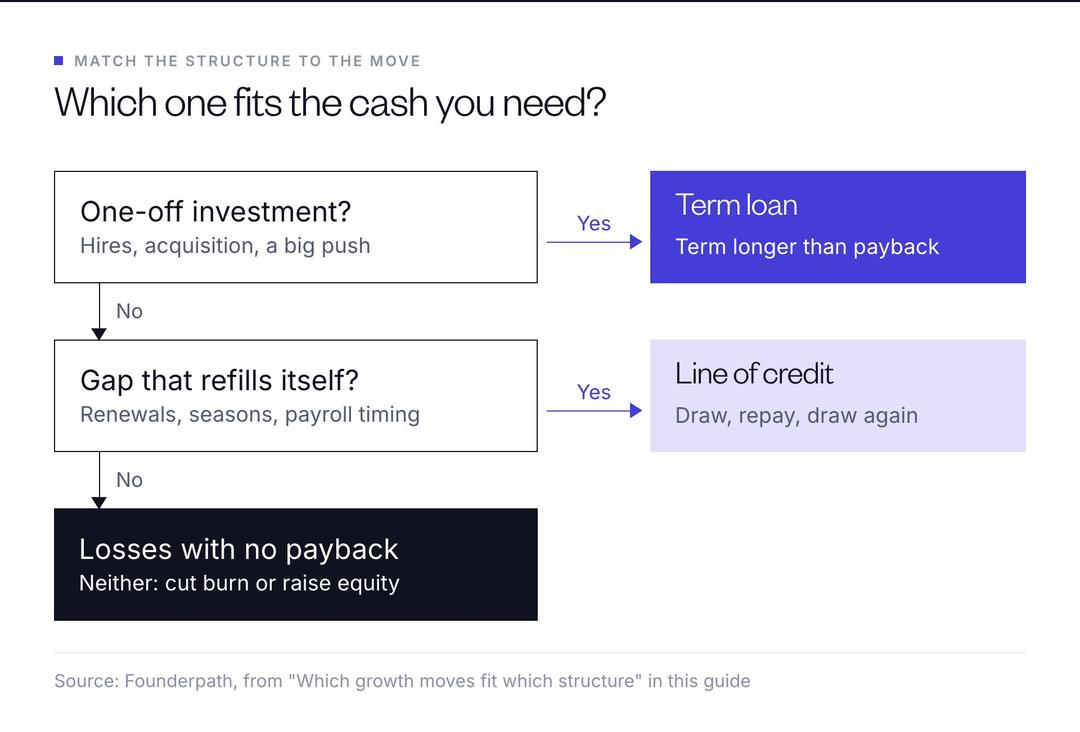
A quick test for which structure fits the move. Source: Founderpath, from the table in this section
What Lenders Look At for a SaaS Company
Banks underwrite on historical profit, hard collateral and the owners' personal credit, which is why many SaaS companies struggle to qualify. SaaS-focused lenders underwrite the subscription base instead, and the same numbers decide the size of a term loan or a line:
- ARR or MRR. The facility is usually sized as a multiple of recurring revenue. SaaS Capital states that it makes 5x to 8x MRR available and asks for at least $250K of MRR (November 2026).
- Retention and churn. Recurring revenue is only collateral if it stays. SaaS Capital also states it asks for at least 85% retention; a lender reads high churn as a shrinking asset.
- Gross margin and burn. These show how much of each revenue dollar is left to service a payment.
- Growth. Growth supports a larger facility, but a lender will also test whether you can repay if growth slows.
For a line, lenders also care about how the balance behaves. A line that is drawn to the limit and never comes down looks like a term loan without a schedule, and a bank that reviews the line every year (Chase notes lines may require annual renewals and account reviews) may resize it.
Collateral, Personal Guarantees and Covenants
Collateral. Many lenders secure either structure with a lien on business assets, recorded publicly as a UCC filing. Chase notes that term loans are more often secured, especially for large amounts or long terms, while lines can be secured or unsecured.
Personal guarantees. OnDeck notes that unsecured lines may require one. For SBA loans and lines, it's a rule: 13 CFR 120.160 says holders of at least a 20% ownership interest generally must guarantee the loan. Before you sign one, read what a personal guarantee really commits you to.
Covenants. Many loans and lines carry tests you must keep passing: minimum revenue growth, minimum cash, a maximum leverage ratio. Miss one and the lender can raise the rate, demand repayment or stop new draws. A line is the more exposed of the two, because a lender can often stop funding the next draw without calling anything. Our guide to debt covenants walks through how a revenue test can fail after a churn spike.
That risk is real for lines in a downturn. Chris Vandersluis recalls the year his company lost money and its bank stopped waiting:
I had to sweat blood that year and continue to start cleaning up all kinds of things, starting with the bank going, "We're calling the line of credit, you owe me a hundred thousand dollars."
The lesson isn't to avoid lines. It's to keep them for gaps that close on their own, so a bank pulling the line hurts your timing, not your survival.
When Neither One Fits
Be honest about the move before you pick a structure, including whether it should be funded with debt at all (debt vs equity financing). Neither a term loan nor a line of credit fits when:
- The business loses money with no path to profit. Debt adds a fixed payment to a cash problem. Cut burn first, or raise equity from investors who accept that risk.
- There is little recurring revenue yet. Pre-revenue companies and companies with high churn have nothing for a SaaS lender to lend against, and a bank will want collateral and a personal guarantee instead.
- The payback is a guess. A new channel you haven't tested should run on cash first. Borrow once the numbers hold.
- The amount is below the lender's minimum. Many SaaS facilities start in the hundreds of thousands; a small gap is often cheaper to cover by collecting annual payments up front or tightening payment terms.
There is also a middle option. A delayed-draw term loan commits a total amount up front and lets you draw it in tranches, so you pay interest only on what you've taken, but on a term loan's schedule. Nathan Latka, Founderpath's CEO, describes Badger Maps drawing $2.8M of a $4.2M Founderpath term loan, knowing it could take the rest later at terms it already knew. Steve Benson also borrowed $1.5M in three tranches from another lender for the same reason. If your need grows in steps, ask any lender whether it offers this.
Where Founderpath Fits
Founderpath offers both structures to software companies with recurring revenue, with no equity taken in either. As stated on the product pages on November 25, 2026:
- Term loans run from $500K to $10M for companies at $3M+ in revenue, with interest from 15%, terms up to 4 years and an interest-only period of up to 24 months. The page states no warrants, no full personal guarantee (a lien on business assets only) and no prepayment penalty on early repayment. For an acquisition, Founderpath lends against the combined company's ARR, generally capped around 50% combined leverage.
- The line of credit is a committed revolving facility of $250K to $5M, sized against your recurring revenue and retention. You pay interest only on the drawn balance, can draw in minutes once the facility is in place, and can repay at any time without a penalty. The page does not publish a rate; it says the rate is disclosed up front when the facility is offered. It states no equity, warrants or board seats, and a lien on business assets rather than a full personal guarantee.
If you're comparing these with revenue-based financing or venture debt, our guide to SaaS debt financing covers the full range, and the SaaS debt financing hub explains how each option is underwritten.
Connect your billing, banking and accounting data and you'll see what you qualify for: check your terms here.
Sources and Method
We checked every figure in this guide against its source in November 2026. Lender terms are what each lender states on its own site at that date, so confirm them in a term sheet.
- How each product works: guides from Washington Trust Bank (March 2025), PNC (June 2026), OnDeck (June 2025, updated May 2026) and Chase (undated, read November 2026).
- Survey data: the Federal Reserve Banks' 2026 Report on Employer Firms, from the 2025 Small Business Credit Survey (6,525 responses, fielded September to November 2025); application rates by product on page 15 and outcomes by product on page 18.
- Lender terms: SaaS Capital (rate, commitment fee, warrant, MRR multiple, minimums); Founderpath's term loan and line of credit pages.
- Rules: 13 CFR 120.160 (personal guarantees on SBA loans) and 13 CFR 120.223 (SBA subsidy recoupment fee on prepayment).
- Founder evidence: talks by Steve Benson, Tim Schumacher, Chris Vandersluis and Nathan Latka in the Founderpath resource library, linked at the timestamp quoted.
- Calculations: the worked example uses a nominal 15% annual rate (1.25% a month) on both structures, a 0.5% a year unused-line fee on the line and no other fees. The term loan payment is the standard amortizing formula, payment = principal x r / (1 - (1 + r)^-n). The figures are illustrations, not APRs or quotes.
Term Loan vs Line of Credit FAQ
What are the disadvantages of a term loan?
You pay interest on the full amount from the day it is funded, even while the cash sits in your bank account, and the repayment schedule is fixed whether or not the month was a good one. Term loans are also more often secured by business assets, can carry an origination fee and covenants, and are hard to resize once signed. For a one-off investment those trade-offs are usually worth it. For a short-term cash gap they are not.
What is better, a loan or a line of credit?
Neither is better in general; the use decides. A term loan fits a one-off investment that pays back over years, such as a hiring plan or an acquisition. A line of credit fits cash needs that come and go, such as the months between annual renewals, seasonal dips or payroll timing. Using a line for a permanent investment, or a term loan for a temporary gap, makes either one more expensive or riskier than it needs to be.
Can you pay off a term loan early?
Usually yes, but check the agreement for a prepayment fee first. Some lenders charge one, and SBA 7(a) loans with a maturity of 15 years or more carry a subsidy recoupment fee of 5%, 3% or 1% when you prepay more than 25% of the highest outstanding balance in any of the first three years. Founderpath's term loan page states there is no prepayment penalty.
Is a line of credit cheaper than a term loan?
Per dollar borrowed, often not. Washington Trust Bank and Chase both say line of credit rates are usually higher than term loan rates. A line is cheaper in total only when you use it for part of the time, because you pay interest on the drawn balance. If you draw the whole line and leave it drawn, it costs at least as much as a term loan and leaves you without a buffer.
Can you use a line of credit to fund hiring?
You can, but it is a poor fit for permanent hires. Salaries recur every month and a new team can take 18 to 24 months or more to pay back, so the line can stay fully drawn for years and stops being a buffer. A bank line that has to be renewed every year can also be reduced or called while the new hires are still ramping. A term loan with a term longer than the payback period suits hiring better.
Do you need a personal guarantee for a line of credit?
It depends on the lender. Many lenders may ask for one, especially on unsecured lines, and SBA rules require anyone owning 20% or more of the business to guarantee an SBA loan. Some SaaS lenders lend against recurring revenue instead. SaaS Capital states that usually no personal guarantee is required, and Founderpath's product pages state a lien on business assets rather than a full personal guarantee (both as of November 2026).
What do lenders look at when a SaaS company applies?
Recurring revenue first, measured as ARR or MRR, then retention and churn, gross margin, growth and how much cash the company burns. SaaS-focused lenders size the facility on recurring revenue, for example SaaS Capital states it lends 5x to 8x MRR and asks for at least 85% retention (November 2026). Banks put more weight on historical profit, collateral and the owners' personal credit.