
On this page
To finance a partner buyout, you agree on a price for the departing partner's stake, then pay it from some mix of company cash, installments to the partner (a seller note), a loan such as an SBA 7(a) or a term loan, or money from a new investor who buys the shares. Most buyouts combine two or more of these, and the right mix depends on how much cash your business generates and how soon the partner needs to be paid.
Key Takeaways
- SBA 7(a) loans can fund a complete or partial change of ownership, up to $5 million per loan, according to the SBA's 7(a) program page.
- For an owner buyout, the SBA's equity requirement is 10% of the purchase price, which the lender may reduce or waive, and the loan needs debt service coverage of at least 1.25x, under SOP 50 10 8.1, effective October 1, 2026.
- The same SOP requires unlimited personal guarantees from owners of 20% or more and, when business assets don't fully secure the loan, a lien on available equity in their personal real estate, which matters for asset-light SaaS companies.
- SaaS acquisitions sold at a median 3.8x revenue in 2025 and 3.1x in the first quarter of 2026, according to Aventis Advisors' deal database.
- TimeControl CEO Chris Vandersluis bought out his partner after a loss-making 1993 for about a year's salary, money he borrowed from family and friends, as he told Founderpath in a recorded talk.
How a partner buyout works, step by step
- Read the agreement you already have. Your operating agreement, shareholders' agreement or founder stock purchase agreement may already set a price formula, a right of first refusal or a payment schedule.
- Separate vested from unvested shares. Under a typical founder vesting schedule, Cooley explains, a company can buy back unvested shares at the lower of cost or fair market value when a founder leaves. Only the vested stake needs real money.
- Value the stake (next section).
- Decide who buys. The company can redeem the shares, or you can buy them personally. That choice changes who borrows, who guarantees and how the deal is taxed, so settle it with a lawyer and a tax adviser. This guide doesn't give legal or tax advice.
- Choose and line up the money before you sign: most lenders want the purchase agreement, and your partner wants to know the cash is real.
- Sign, close and update the cap table, then check that any existing lender has consented.
How to value a partner's stake
SaaS companies are usually valued as a multiple of revenue or ARR. A dated benchmark helps both sides start from the same place. Aventis Advisors' deal database, updated in November 2026, shows a median of 4.5x revenue across 543 SaaS acquisitions since 2015, with the middle half between 2.4x and 8.1x. The yearly median was 3.8x in 2025 and 3.1x in the first quarter of 2026, and for deals of $5M to $20M, the size band closest to many founder buyouts, Aventis puts the median at 3.2x. Growth, net revenue retention and margins move a company up or down that range; our SaaS valuation calculator and revenue multiple calculator let you test your own numbers.
Then adjust from the whole company to the stake:
- Cash and debt: add the company's cash and subtract its debt to get from enterprise value to equity value.
- Minority and control: a minority stake that can't be sold freely is often negotiated at a discount to its pro-rata share of the company. How much is a negotiation, not a formula.
- Lender rules: an SBA lender must order its own business valuation from an accredited appraiser for a change of ownership (an internal valuation is allowed on 7(a) Small and Express loans when the price is $350,000 or less), and if the price is above that valuation the difference has to come from equity, under SOP 50 10 8.1.
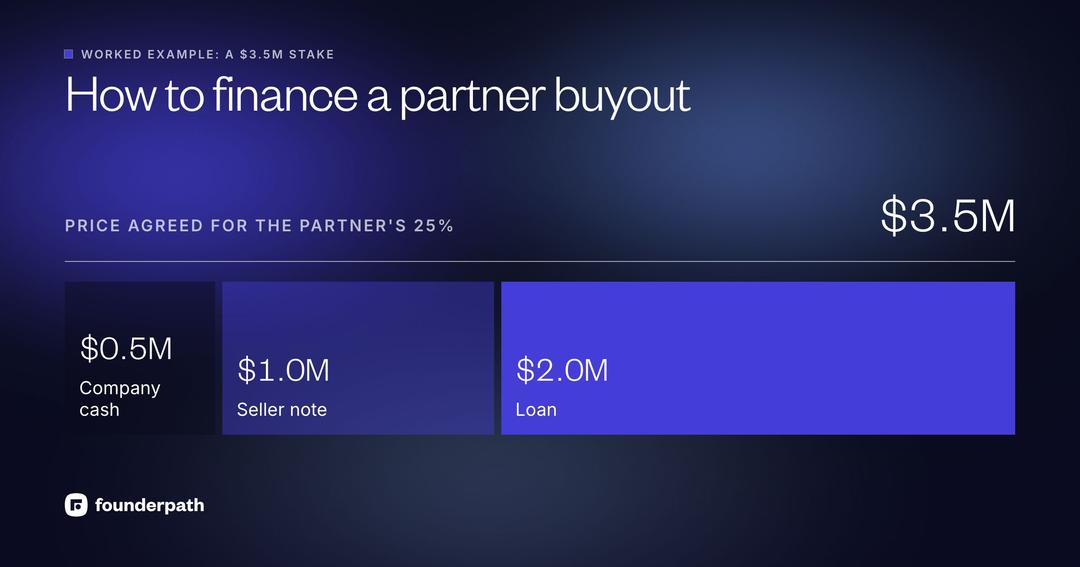
Worked example. A SaaS company has $4M in ARR and a co-founder who owns 25%. At 3x to 4x ARR, close to the 2025 and early-2026 medians, the company is worth $12M to $16M, so 25% is $3M to $4M before adjustments. Say the two founders agree on $3.5M. These are illustrative numbers, not a quote.
A fair price is one that both sides can live with. Vandersluis described how he and his partner knew they had found it after TimeControl's loss-making 1993:
In the end we found a price for him that would work. It was about a year's salary, and we knew it was the right price because his wife said, wait a minute, if he buys this from you, could he make millions? And Don said, well, yeah. And my wife at the time said, well, hold on a minute, if we give them this money, could we lose everything? And I went, yeah. And so we knew we had the right price.
He also points out that timing helps: buying out a partner who wants to leave, when you want to stay, is a good moment to negotiate (watch at 4:17).
Ways to pay for a partner buyout
| Option | Cash to the partner at close | Who carries the risk | Personal guarantee | New shares issued |
|---|---|---|---|---|
| Company cash | All of it, if the bank balance allows | The company | No | No |
| Seller note or installments | Part, the rest over time | The departing partner | Set by the note | No |
| SBA 7(a) loan | Most of it, after the equity requirement | Remaining owners and the company | Yes, owners of 20% or more | No |
| Bank term loan | Most of it | The company and its owners | Set by the bank | No |
| Term debt from a SaaS lender | Most of it | The company | Varies by lender | No, unless warrants |
| Secondary sale to a new investor | All of it, from the investor | The investor | No | No, the investor takes the shares |
Terms as described in the sections below; SBA rules from SOP 50 10 8.1, effective October 1, 2026.
Company cash
If the company has the cash, paying from the balance sheet is simplest: no lender, no interest, no guarantee. The risk is what it leaves behind. A buyout that drains the cushion you need for payroll and slow-paying customers swaps a cap-table problem for a runway problem. Most founders use cash for part of the price and finance the rest.
Seller note or earn-out
A seller note means the departing partner accepts part of the price in installments, usually paid from cash flow over a few years. It is often the cheapest money in the deal, and it keeps the partner invested in a smooth handover. The trade-off is risk for them: if the company struggles, they wait.
A note interacts with any loan you add. Under SOP 50 10 8.1, seller earnouts are prohibited in an SBA-financed change of ownership, and seller debt counts toward the SBA's equity requirement only if it is on full standby, with no principal or interest paid for the life of the 7(a) loan. Outside SBA deals, a new lender may want the note to rank behind it. Chris Federspiel, CEO of Blackthorn, said the seller of a product his company acquired refused to be second in line when Blackthorn took on a debt facility, so the company paid that seller out early (watch at 19:13). Agree the ranking before you sign.
SBA 7(a) loan
This is the option the bank pages ranking for this search lead with, and it has real strengths: the SBA's 7(a) program covers complete and partial changes of ownership, up to $5 million, and SOP 50 10 8.1 caps variable rates on standard 7(a) loans over $350,000 at the prime rate (or SBA's optional peg rate) plus 3%. The rules for an owner buyout, from SOP 50 10 8.1 (effective October 1, 2026):
- At least one original owner must stay and guarantee the loan. Anyone who hasn't worked in the business for at least 24 months must buy less than 50% and can't become the largest shareholder; otherwise the lender applies the stricter credit standards for a full acquisition.
- The equity requirement is 10% of the purchase price. The lender may reduce or waive it if the business keeps enough liquidity and its balance sheet has no negative net worth at the last fiscal year-end.
- Debt service coverage must be at least 1.25x, and a change-of-ownership loan can't amortize over more than 10 years, with limited exceptions for real estate.
- Owners of 20% or more give unlimited personal guarantees, and a selling owner who keeps less than 20% gives a full guaranty for at least two years. If business assets don't fully secure the loan, the lender must take available equity in the personal real estate of those owners and guarantors.
That last rule is the catch for SaaS. A software company has few fixed assets, so a buyout loan is rarely fully secured by the business, and the guarantors' homes are likely to back it. In the worked example, a $2.0M SBA loan repays its principal over at most 10 years, an average of $200,000 a year, plus interest.
Bank term loan
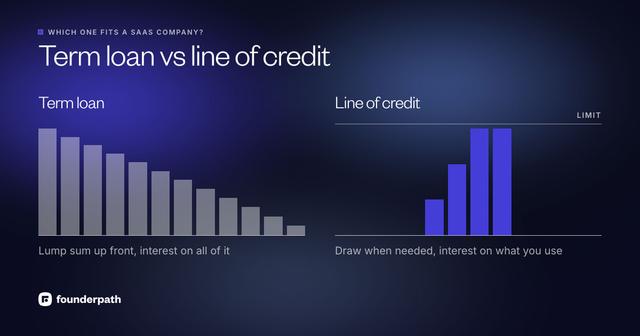
A conventional bank loan follows the bank's own policy rather than the SBA's. It can be faster, but banks lend against collateral and cash flow, and both are thin in an early SaaS company. One practical warning comes from Celtic Bank, an SBA lender, which says on its partner buyout page that it is not uncommon for lenders to call in lines of credit when they hear a partner is leaving, especially if that partner had the longest relationship with the bank. Talk to your current lender early.
The bank can also be closer than you think. OnBoard's founder financed his co-founder buyback through his first customer, a financial institution:
Eventually they became my debt partner when I talked about buying back my co-founder. My first customer, since this was a financial institution, they helped me figure out a loan which allowed me to buy back my partner.
Term debt from a SaaS lender
Some lenders that underwrite recurring revenue, rather than fixed assets, will fund a buyout, sizing it the way they size SaaS acquisition financing. Their terms vary widely: some take warrants (the facility Federspiel described for Blackthorn did, watch at 15:55), some don't. Compare the interest, fees, warrants, covenants, guarantees and the payment due at maturity together, and ask in writing whether a buyout is an approved use of funds. Founderpath's terms are in the section below.
Secondary sale to a new investor
If the company can't carry payments, a new investor can buy the departing partner's shares directly. The partner gets cash, the company takes on no debt, and no new shares are issued, but you gain a shareholder with their own expectations and rights. Investors don't always want a departing founder's stake. Federspiel bought out his two co-founders in 2018 with most of his savings and help from his aunt, after outside investors passed:
I pitched so many investors, no one wanted anything to do with me.
Which option fits
Three questions narrow it down. Can the partner wait to be paid? Then a seller note may cover much of the price. Can the company's cash flow cover loan payments with room to spare, the 1.25x coverage an SBA lender tests? If not, a secondary sale, a lower price or a later date is safer than a loan. Will the remaining owners sign personal guarantees and pledge property? Then an SBA 7(a) or bank loan is open to you; if not, look at term debt secured on business assets.
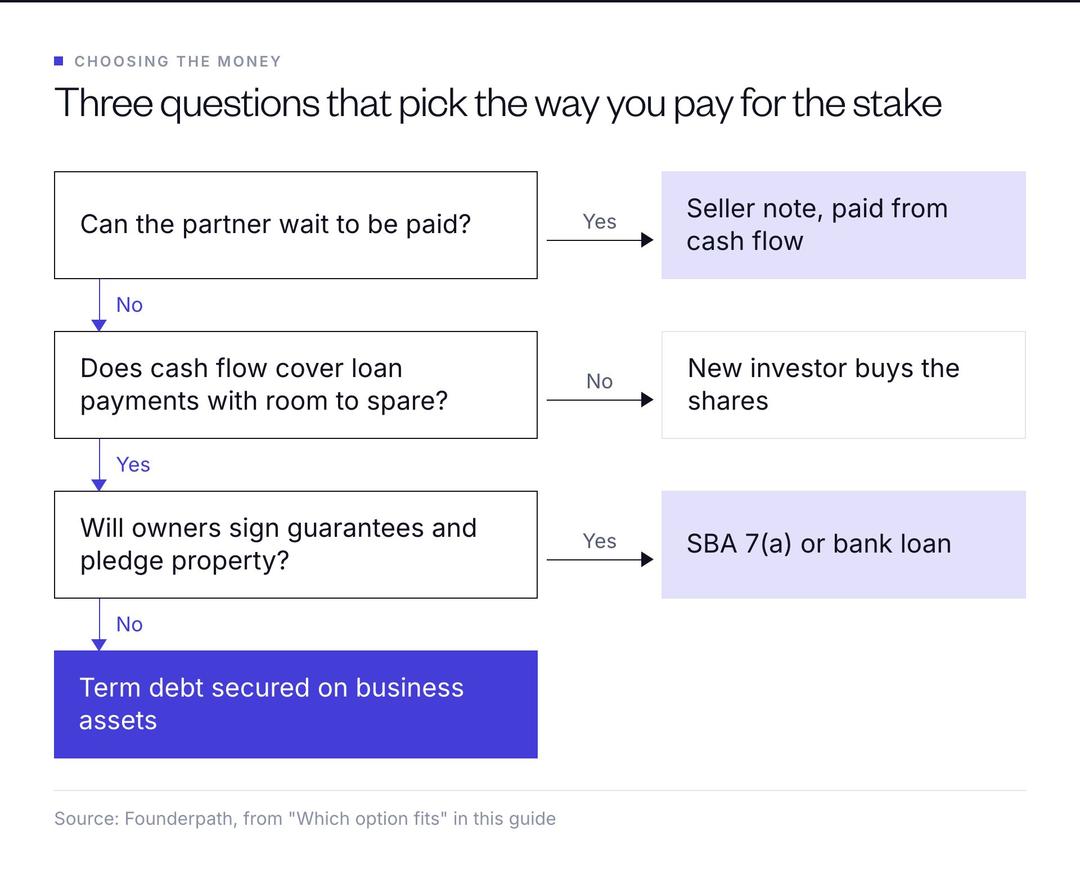
Three questions that pick the way you pay. Source: Founderpath, from this section; the 1.25x coverage test is from SBA SOP 50 10 8.1
Back to the worked example: $0.5M of company cash at close, a $1.0M seller note paid over three years and a $2.0M term loan. If the loan is interest-only at 15%, it costs $300,000 a year in interest ($2.0M x 15%), and the seller note adds about $333,000 a year of principal ($1.0M / 3) plus its interest. That is roughly $633,000 a year before the note's interest, or about 16% of the company's $4M ARR. Run your own figures through the SaaS debt capacity calculator before you commit.
The trade-offs to weigh
- Personal guarantee: an SBA loan puts the remaining owners' personal assets behind the company's debt. Read what you are signing.
- Collateral: asset-light companies end up pledging what they have. Know which lender takes which lien.
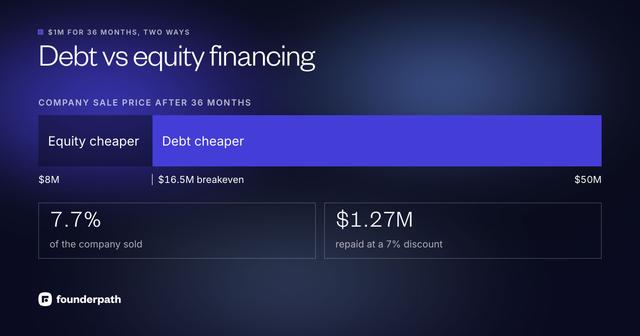
- Dilution: a loan or a seller note issues no new shares. Warrants and equity rounds do; our dilution calculator shows how much, and our guide to debt vs equity financing works through the trade-off.
- Cash flow: every option except a secondary sale is paid from future cash. Chadha said that the debt from buying back his co-founder and another partner was the first reason he later took institutional capital, and described the pressure that debt brings from family (watch at 10:34).
- Existing agreements: an existing loan agreement may restrict share repurchases and distributions without the lender's consent. Check yours before you promise a closing date.
When not to fund a buyout with debt
Debt is the wrong tool when the company's cash flow can't cover the payments with room to spare, when growth is slowing, or when you'd be borrowing at a price above what an independent valuation supports. It also isn't the only way to rebalance ownership. Sometimes the cheapest fix is no purchase at all:
- Leave the stake in place. A departed founder can stay a passive shareholder. You keep the cash; the cost is a name on the cap table.
- Rebalance with an option pool. When Voxpopme's managers held only about 8% to 15% between them, as Latka recalled from diligence, Founderpath made its 2024 financing conditional on a new employee option pool, part of which would go to the go-forward team. ZoomInfo's Henry Schuck said that when his co-founder left in 2015, both of them put part of their ownership into a pool for employees (watch at 14:03).
- Use the vesting terms for unvested shares, as described above.
How Founderpath fits
Founderpath provides non-dilutive capital for software companies. Its term loans run from $500K to $10M for software companies with $3M+ in revenue, at interest from 15%, over up to four years with up to 24 months of interest-only payments. There are no warrants, no origination fees, no prepayment penalty and no full personal guarantee; Founderpath takes a lien on business assets only. Most term loans close in under four weeks once your billing, bank and accounting data are connected. All of these terms are from the term loans page as of November 2026; the downloadable term loan model uses a 2% origination input by default, so check fees on your own term sheet.
On buyouts specifically, Founderpath's software industry page lists buying out a co-founder or investor among the uses of its term loans, for companies with $3M+ in revenue, as of November 2026. In a 2024 session Founderpath published, CEO Nathan Latka, who hosted the session, said, after Federspiel described his 2018 buyout, that funding buyouts of non-operating shareholders is a big use of Founderpath's capital (watch at 5:47). Confirm in your term sheet that the buyout is an approved use of funds.
Founderpath isn't the right fit for every buyout. Its term loans are aimed at companies with roughly $3M+ in revenue, an SBA loan can be cheaper if you are willing to pledge personal property, and a patient partner on a seller note may cost less than any lender. To compare offers on equal terms, download the term loan Excel model and read our guide to SaaS debt financing.
Check what you qualify for. It takes less than 5 minutes.
Partner Buyout FAQ
Can I get a loan to buy out my business partner?
Yes. SBA 7(a) loans can fund complete and partial changes of ownership, up to $5 million per loan, and banks and some SaaS lenders also lend for buyouts. Every lender will check that the company's cash flow can carry the payments after the partner is paid, and the SBA requires debt service coverage of at least 1.25x for an owner buyout.
Can I use an SBA loan to buy out a partner?
Yes. Under SOP 50 10 8.1, effective October 1, 2026, an owner buyout is its own category of 7(a) change of ownership. At least one original owner must stay and guarantee the loan, the equity requirement starts at 10% of the purchase price and can be reduced, and the loan amortizes over no more than 10 years. Owners of 20% or more give full personal guarantees.
How do you value a business partner's share of a SaaS company?
Start with an ARR or revenue multiple for the whole company, adjust for cash and debt, then apply the partner's percentage. Aventis Advisors' deal database puts the median SaaS acquisition at 3.8x revenue in 2025 and 3.1x in the first quarter of 2026. Check what your agreement says about price first, and get an independent valuation if you borrow from an SBA lender, which must order one.
Can I pay my partner over time instead of all at once?
Yes, with a seller note: the departing partner accepts part of the price as installments, usually from the company's cash flow. It is often the cheapest money in the deal, but the partner carries the risk, and a new lender may require the note to rank behind its loan. An SBA lender counts seller debt toward the equity requirement only if it is on full standby, with no payments for the life of the 7(a) loan.
Do I need a personal guarantee to finance a buyout?
With an SBA 7(a) loan, yes: anyone who owns 20% or more gives an unlimited personal guarantee, and if business assets don't fully secure the loan the lender must take available equity in their personal real estate. Other lenders set their own terms. Founderpath's term loans ask for no full personal guarantee and take a lien on business assets only, according to its term loans page as of November 2026.
What happens to a co-founder's unvested shares when they leave?
If the founder stock was subject to vesting, the company usually has the right to buy back the unvested shares at the lower of cost or fair market value, as Cooley describes the typical arrangement. That part of a buyout may cost very little. You only need to finance the vested shares, so read the stock purchase agreement before you negotiate.
Should the company buy the shares, or should I buy them personally?
Either can work. The company can redeem the shares, or you can buy them yourself, and the SBA rules allow both structures. The choice changes who borrows, who guarantees and how the deal is taxed, so decide it with your lawyer and tax adviser before you approach a lender.
Does Founderpath fund co-founder or investor buyouts?
Founderpath's software industry page lists buying out a co-founder or investor among the uses of its term loans, for software companies with $3M+ in revenue, as of November 2026. Term loans run from $500K to $10M at interest from 15%. Confirm that the use of funds is approved in your term sheet before you sign anything with the partner.
Sources and method
We checked every figure on this page in November 2026. SBA rules come from the regulator's own documents: the 7(a) program page and SOP 50 10 8.1, effective October 1, 2026, which replaced SOP 50 10 8 (June 1, 2025). Valuation multiples come from Aventis Advisors' deal database, as published by Aventis. Founderpath's terms come from its live product pages on the date of review; they are Founderpath's own statements, and your term sheet governs. Founder quotes are continuous excerpts from the automatic YouTube caption transcripts on Founderpath's resource pages, checked at the linked timestamps, with punctuation added and fillers and repeated words removed. The captions do not label speakers; the remark attributed to Nathan Latka comes from the session's host, identified from context. The worked example uses illustrative numbers, and its arithmetic is shown in the text.
- 7(a) loans, U.S. Small Business Administration, read November 2026
- SOP 50 10 8.1, Lender and Development Company Loan Programs, U.S. Small Business Administration, effective October 1, 2026 (Appendix 15, change of ownership)
- SaaS Valuation Multiples: 2015-2026, Aventis Advisors, published August 31, 2026, updated November 2026
- Founder's Stock, Vesting and Founder Departures, Cooley GO, read November 2026
- Finance a Partner Buyout, Celtic Bank, read November 2026
- Founderpath term loans and software industry page, read November 25, 2026
- High Volume, Low ARPU Sales Playbook, Chris Vandersluis, Founderpath resource
- Founder First PE Playbook, Paroon Chadha, Founderpath resource
- How to Buy SaaS Products and Keep Control of Your Company, Chris Federspiel with Nathan Latka, Founderpath resource published 2024
- The Capital Efficient Founder, Henry Schuck, Founderpath resource