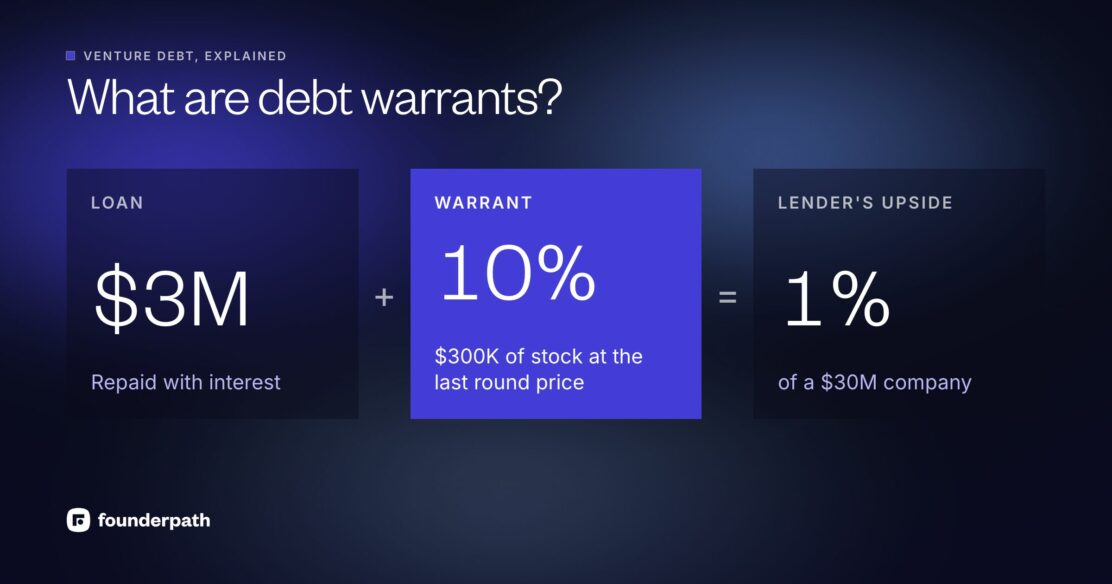

Debt warrants are rights a lender receives along with a loan to buy a set number of the borrower’s shares at a fixed price, usually the price of the company’s last equity round, before the warrant expires, typically 7 to 10 years later. They are standard in venture debt: the lender earns interest on the loan plus a small share of the upside, and the founder is diluted only if the lender exercises.
How many shares the lender can buy is set by warrant coverage, a percentage of the loan. On a $3M loan with 10% coverage, the lender can buy $300,000 of stock at the last round’s price, about 1% of a company valued at $30M.
Key Takeaways
- Hercules Capital, a listed US venture lender, says its warrant coverage generally ranges from 3% to 20% of the loan principal, at the price of the most recent equity round (2025 annual report).
- TriplePoint Venture Growth puts its own range at 2% to 10% of the committed loan amount, and Trinity Capital says its warrants are typically exercisable for 7 to 10 years (2025 annual reports).
- The stake a warrant buys is roughly coverage times loan divided by post-money valuation: 10% on a $3M loan at a $30M valuation is 1%, against a 16% median dilution per priced round on Carta in 2025.
- In Founderpath’s analysis of Q4 2025 SEC filings, the three venture-focused lenders held warrants in 67 of the 118 software companies they lent to (57%), against 10 of 660 lending relationships (1.5%) at 12 large sponsor lenders.
- Warrants are a small part of lender returns: their reported fair value was 1.4% of loan principal at the median across public venture lenders (Gonzalez-Uribe and Mann, 2024).
How debt warrants work
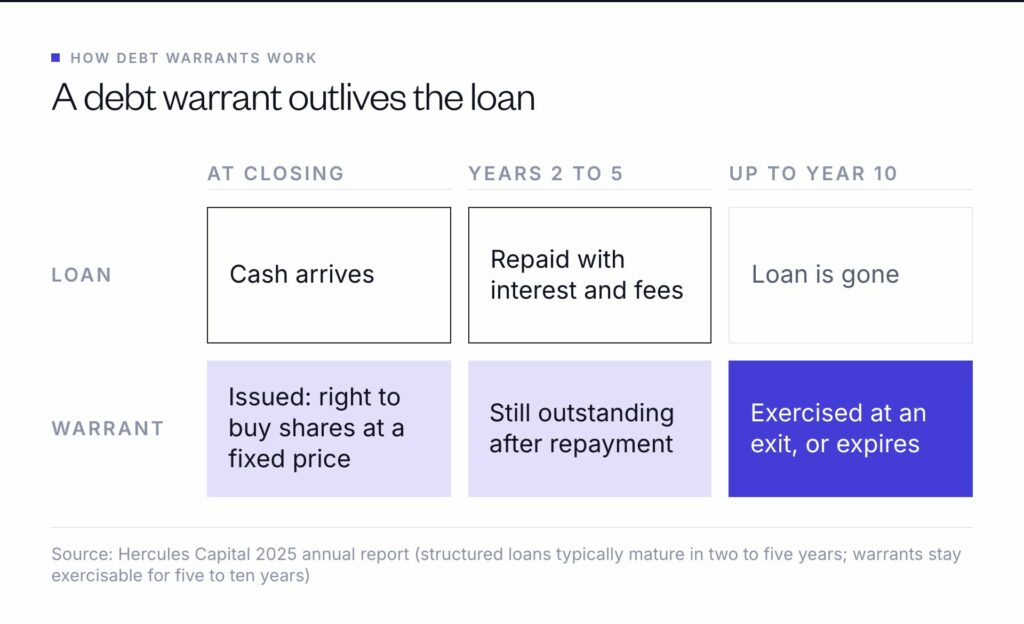
A debt warrant is a separate security issued when the loan closes. It works like a stock option you give the lender: a right, not an obligation, to buy shares later at a price fixed today. Until the lender exercises it, the lender owns no shares, has no vote and receives no dividends. Four terms define every warrant:
- Coverage: how much stock the lender can buy, quoted as a percentage of the loan (the next section shows the math).
- Strike price: the price per share the lender pays to exercise. Hercules Capital says its strike is “generally equal to the most recent equity financing round” (Hercules Capital 10-K, 2025). TriplePoint also allows a recent third-party valuation or the price of the next round (TriplePoint 10-K, 2025). Some lenders ask for “penny warrants” with a strike near $0.01, which makes the warrant worth almost the full share price (Velawood).
- Class of stock: often the same preferred shares your last investors bought. Horizon Technology Finance held warrants “predominantly” in preferred stock (Horizon 10-K, 2025), while TriplePoint and Trinity take preferred or common.
- Term: how long the right lasts. Trinity Capital says its “typical exercise period for warrants is seven to 10 years” (Trinity Capital 10-K, 2025). Hercules says five to ten years after issuance, or three to five years after an IPO, whichever is shorter.
That term is the part founders tend to miss. Hercules says its structured loans typically mature in two to five years, so the warrant usually outlives the loan. Repaying early ends the interest, not the warrant. The lender typically exercises at an exit, when the company is sold or goes public, and an unexercised warrant simply expires.
A real case: integration platform Celigo’s first outside capital, in 2015, was about $1.5M of venture debt, and CEO Jan Arendtsz says “there was a warrant there.” The company reached $92M in ARR by September 2024 (per GetLatka). The warrant was priced when the company was a fraction of that size.
What is warrant coverage?
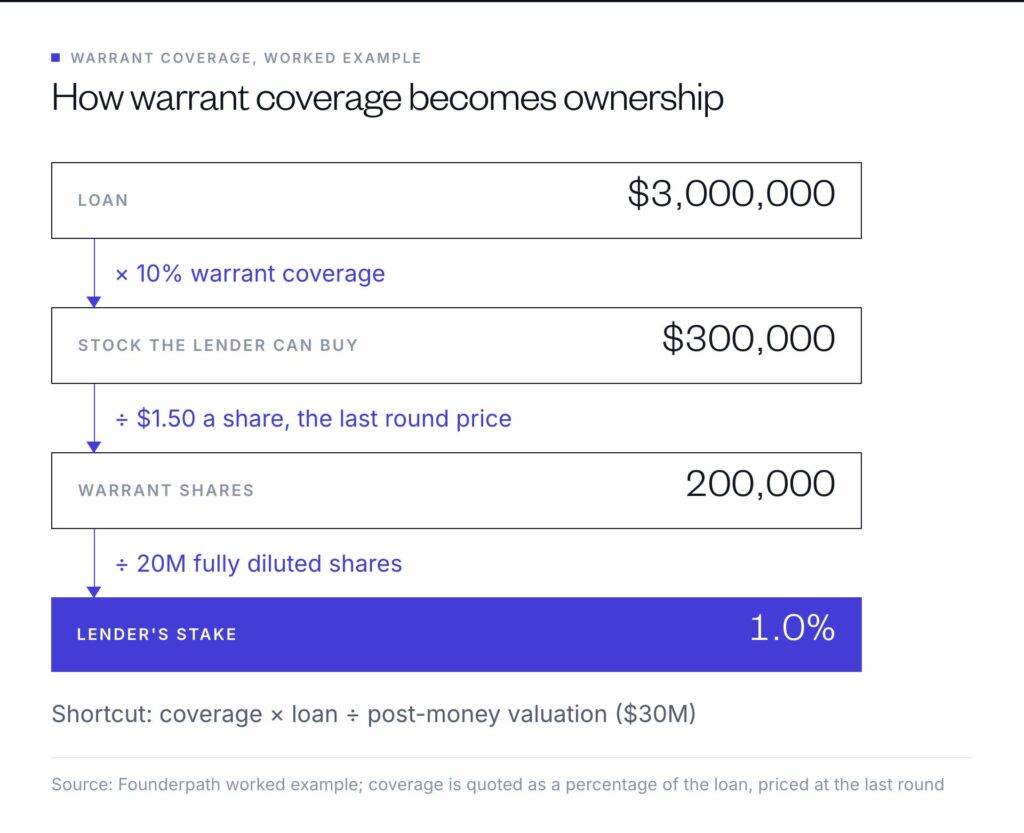
Warrant coverage is the dollar value of stock the lender can buy, stated as a percentage of the loan. To turn it into shares, multiply the loan by the coverage and divide by the strike price:
- Warrant shares = loan amount × coverage ÷ strike price
- Lender’s stake ≈ loan amount × coverage ÷ post-money valuation of the last round, when the strike is that round’s price
There is no market-wide dataset of coverage, but some of the largest listed venture lenders state their ranges to the SEC. Hercules Capital says its coverage “generally ranges from 3% to 20% of the principal amount” (2025 10-K). TriplePoint says 2% to 10% “of the committed loan amount” (2025 10-K).
Note the word committed. A $10M facility you only draw $3M from can still carry warrants on the full $10M unless the agreement ties coverage to the amount drawn. Cooley’s venture debt checklist puts this question first in its warrant section: “Is the number of shares based on the amount of the loan actually drawn at closing or the entire available loan facility?” (Cooley GO).
The table shows the stake a warrant buys at a $30M post-money valuation, for three loan sizes and three coverage levels inside the lenders’ stated ranges.
| Loan | 5% coverage | 10% coverage | 20% coverage |
|---|---|---|---|
| $1M | 0.17% | 0.33% | 0.67% |
| $3M | 0.50% | 1.00% | 2.00% |
| $5M | 0.83% | 1.67% | 3.33% |
How much do debt warrants dilute founders?
Often less than 1% of the company per loan, far less than a priced round. The clearest public example is Roku. In June 2017, Silicon Valley Bank agreed to lend Roku up to $40M, and Roku issued warrants for 408,648 Series H preferred shares at $9.1734, the price of its 2015 Series H round (Roku S-1/A, 2017). That is $3.75M of stock, or about 9.4% coverage, and 0.48% of the shares outstanding at the time.
Compare that with equity. Startups on Carta sold a median 16% of the company in each round from seed through Series C in 2025 (Carta, State of Private Markets: 2025 in review). Blackthorn’s CEO made the same comparison after turning down growth investors who wanted a board seat. His lenders, who combined debt with an equity piece, ended up with a much smaller stake than a round would have taken:
So then we did this debt facility. So the benefit of doing the debt facility is that they now have, like, I don’t know the exact number, it’s shuffled a little, but like 5 to 6%, versus doing [a] round is like 20%, give or take.
Chris Federspiel, CEO, Blackthorn, watch at 18:16
Small is not free, though. The warrant’s cost shows up at the exit, and it grows with your success. In the worked example, the lender’s 1% would be worth about $1.5M if the company later sold for $150M. The lender pays the $300,000 strike to exercise, so the warrant transfers about $1.2M of value from the other shareholders, on top of the interest and fees you already paid. To model your own numbers, try the dilution calculator.
Why do lenders ask for warrants?
Venture lenders lend to companies that usually don’t make a profit, against the backing of their investors rather than assets or cash flow. Interest caps what they can earn if the company does well, while a failed company can wipe out the loan. The warrant gives them a small share of the wins to offset the losses.
It is a sweetener, not the main return. Across public venture lenders, the reported fair value of warrants “is only 1.4% of loan principal at the median, and 3% at the mean” (Gonzalez-Uribe and Mann, 2024). Loans carry “spreads of five to ten percentage points above the prime rate, and many fixed fees”, so interest does most of the work. Hercules Capital targets a total return of 10% to 20% on its loans, including warrants. At the end of 2025 it held warrants in 108 companies, worth about $41.1M, and it says about half of its warrants may never generate a return. The ones that did returned between 1.02x and 42.71x (Hercules Capital 10-K, 2025).
Which lenders take warrants?
Mostly venture lenders, which lend to VC-backed companies. Their loans “essentially never happen prior to the Series A round”, and about 15% of Series A rounds and 20% of Series B rounds are followed by a venture loan within two years (Gonzalez-Uribe and Mann, 2024).
Founderpath tracks the software loans that 15 listed lenders, known as business development companies or BDCs, report in their SEC filings. In the Q4 2025 filings behind our Software Private Credit Tracker, the three venture-focused lenders held equity warrants in 57% of the software companies they lent to. The 12 large lenders that mostly finance private-equity-owned companies, including Ares, Blackstone, Blue Owl and Golub, held them in 1.5% of their software lending relationships.
| Lender | Type | Software borrowers | Holding warrants | Share |
|---|---|---|---|---|
| Horizon Technology Finance | Venture | 14 | 11 | 79% |
| Trinity Capital | Venture | 49 | 33 | 67% |
| Hercules Capital | Venture | 55 | 23 | 42% |
| All three venture lenders | Venture | 118 | 67 | 57% |
| 12 sponsor and middle-market lenders | Sponsor | 660 relationships | 10 | 1.5% |
Two caveats. The count shows warrants held at year end, so some predate the current loan, and it says nothing about coverage size. And these are large, mostly investor-backed borrowers, not bootstrapped companies. Even venture lenders price by borrower: Hercules held no warrants in many of its later-stage software borrowers.
Founders see the same pattern at smaller sizes. Surefire Local’s first debt, $1M in 2016, came from a venture lender with 2% warrants, prime plus 2% interest, a one-year balloon, cash covenants and a guarantee from the company’s institutional investors, as founder Chris Marentis shows in his talk’s slide on the deal. Some lenders offer a cash success fee instead of warrants: Horizon reported success fee arrangements in eight portfolio companies at the end of 2025 (Horizon 10-K, 2025).
What to negotiate in a warrant
Coverage is negotiable, and it usually trades off against the interest rate. Read the warrant agreement as closely as the loan agreement, and push on these terms:
- Coverage percentage: ask where it sits in the lender’s range, and what a lower coverage would cost in rate or fees.
- Drawn vs committed amount: tie coverage to the money you actually draw, or split it, part at signing and part at each draw.
- Strike price: keep it at the last round’s preferred price. Avoid penny warrants, and read any formula tied to a future round carefully.
- Term: shorter is better for you. Ask whether the warrant ends at an IPO or a sale if the lender doesn’t exercise.
- Class of stock: common stock carries no liquidation preference; preferred does.
- No step-ups: refuse clauses that add warrants if you miss a covenant, refinance late or extend the loan.
- A cash fee instead: some venture lenders accept a success fee or exit fee in place of warrants.
Step-ups are where warrants get expensive. Issuu’s CEO described a lender that kept adding terms after a missed revenue covenant, until it demanded more equity every month the company didn’t refinance:
They wanted, at one point, an additional point in the company for each month that we didn’t refinance the business, and wanted to charge us a penalty of a million dollars if we didn’t give them those 1% warrants within 3 days.
Joe Hyrkin, CEO, Issuu, watch at 15:22
Issuu refinanced with a different lender before paying much of those penalties. Hyrkin tells the full story in his keynote:
Watch the full talk by Joe Hyrkin, with transcript.
Are debt warrants good for startups?
They can be, if you are already VC-backed and the loan replaces equity you would otherwise sell. They are a poor trade when the loan only delays a problem.
Pros
- Much less dilution than a priced round: often under 1% per loan, against a 16% median per round on Carta in 2025.
- No board seat for the lender, and no vote until it exercises.
- Coverage usually trades off against the interest rate, so accepting warrants can lower the cash cost of the loan.
Cons
- You still repay the loan with interest and fees; the warrant comes on top.
- The warrant’s cost grows with your valuation, so it is most expensive when you do best.
- It survives repayment and sits in your fully diluted share count for years.
- Covenant breaches can bring step-ups or penalty warrants, as Issuu found.
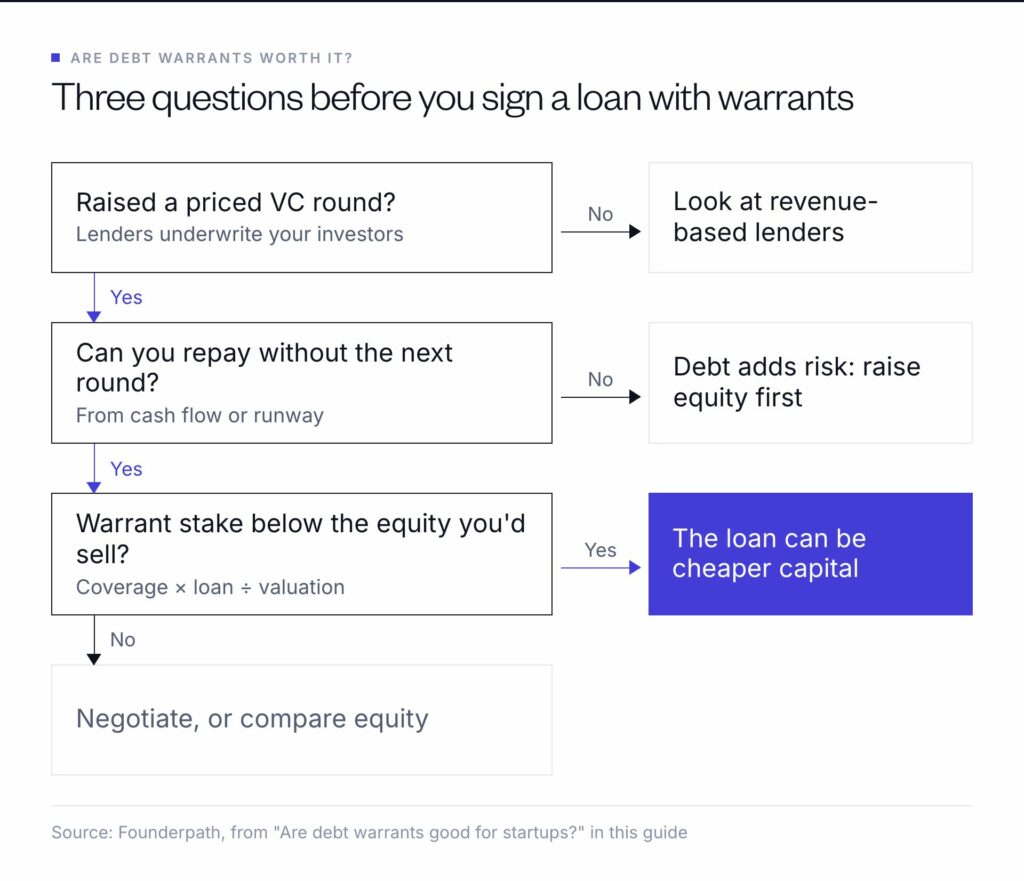
The deciding questions are whether a lender will underwrite you at all, whether you can repay without depending on the next round, and whether the warrant stake is smaller than the equity you would sell instead.
Alternatives to debt with warrants
If you haven’t raised a priced round, venture debt is rarely on the table anyway. Lenders that underwrite your revenue instead of your investors often take no warrants, though some do, so check the term sheet:
- Revenue-based financing: an advance repaid from future revenue, for a fixed fee or discount.
- Revenue-backed term loans: fixed monthly payments, underwritten on recurring revenue and retention.
- Customer prepayments: annual contracts paid upfront, at the cost of a discount.
Each has its own trade-off. Badger Maps founder Steve Benson, who funded his company with revenue-based loans and later term loans, put the cost shape of revenue-based financing plainly:
If you grow quickly, then these loans can become really expensive, like on a percent basis, probably like 25 percent… I think for me it worked out to be about 18 because we weren’t that good at growing, but if we had been good at growing it would have been a lot more expensive.
Steve Benson, Founder and CEO, Badger Maps, watch at 12:06
For the full comparison of venture debt with these options, including rates, fees and covenants, see our guide to venture debt and the overview of non-dilutive funding.
Fund growth without giving up equity
Founderpath provides non-dilutive capital for B2B SaaS companies with at least $10K MRR. There’s no equity, no warrants, no board seats and no personal guarantees. Connect your billing, banking and accounting data, and most founders see funds within 24-48 hours.
Check what you qualify for. It takes less than 5 minutes.
Frequently asked questions
What is warrant coverage?
Warrant coverage is the dollar value of stock a lender can buy through its warrant, stated as a percentage of the loan. With 10% coverage on a $3M loan, the lender can buy $300,000 of stock at the strike price, usually the last round’s price per share. Hercules Capital says its coverage generally ranges from 3% to 20% of principal; TriplePoint says 2% to 10% of the committed amount.
Are debt warrants dilutive?
Yes, but only when the lender exercises them, and often by less than 1% of the company per loan. A quick estimate is loan amount times coverage divided by the post-money valuation of the last round: 10% coverage on a $3M loan at a $30M valuation is about 1%. Roku’s 2017 warrants to Silicon Valley Bank, on a loan of up to $40M, came to 0.48% of its shares outstanding.
Do warrants count in the cap table?
Outstanding warrants are normally counted in the fully diluted share count, the figure investors use to price the next round and calculate ownership, even before they are exercised. The lender only becomes a shareholder, with the rights of that class of stock, after it exercises.
How long do venture debt warrants last?
Usually 7 to 10 years, much longer than the loan. Trinity Capital says its typical exercise period is seven to 10 years, and Hercules Capital says five to ten years after issuance or three to five years after an IPO, whichever is shorter. Hercules says its loans typically mature in two to five years.
Can warrants be cancelled when the loan is repaid?
Not usually. A warrant is a separate security from the loan, so repaying the loan early ends the interest but not the warrant, unless the warrant agreement says otherwise. If you want a buyback right or a shorter term, negotiate it before signing.
What happens to warrants when the company is sold or goes public?
It depends on the warrant agreement. Lenders usually exercise at the exit, often without paying cash by netting the strike price against the shares, or the agreement may let the warrant expire if it isn’t exercised at a sale or IPO. Hercules keeps its warrants exercisable for three to five years after an IPO.
Do all business loans come with warrants?
No. Warrants are mainly a venture-lender term. In Founderpath’s analysis of Q4 2025 SEC filings, the three venture-focused lenders held warrants in 57% of the software companies they lent to, against 1.5% at 12 large sponsor lenders. Revenue-based lenders often take none, and some venture lenders accept a cash success fee instead.
Is a debt warrant the same as a warrant in debt?
No. A debt warrant is an equity right attached to a business loan. A “warrant in debt” is the form used to file a civil claim for money in Virginia’s General District Courts, often to collect a debt. If you have been served one, it is a court matter, not a financing term.
Recent Articles

CARR vs ARR: What Contracted ARR Is and How It Differs
CARR is your ARR plus signed contracts that aren't live yet, minus churn notices. How to calculate CARR, how it differs from ARR, bookings and RPO, and how to report it honestly.

What Is a UCC Filing? What It Means When a Lender Files One
A UCC filing is a public notice that a lender has a lien on some or all of your business assets. What a UCC-1 contains, how long it lasts, how it affects new financing and how to remove one.

What Are Debt Warrants? How Venture Debt Warrants Work
Debt warrants give a lender the right to buy shares at a fixed price alongside a loan. How warrant coverage works, what it costs in dilution, and which lenders take warrants.