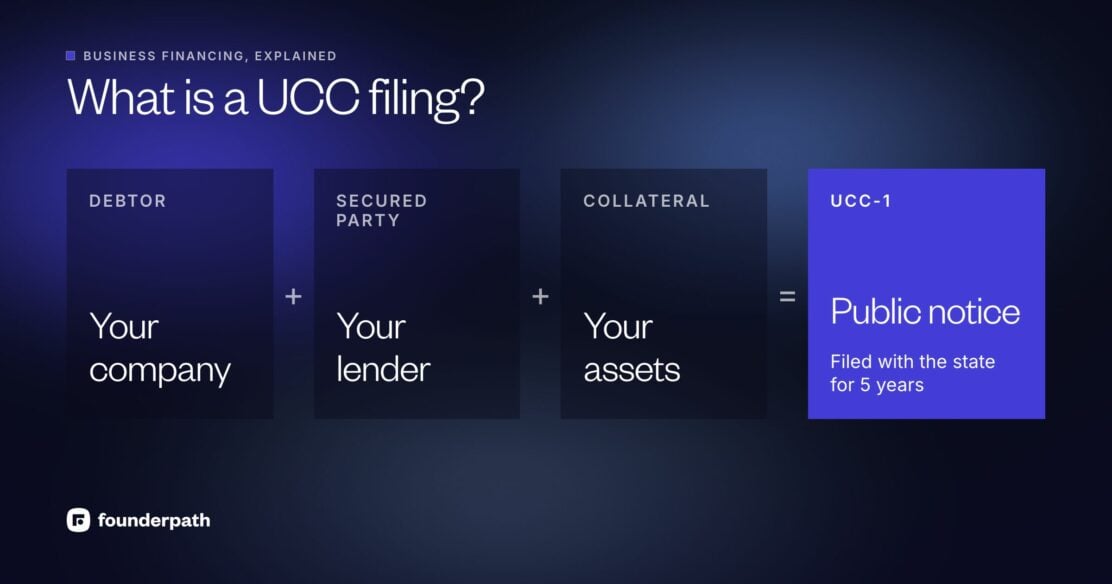

A UCC filing is a public notice, usually a form called a UCC-1 financing statement, that a lender files with a state office to show it has a lien on some or all of a borrower’s business assets. It names the borrower, the lender and the collateral, which can be one piece of equipment or “all assets”. The filing puts the lender ahead of later creditors, stays on record for five years unless it is renewed, and is removed with a UCC-3 termination once the debt is paid.
Expect one whenever you take a secured business loan, an equipment lease, a merchant cash advance or revenue-based financing. It is not a court judgment or a mark of trouble, but every future lender will see it and read it as a claim on what you have already pledged.
Key Takeaways
- Under UCC Article 9, a financing statement needs only three things: the debtor’s name, the secured party’s name and an indication of the collateral (section 9-502).
- A UCC-1 is effective for five years from the filing date, and a continuation filed in the last six months adds another five years (section 9-515).
- Lenders with competing filings rank by who filed or perfected first, so an earlier “all assets” filing usually puts a new lender in second place (section 9-322).
- Once nothing is owed, a lender that receives your signed demand must file or send a termination within 20 days, or owe you $500 plus any losses (sections 9-513 and 9-625).
- Filing is cheap: $5 online in California and Texas, $20 online in New York and $70 on the web in Delaware, per each state’s fee schedule in October 2026.
How a UCC filing works
UCC stands for Uniform Commercial Code, a model law that every US state has enacted in its own version. Its Article 9 covers secured transactions: loans and other deals where a borrower pledges property as collateral. Two documents do the work, and founders often confuse them:
- The security agreement is the private contract you sign. It grants the lender a security interest in specific collateral and sets out what happens if you default.
- The financing statement, or UCC-1, is the public notice the lender files about that contract. New York’s Department of State puts it plainly: a UCC-1 is filed “to provide notice that a creditor has a security interest in a debtor’s personal property. It is not an agreement” (NY Department of State, UCC FAQ).
The form itself is short. A financing statement is sufficient “only if it” gives the name of the debtor, the name of the secured party or its representative, and indicates the collateral (UCC section 9-502). The standard national form comes from the International Association of Commercial Administrators, with a current revision date of July 1, 2023 (IACA UCC forms), though states set their own rules. New York, for one, rejects the national form when the debtor is an organization (NY DOS).
The debtor’s name is the detail that matters most. It must be your company’s registered legal name, because a trade name alone is not enough (section 9-503), and a misspelled name only counts if the state’s own search would still find the filing (section 9-506). That is also why lenders search under your exact legal name before they fund.
Why lenders file a UCC-1
Signing the security agreement gives the lender a claim against you. Filing the UCC-1 makes that claim hold up against everyone else, which the code calls perfecting the security interest. For most collateral, “a financing statement must be filed to perfect all security interests” (section 9-310), with exceptions such as deposit accounts, which a lender can perfect only by control (section 9-312).
Perfection decides who gets paid first. When two lenders claim the same collateral, their interests “rank according to priority in time of filing or perfection” (section 9-322). The lender that files first stands first in line, a later filer collects only from what is left, and creditors with no filing at all come last.
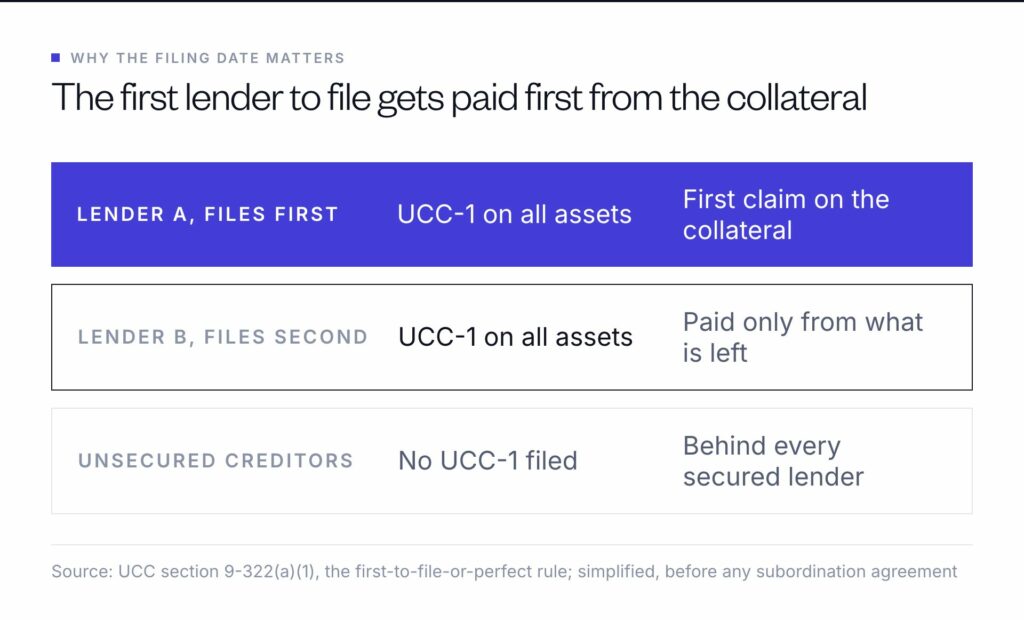
That is why lenders file early. A UCC-1 can be filed before the loan agreement is even signed, as long as you authorize it (section 9-502(d)), and a lender that funds before it files risks someone else getting in ahead of it.
Types of UCC filings
You will mostly meet the UCC-1, the UCC-3 that changes or ends it, and the forms used to search the records. Each is filed with the same state office.
| Form | Who files it | What it does |
|---|---|---|
| UCC-1 financing statement | Lender | Starts the public record of a security interest |
| UCC-3 amendment | Usually the lender | Changes a filing: a continuation for five more years, a termination, an assignment to a new lender, or added or released collateral |
| UCC-5 information statement | Debtor | Puts on record that a filing is inaccurate or was wrongfully filed; it does not remove the filing |
| UCC-11 information request | Anyone | Requests a search, or certified copies, of the filings under a debtor’s name |
Blanket liens vs specific collateral
The collateral line is where UCC filings differ most. A specific lien covers named property, such as a server rack, a vehicle or a particular set of receivables. A blanket lien covers everything. The code lets a financing statement say only that it “covers all assets or all personal property” (section 9-504), even though the security agreement itself must describe the collateral more precisely: “all the debtor’s assets” there “does not reasonably identify the collateral” (section 9-108).
Read the security agreement, not just the filing. A UCC-1 that says “all assets” warns other lenders off everything, even if your contract only pledges receivables. Software companies see blanket liens often, because they own few hard assets. Their value sits in receivables, bank balances, code and customer contracts, which lenders find harder to value than equipment. Badger Maps’ founder described how lenders saw recurring revenue when he first borrowed, around 2015 or 2016:
Debt back in those days, if some of you may recall, was not as good of a deal as it is today. Right? Like, the lenders have a difficult time wrapping their arms around the concept of, like, ARR and MRR. They’re like, that’s not an asset, that’s not collateral.
Steve Benson, Founder and CEO, Badger Maps, watch at 0:28
Who files UCC liens
Almost any lender that takes collateral: banks, equipment lessors and finance companies, venture lenders, and the providers of merchant cash advances and revenue-based financing. With a cash advance, the provider buys a share of your future receivables, and its UCC-1 covers those receivables. Fundkite’s CEO described what the filing is for when a merchant stops paying:
We have a UCC filing on the receivables, and we file in courts for arbitration. Takes time, takes time. But … a lot of times the communication just works it out.
Alex Schwartz, CEO, Fundkite ($70M revenue), watch at 23:38
Cash-advance liens can outlast the relationship. In January 2025, New York’s Attorney General announced a settlement with the cash-advance provider Yellowstone Capital that included a $1.065 billion judgment and required it to “terminate some liens on small businesses’ property” (NY Attorney General). The settlement page notes that UCC liens “typically expire automatically after five years” (Yellowstone settlement, updated April 16, 2026). Our guide to merchant cash advances for startups covers their costs in detail.
Getting new financing when a lender already has a UCC filing
Before funding, a new lender searches the state records under your legal name. If it finds an earlier blanket filing, it would rank second on every asset you own, so it will usually ask for the old lien to be cleared first, offer less, or decline. Nathan Latka, Founderpath’s CEO, hit this when a restaurant owner asked him for a $300,000 loan:
I can’t collateralize anything here because you’ve already given the collateral to other debt providers. … And you don’t have any personal assets. So … my only offer that I can think of making here is basically a cash flow loan.
Nathan Latka, CEO, Founderpath, on The Deal with Harlan Scott of Industry, watch at 14:25
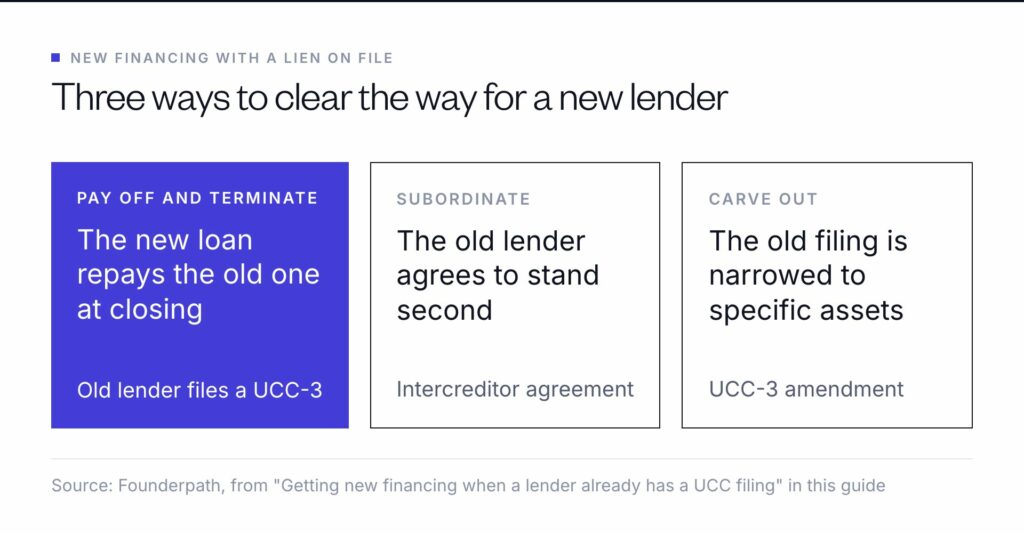
Three structures clear the way, and a new lender will usually name the one it needs:
- Pay off and terminate: the new loan repays the old one at closing, and the old lender files a UCC-3 termination. This is the cleanest option.
- Subordinate: the existing lender signs a subordination or intercreditor agreement and agrees to stand second, so the new lender ranks first despite filing later.
- Carve out: the existing lender amends its filing with a UCC-3 to release specific collateral, such as your receivables, so the new lender can take a first lien on them.
Check your current loan agreement before you shop for new money. Some forbid other secured debt, or require the existing lender’s consent, regardless of what the UCC records show.
How long does a UCC filing last?
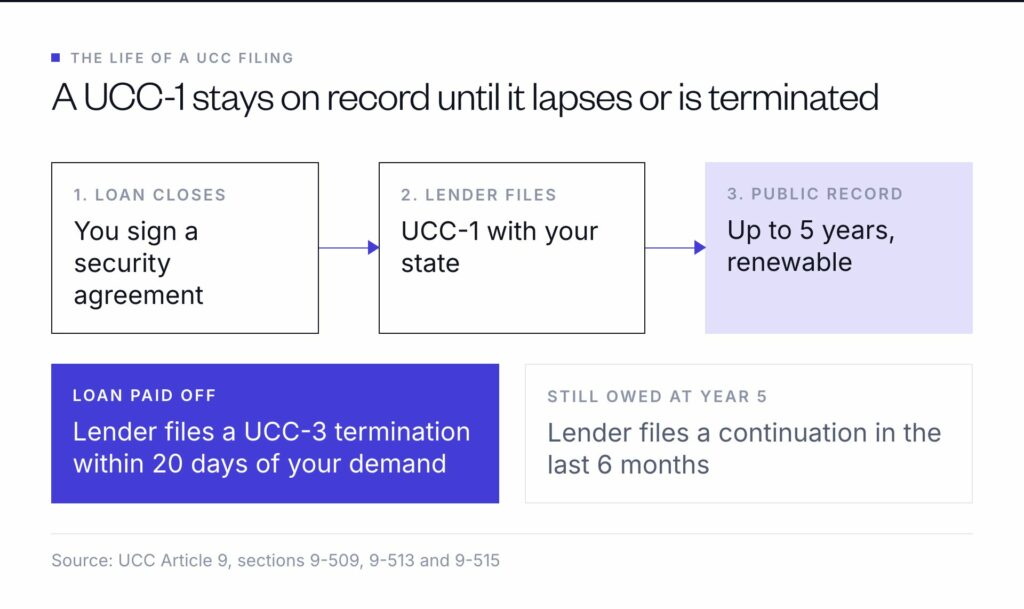
Five years. A financing statement “is effective for a period of five years after the date of filing”, and it lapses at the end of that period unless the lender files a continuation, which it can do “only within six months before the expiration”. Each continuation adds another five years (section 9-515). A lapsed filing no longer perfects the lender’s interest.
How to check UCC filings on your company
Search the filing office of the state where your company is organized. A registered organization “is located” in the state that formed it (section 9-307), so a Delaware corporation’s UCC filings sit in Delaware even if the whole team works in California. In most states the office is the Secretary of State; Florida has handed its registry to a private operator, the Florida Secured Transaction Registry (Florida Department of State).
Search the exact registered name, then any former names. New York warns that its public search “will not retrieve similar names or variants” (NY DOS). Searches are cheap or free: California’s portal lets you search by debtor name for free (California Secretary of State, 2020), and Texas charges $1 per web inquiry (Texas Secretary of State). Lenders run these searches constantly: Texas alone processed about 583,255 requests for UCC records in fiscal 2024, alongside about 662,323 filing transactions (Texas Secretary of State report, December 2024).
| State | File a UCC-1 online | File on paper | Official search |
|---|---|---|---|
| California | $5 | $10 (1-2 pages) | Free online; $5 per name certified |
| Delaware | $70 | $125 through an authorized filer (1-4 pages) | Not on the published fee page |
| Florida | $35 | $35 on current forms, $40 on older forms | Through the state’s registry operator |
| New York | $20 | $40 | $25 per debtor name |
| Texas | $5 | Not accepted since August 29, 2025 | $1 per web inquiry |
Business credit bureaus pick these records up too. Experian’s business credit reports “show any judgments, UCC filings or tax liens against your company” (Experian, 2023, updated 2025), so a lender or supplier checking your business credit may see a filing before you mention it.
How to remove a UCC filing
A paid-off loan does not clear the record by itself. To get a filing removed:
- Pay off the debt and ask in writing. Once nothing is owed and no further advances are committed, a lender that receives your signed demand must, “within 20 days”, send you a termination statement or file it (section 9-513). Ask for the UCC-3 in your payoff letter so it happens at closing.
- File the termination yourself if the lender doesn’t. When the lender fails that duty, the debtor may authorize and file the termination, as long as it says the debtor authorized it (section 9-509(d)).
- Know the penalty. A lender that fails to terminate owes $500 “in each case”, on top of damages that can include “the debtor’s inability to obtain, or increased costs of, alternative financing” (section 9-625).
- Challenge a filing you never authorized. A lender may file a UCC-1 only if you authorized it, and signing a security agreement counts as authorization (section 9-509). Against an unauthorized filing you can demand a termination, file a UCC-5 information statement to put your objection on record, though it “does not affect the effectiveness” of the filing (section 9-518), and claim the same $500.
These are the model rules; each state enacts its own version, and the 20-day rule has exceptions, including filings that cover receivables a business has sold outright rather than pledged, as in some revenue purchase agreements. For a filing you dispute, or a lien in the middle of a sale or a funding round, ask a lawyer to read the agreement.
Is a UCC filing bad?
No. It is the normal paperwork of secured borrowing, and a company with a bank loan or an equipment lease will usually have one. It does not mean you missed a payment. It becomes a problem in three situations:
- A blanket lien you no longer need blocks or prices up your next financing, because the new lender ranks second.
- A stale filing from a paid-off loan still shows up in a buyer’s or investor’s diligence until it is terminated or lapses.
- Several filings from cash-advance providers tell a lender that receivables are already pledged several times over, which can end the conversation.
The fix in each case is the same: know what is filed against your company, get terminations at every payoff, and negotiate the narrowest collateral description your lender will accept. For how secured lenders compare on rates, fees and covenants, see our guides to venture debt and revenue-based financing.
Founderpath and UCC filings
Founderpath provides non-dilutive capital for B2B SaaS companies with at least $10K MRR. There’s no equity, no warrants, no board seats and no personal guarantees. Connect your billing, banking and accounting data, and most founders see funds within 24-48 hours.
Like other lenders, Founderpath files a UCC-1 when it funds. As our comparison with Lighter Capital shows, revenue financing carries a first-position lien on future receivables and the bank account, and term loans a first-position lien on all business assets. Because there is no personal guarantee, the filing is against the business, not your house.
Check what you qualify for. It takes less than 5 minutes.
Frequently asked questions
Is a UCC filing the same as a lien?
Not quite. The lien, or security interest, is created by the security agreement you sign with the lender. The UCC-1 is the public notice of that lien, filed with the state so other creditors know about it. New York’s Department of State says a UCC-1 “is not an agreement”. In everyday use, people call both a UCC lien.
What does it mean if a company has a UCC filing?
It means a lender has a security interest in some or all of the company’s assets, usually because it lent money, leased equipment or bought receivables. The filing names the lender and describes the collateral. It says nothing about whether the company is paying on time.
How long does a UCC filing last?
Five years from the filing date. The lender can extend it by another five years by filing a continuation in the last six months before it lapses, under UCC section 9-515. A filing for a paid-off loan should be terminated earlier with a UCC-3.
Can a lender file a UCC without my permission?
No. Under UCC section 9-509 a lender may file a UCC-1 only if the debtor authorized it, but signing a security agreement counts as authorization. If a lender files without any authorization, you can demand a termination and recover $500 in statutory damages under section 9-625.
How do I remove a UCC filing after paying off a loan?
Send the lender a signed written demand. Once nothing is owed, it must send you a termination statement or file one within 20 days under UCC section 9-513. If it doesn’t, you may file the termination yourself, stating that you authorized it, and the lender owes $500 plus any losses.
Where are UCC filings recorded?
In the state where the company is organized, usually with the Secretary of State. A Delaware corporation’s filings are in Delaware even if its office is in California. A fixture filing, for equipment attached to a building, goes to the office that records mortgages on that property instead.
What is the difference between a UCC-1 and a UCC-3?
A UCC-1 is the original financing statement that starts the record. A UCC-3 changes an existing filing: it can continue it for five more years, terminate it, assign it to a new lender, or add or release collateral.
Does a UCC filing affect my business credit?
It can appear on it. Experian’s business credit reports show UCC filings against a company, so lenders and suppliers who check your business credit may see them. A filing is not a missed payment, but several open filings tell a lender your assets are already pledged.
Do merchant cash advance companies file UCC liens?
Usually, yes. A cash-advance provider buys a share of your future receivables and files a UCC-1 covering them, sometimes as a blanket lien on all assets. Check what a provider files before you sign, because a broad filing can block later financing until it is terminated.
Recent Articles

CARR vs ARR: What Contracted ARR Is and How It Differs
CARR is your ARR plus signed contracts that aren't live yet, minus churn notices. How to calculate CARR, how it differs from ARR, bookings and RPO, and how to report it honestly.

What Is a UCC Filing? What It Means When a Lender Files One
A UCC filing is a public notice that a lender has a lien on some or all of your business assets. What a UCC-1 contains, how long it lasts, how it affects new financing and how to remove one.

What Are Debt Warrants? How Venture Debt Warrants Work
Debt warrants give a lender the right to buy shares at a fixed price alongside a loan. How warrant coverage works, what it costs in dilution, and which lenders take warrants.