
On this page
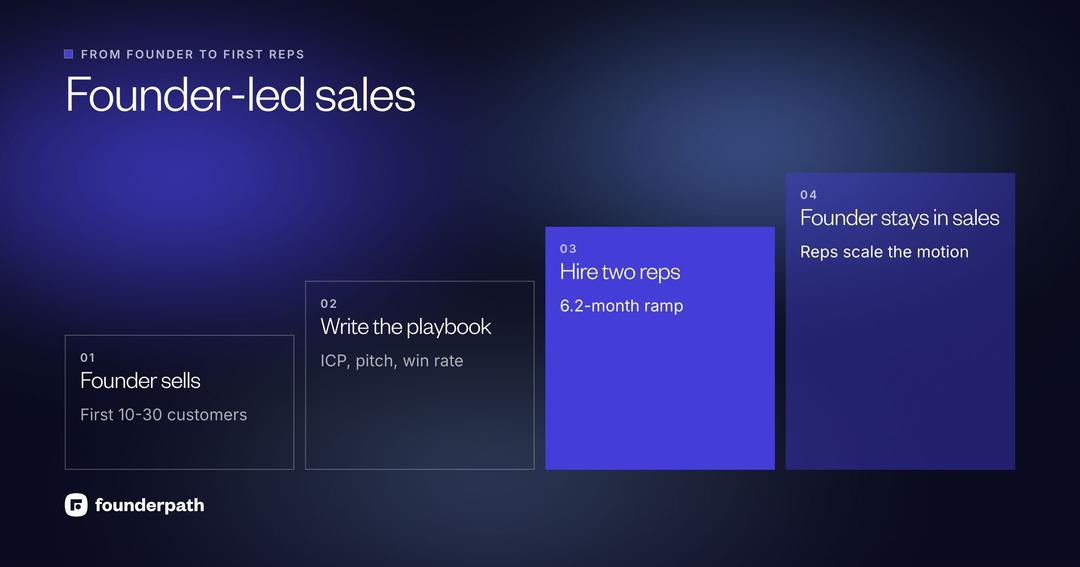
Founder-led sales is when a startup's founder personally sells to the first customers, from finding prospects to closing deals, to learn who buys, why and at what price. The founder hands the selling to hired reps once that sale repeats, usually after the first 10 to 20 customers and up to about 30, and stays involved in sales after the hand-off.
Key Takeaways
- SaaStr's Jason Lemkin advises closing the first 10 to 20 customers yourself, then hiring two sales reps rather than one (SaaStr, March 2025).
- Pete Kazanjy, author of Founding Sales, puts a good B2B win rate at 15% to 30% of first meetings, a number to know before anyone else sells for you.
- A new account executive takes 6.2 months on average to reach full productivity and earns $200K at target, and only 48% hit quota (Bridge Group, June 2026, 158 B2B companies).
- Adam Baker sold a company to about $500K ARR with one SDR, then hired seven go-to-market people at once and had to let them go; he now says to tick off a full checklist before the first sales hire (Founderpath NYC keynote, 2024).
- Pendo's Todd Olson, an engineer who had never sold, kept selling himself to stay close to customers and closed a $60K ARR deal when Pendo's largest before was about $1,500 (Founderpath talk).
Each section below gives the general answer first, then founders who made that decision, linked to the exact moment in their talk.
What founder-led sales is for
The guides that rank for this question agree on the definition. Founding Sales describes it as the way founders discover, refine and scale their product's first sales motion, and HubSpot as the founder becoming deeply involved in selling and sales strategy. In practice the founder does three jobs no hire can do yet:
- Learn the buyer. Who feels the problem badly enough to pay, who uses the product and who signs.
- Find the pitch and the price. Which words make a prospect lean in, which objections come up, and what a customer will pay.
- Change the product. A founder can hear an objection on Tuesday and ship the fix on Friday. A salesperson can only pass it on.
The goal is a sale that repeats: the same kind of customer, the same pitch and a predictable result. That is what you eventually hand to a rep. Most practitioners add that the founder never fully leaves. Growth Unhinged's founder-led sales framework argues that a founder never transitions out of sales; only the role changes.
Pendo's co-founder made the case for selling first even without any sales experience:
Early days you build a product, and conventional wisdom from other founders and board members [is] like, go hire a salesperson to go sell it. But I realized if I hired a salesperson that it was actually going to separate me from the feedback loops of working directly with customers. And while I am an engineer by training, honestly never carried a bag in my life, I decided that I had to overcome that inexperience and maybe a little bit of fear and go out there and pound the pavement myself and try to get those first few customers.
He walked the Dreamforce expo floor on a free pass collecting leads. When a prospect asked who would onboard them, at a company of four people, he promised a person on site by Monday and flew an engineer out. The contract was a $60K ARR deal when Pendo's largest before was about $1,500 ARR (watch at 3:41). A salesperson would not have made that promise, and that is the point: the founder can bend the company to win the deal and learn from it. Pendo is venture-backed, and Olson says so in the talk.
How to do founder-led sales
The steps are the same whatever you sell. What changes is how many calls it takes.
- Talk to your ideal customer before the product is done. Badger Maps founder Steve Benson says someone on the founding team, with ownership and a seat at the table, should get in front of hundreds of people who fit the ideal customer profile before you build a sales team, and ask each whether they would buy at a stated price (watch at 20:32). People are polite about an idea and honest about a price.
- Run every call yourself and log it. Put every lead, call and deal in a CRM from the first week. SaaStr's transition guide lists CRM setup among the basics to have before you hand off sales.
- Call it sales. Customer.io wanted to be fully self-serve, so when prospects emailed asking to talk, Colin Nederkoorn took the calls, qualified them and sent poor fits elsewhere. He says he did not realize at the time that this was sales. To scale it he hired salaried onboarding specialists who mostly took orders, and it took years to reach a sales team with account executives and a chief revenue officer. His advice to founders in the same spot is to call it sales (watch at 15:58).
- Write down what works. The pitch, the demo, the objections and your answers, and the questions that tell you a buyer is real. MRR Unlocked's guide recommends a named qualification framework such as SPICED or MEDDIC, applied to every deal.
- Track three numbers. Win rate, sales cycle length and average deal size. Pete Kazanjy, in the Holloway edition of Founding Sales, puts a good B2B win rate at 15% to 30% of first meetings or demos. In Ebsta and Pavilion's 2025 GTM Benchmarks, drawn from 655,000 opportunities at 387 companies in 2024, new business deals closed at a 19% win rate and took 91 days on average. Use the win rate calculator to get yours from your CRM.
When to hire your first sales rep
There is no single revenue number. SaaStr says the hand-off typically comes around $1M ARR, or when you can no longer handle the volume of leads yourself, while MRR Unlocked rejects revenue thresholds altogether and looks for capacity and repeatability instead. The sources do agree on the signals:
| Signal | What it looks like | Who says it |
|---|---|---|
| Customers you closed yourself | 10 to 20, up to a few dozen | SaaStr; Founding Sales |
| A defined ideal customer | You can name who buys, who uses and who signs | SaaStr; Founding Sales |
| A written playbook | Pitch, demo, objections, qualification questions | SaaStr; MRR Unlocked |
| A known win rate | 15% to 30% of first meetings | Founding Sales (Holloway) |
| A predictable cycle and deal size | You can forecast when a deal will close | MRR Unlocked |
| You are at capacity | Deals slip because you have no time to work them | MRR Unlocked; Founding Sales |
| Customers stay | Retention is good enough that new deals add up | Buildern's Hmayak Tigranyan (below) |
Sources: SaaStr, March 2025; Founding Sales and its hiring chapter; MRR Unlocked, May 2025.
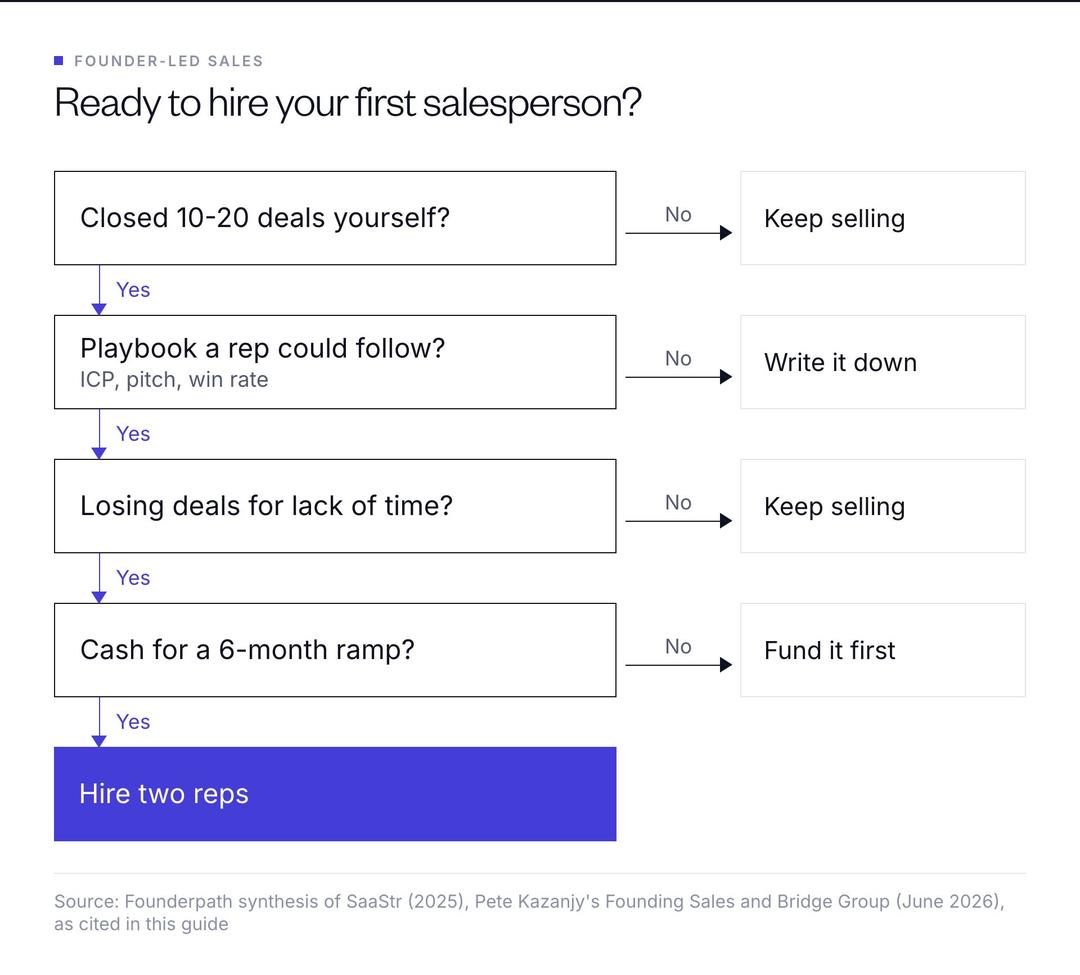
The four checks in order: deals closed yourself, a playbook a rep could follow, deals lost for lack of time, and cash for the ramp. Source: Founderpath, from the signals and Bridge Group figures in this guide.
Hiring before these are true is the most common way founder-led sales goes wrong. Adam Baker, now CEO of Dealpad, told the story at a Founderpath keynote. At a company he ran, he and one SDR grew sales to about $500K ARR. Then he hired a head of sales, two SDRs, two account executives and two marketers at once (watch at 4:20). Over the next 15 months revenue fell and he had to let the team go. He blames himself: the deals had closed on his relationships, and there was no defined ideal customer, no consistent use case and no playbook for anyone to follow (watch at 7:40). His advice now:
If you're a founder doing [founder-led] sales, before you hire your first salesperson, make sure every single one of that list is ticked off. And if it's not, don't hire anybody. Keep doing it yourself, because you will come unstuck. They will come unstuck.
He adds that it can take six months to a year before you realize a hire is not working, by which time the cost is spent.
The same mistake happens later, when a company moves into a new segment. Proposify sold self-serve to small businesses. After raising its first major round, Kyle Racki tried to go upmarket by hiring a sales team rather than selling the first larger deals himself:
I made also the mistake of basically just hire a team and a VP … to figure it out instead of trying to learn that myself and try to sell deals myself.
After a few false starts, he says, the team realized the product had to change significantly before larger businesses would buy. A founder selling those first deals would have heard that sooner.
Who to hire first
Hire account executives, not a VP of sales. A VP builds and manages a team, and there is nothing to manage until a sales motion works. SaaStr's guide to transitioning from founder-led sales (August 2025) puts the first account executives at around $1M to $2M ARR and the first head of sales at around $2M to $3M ARR for sales-led companies.
Hire two, not one. SaaStr and Dock both recommend it. With two reps you can tell whether a miss is the person or the playbook. With one, a bad hire looks like a bad market.
Decide which kind of first hire you want before you hire. Mark Kosoglow was Outreach's first sales hire and led its sales for years. He says most early companies he advises get this first hire wrong, and that there are three kinds (watch at 4:46):
- A seller, whose only job is to sell, with no product or board meetings.
- A head of sales, who sells but also builds the process and the team.
- A commercial co-founder, who helps run the business.
He adds that if your first sales hire cannot recruit the first team from people they already know, they should not be your first sales hire, unless all you want is a seller (watch at 6:41).
Hire people who already know the buyer. Buildern's Hmayak Tigranyan sold the product alone for over three years, with no salesperson, support or customer success team. When Buildern hired its first salespeople in early 2026, they came from the construction industry, so they already knew what to sell and how (watch at 14:03). He names good retention as the condition that makes sales reps worth it (watch at 15:03).
The exception: sellers you already trust. Richard White hired three of his best salespeople from his previous company, UserVoice, about a year before Fathom had a team product to sell. He put them in customer success to learn the product and the customers, so they could sell the day the product was ready (watch at 15:46). That works when the founder has proven sellers in their network and many active users to sell to. It is not the same as hiring a stranger to discover the sale.
How to set up the first rep to succeed
The first rep should scale a sale you have proven, not find one. Kyle Vamvouris, a sales consultant who builds playbooks for SaaS companies, describes the goal as a sales process you are so confident in that you can hire a rep, have them follow it and see them hit their number (watch at 0:32). Before the start date:
- Write the ideal customer profile and the playbook. The pitch, the demo flow, the top objections with your answers, and the qualification questions.
- Clean the CRM. Every open deal has a stage, a next step and a date. Vamvouris's rule of thumb is that a deal with no next step on the calendar does not exist (watch at 10:42).
- Set quota and pay from benchmarks. The Bridge Group's 2026 survey of 158 B2B companies found median on-target earnings of $200K for an account executive and a median quota of $875K at SaaS companies, about 4.6 times on-target earnings across the sample. Model your own plan with the sales commission calculator.
- Plan for the ramp. The same survey found it takes 6.2 months on average for a new account executive to reach full productivity, the longest in the study's history, and only 48% of reps hit quota. Buildern's numbers fit that range: Tigranyan describes a quota of about $1M in new ARR a year and on-target earnings of about $150K for its reps.
- Add reps against pipeline, not ahead of it. Kosoglow found that at around 25 active open opportunities, a rep's win rate and deal size fell and the sales cycle lengthened. He would push reps slightly past that number, then hire the next rep into the pipeline that already existed (watch at 9:05).
- Stay in the deals. Sit in on the first calls, keep a few strategic accounts and keep owning the numbers. Hiring a rep moves you from closing every deal to coaching and stepping in, not out of sales.
How to pay for the first sales hire
The first sales hire is a cash-timing problem. You pay the rep from the first day, but they take about six months to reach full productivity, and deals take months more to turn into cash. Check how long a rep's cost takes to come back with the payback period calculator before you commit. Steve Benson of Badger Maps makes the same point about financing it: even a salesperson does not pay back fast enough to fund with a one-year loan, so the term has to match the time the hire takes to pay off (watch at 19:34).
There are three ways to fund the ramp:
- From profits. No dilution and no repayment, but you can only hire as fast as the business already earns. Buildern reinvests its profit into new hires.
- Equity. SubBase was still mostly founder-led with almost 100 paying companies in 2024 (watch at 10:29). Eric Helitzer says the roughly $4M it raised in a seed round and a converted SAFE let it bring on a head of sales and invest more in go-to-market (watch at 13:55). Equity costs ownership and usually a board seat.
- Non-dilutive capital. Revenue-based financing and other non-dilutive funding advance cash against recurring revenue and are repaid from it, so you keep ownership and pay a fee instead.
Which one fits depends on how proven the sale is. Borrowing against revenue makes sense once you know your win rate, deal size and how long a rep takes to pay back; it is the wrong tool for finding out whether anyone can sell the product besides you. Apart from SubBase's funding round, the founders in this guide described their sales decisions, not how they paid for them, and nothing here says they used any particular kind of funding.
Founderpath provides non-dilutive capital for B2B SaaS companies with at least $10K MRR. There’s no equity, no warrants, no board seats and no personal guarantees. Connect your billing, banking and accounting data, and most founders see funds within 24-48 hours.
Check what you qualify for. It takes less than 5 minutes.
Frequently asked questions
What is founder-led sales?
It is when a startup's founder personally runs the early sales, from finding prospects to closing deals, to learn who buys, why and at what price. The founder hands the selling to hired reps once the sale repeats, and stays involved in sales after that.
How do you do founder-led sales?
Pick a narrow ideal customer and talk to as many of them as you can, ideally before the product is finished. Run every sales call yourself and log it in a CRM. Write down the pitch, the demo, the objections and the questions that qualify a buyer, and track your win rate, sales cycle and deal size.
When should a founder hire the first salesperson?
When you have closed the first 10 to 20 customers yourself, a rep could follow your written playbook, and you are losing deals because you have no time to work them. Also check that you can pay for about six months of ramp, the Bridge Group's 2026 average for an account executive to reach full productivity.
How do you transition from founder-led sales?
Hire two account executives rather than one, give them your playbook, sit in on their first deals and keep a few accounts yourself. Hire a head of sales only once both reps hit a basic quota. The founder stays the owner of revenue after the hand-off.
How many customers should a founder close before hiring a sales rep?
Jason Lemkin of SaaStr advises closing the first 10 to 20 customers yourself. Pete Kazanjy, author of Founding Sales, describes founder-led sales as roughly the first few dozen customers, up to about 30.
Should your first sales hire be an account executive or a VP of sales?
An account executive, usually two of them. A VP of sales builds and manages a team, which needs a working sales motion to manage. SaaStr's guide puts the first head of sales at around $2M to $3M ARR for sales-led companies, after two reps are hitting quota.
Should you hire one sales rep or two?
Two. With two reps you can tell whether a miss is the person or the playbook, and a single rep who fails can stall sales for months. SaaStr and Dock both recommend starting with two.
What is a good win rate for founder-led sales?
Pete Kazanjy puts a good B2B win rate at 15% to 30% of first meetings or demos. Ebsta and Pavilion's 2025 benchmarks, from 655,000 opportunities, found a 19% win rate on new business deals.
What is the best book on founder-led sales?
Founding Sales by Pete Kazanjy is the standard book on the subject. It covers selling the first few dozen customers yourself, then hiring and onboarding the first reps, and it is free to read online.
Sources and method
- Founder cases come from Founderpath’s own recorded interviews and talks. Each quote was checked against the transcript at the linked timestamp; quoted words keep the speaker’s order, with fillers removed and one clarification in brackets. Figures are as the speaker gave them in the talk. None of the cases is presented as having used Founderpath, and no founder’s growth is attributed to any kind of financing except where the founder says so.
- SaaStr, What are the best ways to transition from the founder-led sales stage?, Jason Lemkin, March 29, 2025, and The founder’s guide to transitioning from founder-led sales, August 20, 2025: practitioner advice, not a dataset.
- Pete Kazanjy, Founding Sales and the Holloway edition: practitioner benchmarks, including the 15% to 30% win rate.
- The Bridge Group, AE Models, Motions and Metrics 2026, published June 22, 2026: online survey of 158 B2B companies, medians unless noted.
- Ebsta and Pavilion, 2025 GTM Benchmarks: 655,000 opportunities at 387 companies, 2024 data, B2B across industries.
- MRR Unlocked (May 2025), Dock, HubSpot for Startups and Growth Unhinged (March 2025): the consensus definition and hand-off signals.
- The signals table, the decision tree and the set-up checklist are Founderpath’s own synthesis of these sources and cases.