Founderpath vs Liquidity Group
Founderpath offers revenue financing and term loans for software businesses; Liquidity Group offers private credit for growth-stage and mid-market companies. Compare the amount, repayment schedule and terms of your specific offers before choosing.
Sources checked October 12, 2026 · Published by FounderpathTL;DR
Start with the product, then the offer
As of October 2026, Founderpath publishes these figures on its term-loan and revenue-financing pages. Liquidity's column reflects its private-credit page reviewed on the same date. Advertised terms remain subject to underwriting.
| Feature | Founderpath | Liquidity Group |
|---|---|---|
| Capital amount | RPA typically up to $1.5M per round; term loans $500K-$10M. | Advertised deployments of $10M-$200M. Confirm program fit directly. |
| Company stage | RPA: roughly $1M-$3M ARR. Term loans: roughly $3M+ annual revenue. | Growth-stage and mid-market companies. |
| Pricing | RPA from 7% discount; term loans from 15% interest. These are different pricing methods. | Request deal-specific pricing. No standardized rate card found on the page reviewed. |
| Repayment | RPA: fixed monthly payments. Term loans: up to 48 months, with interest-only periods up to 24 months. | Term loans, revolving working-capital facilities, MRR lines and acquisition financing. Confirm the schedule in your offer. |
| Equity and security | Product FAQs state no equity, warrants or board seats; no full personal guarantee; lien on business assets. | Confirm equity rights, guarantees and security in the financing documents. |
Founderpath's product pages also show a general $500K last-year revenue eligibility block. Product targets and application thresholds are different from approval. Confirm which criteria apply to your business instead of treating a single revenue figure as a promise of funding.
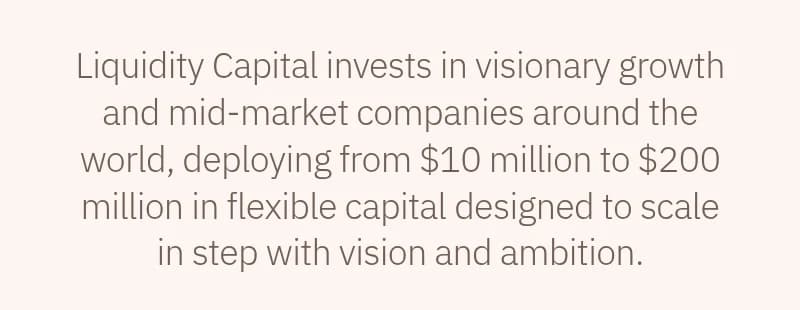
The capture below shows how Liquidity states its range: Liquidity Capital invests in growth and mid-market companies around the world, deploying $10 million to $200 million in flexible capital.
Size and price move together. Gary Guseinov, who funds RealDefense acquisitions with bank debt, described how lenders size debt against EBITDA and what changes when a company asks for more:
“Now, there are certain funds out there who invest or lend into scale. So if you say, hey, yes, my metrics are 4,000,000 of EBITDA, and I'm growing really fast, I want to borrow seven times, 10 times. There are lenders that'll do that. They'll probably want to take some equity as part of their compensation. Their rates might be higher, and their term might be short.”
He was describing the lending market in general, not either provider. Ask each lender how a larger request changes its pricing, term and any equity component.
$280M wired across 759 funded deals
From Founderpath's live statistics. Latest deal record updated October 15, 2026.
What to confirm before signing
Requested amount
A request above Founderpath's advertised term-loan ceiling may warrant a conversation with Liquidity. A smaller request does not prove Liquidity would decline it. Ask each provider about its current programs.
Contract obligations
Compare fees, collateral, guarantees, covenants, any equity rights and assignment provisions in the proposed agreement. Founderpath's product FAQs say no full personal guarantee and a lien on business assets; do not read that as an absence of all obligations.
Cash flow and timing
Review each payment, including any step-up after interest-only months. If an offer uses a floating rate, check its benchmark, floor and reset rules. Compare offer issuance, documentation and cash funding as separate milestones.
Covenants deserve the same scrutiny as the rate. Joe Hyrkin, CEO of Issuu, described what happened after Issuu missed a revenue covenant with an earlier lender, which he did not name:
“We knew we would have to pay a penalty and increased interest. All that was fine. That wasn't the predatory part. [The] predatory part came in when we agreed verbally to change the covenant terms moving forward. And this firm continued to negotiate with us after we had verbally agreed, and kept squeezing and adding in more and more terms to the point where they started to demand … at one point an additional point in the company for each month that we didn't refinance the business.”
Issuu refinanced with another lender before most of those penalties applied. Ask each provider what happens if you miss a covenant, and get any amended terms in writing.
Compare cash repayment scenarios
Start with an illustrative $500,000 advance over 24 months. Enter your written offer's nominal annual interest rate and interest-only period to add a comparison. No Liquidity rate or repayment schedule is assumed.
Your entered loan scenario
Enter a nonnegative rate and whole interest-only period shorter than the total term. This is a model of your inputs, not a Liquidity quote.
Founderpath RPA illustration
Modeled over 24 months- Total cash repayment
- $581,395.35
- Cost above advance
- $81,395.35
- Monthly payment
- $24,224.81
7% annual discount on purchased receivables; fixed monthly payments.
Founderpath term loan illustration
Modeled over 24 months- Total cash repayment
- $581,839.78
- Cost above advance
- $81,839.78
- Monthly payment
- $24,243.32
15% annual interest; fully amortizing from month one. No interest-only period modeled.
Starting rates are from Founderpath's RPA page and term-loan page, checked October 12, 2026. The official workbook calculates RPA payback as cash / (1 - annual discount × months / 12). These are illustrative starting-rate scenarios, subject to underwriting, not matched offers.
Loan interest is modeled at the entered annual rate divided by 12, held constant, with full amortization after any interest-only period. Fees, rate resets, benchmark floors, day-count differences, early repayment and balloons are excluded. This is not an APR or all-in cost calculation.
Warrants are excluded from cash repayment. Coverage is not a cash fee or an ownership percentage; review the strike price, share count, expiry and dilution separately. See EY's September 2025 financing guide.
Provider statements, with limits stated
Founderpath publishes this comparison and offers financing. Product claims here are dated first-party statements, not independent audits. We did not find a standardized rate card on Liquidity's private-credit page reviewed for this comparison. We have not reviewed a borrower contract from Liquidity and do not estimate its rates, warrants or guarantees.
- Liquidity Group: private credit
Undated page, retrieved October 12, 2026. Advertised deployment range, company stage, term loans, revolving working-capital facilities, MRR lines, acquisition financing and customer-testimonial bands.
- Founderpath: term loans
Undated page, retrieved October 12, 2026. Starting interest, size, repayment term, interest-only period and security wording.
- Founderpath: revenue financing
Undated page, retrieved October 12, 2026. Starting discount, product target, typical per-round amount and monthly repayment.
- Founderpath: receivables purchase workbook
Reviewed October 12, 2026. Annual discount applied to purchased receivables; calculator results are mathematical illustrations.
Liquidity Group provides private credit for growth-stage and mid-market companies. As of October 2026, its private-credit page advertises term loans, revolving working-capital facilities, MRR lines and acquisition financing. Source
No universal minimum is established by the sources reviewed. Liquidity advertises $10M-$200M deployments as of October 2026, but a customer-testimonial card attributed to Gushcloud on that page shows a $5-$20M band. Ask about current program eligibility. Source
As of October 2026, Founderpath advertises term loans of $500K-$10M and RPA funding typically up to $1.5M per round. These are advertised amounts, not guaranteed approvals; the available amount depends on underwriting. Source
No. Founderpath advertises these starting rates as of October 2026, but they use different bases. Its workbook applies the annual RPA discount to purchased receivables. A loan model applies interest to outstanding principal. Compare cash flows over the same term, including actual fees. Source
As of October 2026, Founderpath product FAQs state no equity, warrants or board seats, no full personal guarantee and a lien on business assets. Review the proposed agreement for the exact security and guarantee obligations. Source
No. It only models the interest rate and repayment schedule you enter, alongside illustrative Founderpath starting-rate scenarios. Fees, future rate changes, balloons and warrant dilution are excluded. It does not determine eligibility or which offer is best. Source
Compare an actual Founderpath offer.
Request capital