Stripe CapitalReview: Rates, Terms & Alternatives
If you're reading Stripe Capital reviews or comparing Stripe Capitalalternatives, this guide breaks down the invitation-only daily-Stripe-sales-sweep structure, the 8%–19.99% flat-fee pricing range that Stripe documents in its Capital for Platforms docs, the US 60-day minimum auto-debit rule, the $250K max on Stripe's own Fixed Term Loan, and the best Stripe Capital alternatives. Founderpath offers three direct alternatives: a Merchant Cash Advance (% of monthly sales repayment), a Revenue Purchase Agreement (fixed daily / weekly debits, no processor lock-in), and a Term Loan (fixed monthly) — all with published starting rates from 7% / 14% APR and an open application.
Compared in this guide







Quick Cost Comparison
Save $10,000 on total cost with Founderpath RPA + cut monthly burden ~$9,064/mo via Term Loan
Stripe at 12.0% / 12mo: $622/day Stripe sweep, $18,667/mo cash burden. FP RPA: $17,833/mo (12mo, same structure). FP TL: $9,603/mo over 24mo.
See full breakdown ↓TL;DR
What is Stripe Capital?
Stripe Capital is the small-business financing product offered by Stripe to its payment-processing customers. Launched September 5, 2019 per the Stripe newsroom announcement and TechCrunch, it offers two flavours of capital: term loans (issued in the US by Celtic Bank, an FDIC-insured Utah industrial bank) and merchant cash advances (provided by YouLend in the US, UK, France, and Germany; by Fundbox in Australia per the September 2025 launch announcement). Per Stripe's own customer-revenue-impact study (Feb 2020–May 2021), Stripe Capital users grew revenue 114 percentage points faster than peer baseline; sub-$100K-revenue users grew 140 percentage points faster; only 5.5% of Capital customers had previously received a traditional bank loan.
Stripe Capital prices each advance as a single fixed fee on the principal with no interest, no late fees, no origination fees, and no prepayment penalty per the Stripe Capital documentation. The Capital for Platforms documentation discloses an 8%–19.99% fee range across its Flex Loan and Fixed Term Loan products, with a $250,000 USD maximum loan size. The marketing examples on stripe.com/capital show 10% fees on €15K / €20K / €25K offers. Repayment is automated as a fixed percentage of daily Stripe sales (Stripe's own examples show 9%, 12%, or 15% payment rates); in the US a minimum payment is due every 60 days, and if the daily sweep falls short Stripe auto-debits the linked bank account on day 60.
Founders compare Stripe Capital alternatives mainly on four axes: the inability to apply (Stripe Capital is invitation-only — Stripe surfaces an offer in the Dashboard when its model qualifies you, with no way to negotiate the fee or amount), payment-processor lock-in (eligibility requires Stripe processing volume, so any business collecting through Shopify Payments, Chargebee, Recurly, Paddle, or Adyen does not qualify), the US 60-day minimum auto-debit on the linked bank account, and the inverse-APR-to-speed structure of the flat-fee model (faster repayment makes the effective rate worse, not better). Founderpath offers the same purchase-of-future-receivables structure for SaaS, ecommerce, and recurring-revenue founders globally with an open application, published starting rates, and a processor-agnostic underwriting model.
How Stripe Capital Works
Stripe Capital is invitation-only. There is no application form on stripe.com — Stripe recalculates eligibility daily based on payment-processing volume, history, growth trajectory, chargeback rate, customer-base size, and other underwriting signals per the Stripe Capital overview documentation. When the model identifies a qualifying account, Stripe surfaces an offer in the Stripe Dashboard (and email). The borrower can accept the single pre-set offer (principal + flat fee + payment rate) or decline. There is no way to compare or negotiate. If you were previously declined, you are ineligible for a new offer for 30 days (US) or 90 days (UK, France, Germany, Australia).
Pricing is a single fixed feeapplied to the principal — not an APR, not a factor rate, no compounding. Stripe's Capital for Platforms documentation discloses a 8%–19.99% premium range across the Flex Loan and Fixed Term Loan products. The marketing examples on stripe.com/capital show 10% fees: €15,000 advance → €1,500 fee; €20,000 → €2,000; €25,000 → €2,500. Independent third-party reviews on Finder estimate factor rates between 1.06 and 1.20 (i.e. 6%–20% flat-fee equivalent) with effective APRs between roughly 10% and 45% depending on payback speed.
Repayment is automated as a fixed percentage of daily Stripe sales — Stripe's own examples on the /capital landing page show 9% or 15% payment rates. There is no fixed term: payback speed depends entirely on Stripe sales volume. The Fixed Term Loan offered through Capital for Platforms is structured as a 42-week (~10-month) repayment with fixed weekly payments; third-party reviewers (United Capital Source) cite a typical 6–18-month payback range for the variable-rate Flex Loan.
A critical structural rule on US loans: a minimum payment is due every 60 days. Per Stripe's docs, if the daily sweep doesn't cover the minimum by the end of the 60-day window, Stripe automatically debits the linked bank account for the shortfall. Stripe's own example: a $20,000 Flex Loan at a 15% payment rate carries a minimum payment of $2,444.45 every 60 days. In France and Germany the agreement adds a minimum weekly repayment obligation on top of the periodic minimum. This means a slow-sales month can trigger a surprise bank-account debit, not just slower payback.
Because the same fixed fee is owed regardless of payback speed, the effective APR varies inversely with how fast you repay. A $200,000 advance at a 12% flat fee repaid in 18 months ≈ ~15% effective APR; in 12 months ≈ ~22%; in 6 months ≈ ~40% (PV bisection). At launch in September 2019, Stripe co-founder Patrick Collison addressed this on Hacker News acknowledging that the flat-fee model trades off APR transparency for predictable total cost. Operationally there's no penalty to pay early, but no savings either.
Why Founders Look for Stripe Capital Alternatives
Founderpath offers the same purchase-of-future-receivables structure as Stripe Capital — our Revenue Purchase Agreement is the equivalent product, with fixed daily or weekly debits and no processor lock-in. The reasons founders compare the two are application access, processor-agnostic eligibility, pricing transparency, and the 60-day auto-debit rule — not the underlying capital structure.
- 1.You can't apply for Stripe Capital.Stripe Capital is invitation-only — the offer arrives in your Stripe Dashboard or it doesn't. Many SaaS founders never see an offer because their Stripe processing volume signals don't match the underwriting model. Founderpath uses an open application: connect your billing platform and receive an offer in under 24 hours.
- 2.Processor lock-in. Stripe Capital eligibility is computed entirely from Stripe payment-processing data — if you collect through Shopify Payments, Chargebee, Recurly, Paddle, Adyen, or Braintree, you do not qualify. Founderpath is processor-agnostic and integrates with Stripe, Chargebee, Recurly, Paddle, Maxio, and others.
- 3.The 60-day minimum auto-debit.US Stripe Capital loans carry a minimum payment due every 60 days; if your daily Stripe sweep falls short, Stripe debits your linked bank account for the shortfall on day 60. France and Germany add a minimum weekly repayment obligation. Founderpath's RPA debit amount is fixed up front in dollars per day or per week, with no shortfall recalculation and no surprise bank-account debit.
- 4.Lower starting fee with a transparent per-year rate.Stripe Capital's Platforms documentation discloses 8%–19.99% flat fee. Founderpath's Revenue Purchase Agreement starts at a 7% flat discount fee scaling per year, published directly on the Founderpath product page.
- 5.Longer terms reduce monthly cash burden.Stripe Capital's Fixed Term Loan runs 42 weeks (~10mo) and Flex Loans typically repay in 6–18 months. Founderpath's RPA runs up to 36 months and the Term Loan up to 48 months. On a $200K advance, Stripe at a 12% fee over 12 months ≈ $18.7K/month cash burden; Founderpath's Term Loan at 14% APR over 24 months ≈ $9.6K/month — roughly half the monthly cash going out the door.
- 6.Inverse-APR-to-speed.Because Stripe's fee is flat, faster repayment produces a higher effective APR, not a lower one. Founders who beat their projected payback pay more in effective-rate terms. Founderpath's Term Loan is structured as a true APR — repaying early saves you on interest with no prepay penalty.
- 7.Three products in one shop.If your business has seasonal cash flows and you prefer to pay back as a percentage of future monthly sales, Founderpath's Merchant Cash Advance is structurally closest to Stripe Capital's daily-sweep model (just monthly instead of daily and with no processor lock-in). If you want a fixed daily / weekly debit at a published starting rate, that's the RPA. And if you want predictable fixed monthly payments, that's the Term Loan.

Why bootstrapped SaaS founders choose Founderpath— “I'd spent 12 years looking for a fair, transparent debt funding option for my SaaS. The terms are fair, the focus on bootstrapped SaaS founders is unwavering. I feel like I have a financier in my corner.” — Chris Taylor, Canada
Founderpath offers three direct alternatives
Founderpath has three capital products that map to Stripe Capital's repayment structure. Pick whichever schedule fits your cash plan — all funded in under 24 hours with published starting rates, no Stripe processor lock-in, and no 60-day minimum auto-debit:
- →Merchant Cash Advance — for businesses with seasonal cash flows that prefer paying back as a percentage of future monthly sales. Structurally closest to Stripe Capital's daily-sweep model with no processor lock-in and a monthly (not daily) cadence.
- →Revenue Purchase Agreement (RPA) — same legal structure as a Stripe Capital MCA (purchase of future receivables) with fixed daily or weekly debits on a set dollar schedule, priced at a 7% starting flat fee scaling per year vs Stripe's 8%–19.99% range, with terms up to 36 months for lower monthly cash burden.
- →Term Loan — fixed monthly payments at 14% APR starting, terms up to 48 months, no prepayment penalty (save on interest by repaying early — the structural inverse of Stripe's flat fee).
Founderpath funds SaaS and ecommerce founders globally — including all Stripe Capital markets (US, UK, France, Germany, Australia) plus additional jurisdictions where Stripe Capital is not available — with native integrations to Stripe, Chargebee, Recurly, Paddle, and Maxio.
Top 6 Stripe Capital Alternatives
Here are the best Stripe Capital alternatives for SaaS, ecommerce, and DTC founders in 2026.
# | Company | Best For | Pricing | Application |
|---|---|---|---|---|
1 | Founderpath | MCA + RPA + Term Loan — SaaS / ecommerce worldwide, any processor | From 7% RPA flat fee or 14% APR Term Loan | Open, under 24hr |
2 | Capchase | SaaS subscription advances | ~10–12% flat discount fee, 3–24mo fixed monthly | Open, 48hr |
3 | Clearco | Ecommerce daily-sweep MCA | ~8–14% flat fee, 50% daily sweep | Open, 2–5 days |
4 | Wayflyer | Ecommerce / DTC short-term | 5%–10% fixed fee over 3–9mo | Open, 24hr–3 days |
5 | Lighter Capital | Early-stage SaaS RBF | 1.35x–2.0x repayment cap | Open, 2–4 weeks |
6 | Bigfoot Capital | $1M–$5M ARR SaaS term loans | Custom term loans, no warrants | Open, 4–6 weeks |
Founderpath is the only Stripe Capital alternative on this list that combines a merchant cash advance, a revenue purchase agreement, and a term loan with an open application, processor-agnostic underwriting, no minimum-payment auto-debit rule, and published starting rates. Founderpath has funded SaaS and ecommerce founders globally with over $281M in non-dilutive capital across 760+ deals.
Many founders comparing Stripe Capital also evaluate Founderpath vs Capchase, Founderpath vs Clearco, Founderpath vs Wayflyer, and Founderpath vs Lighter Capital.
Pros and Cons of Stripe Capital
Pros
 One-click funding for existing Stripe merchants. No separate application — if Stripe has determined you qualify, the offer is in your Dashboard and funds typically arrive within one business day.
- No interest, no late fees, no origination, no prepayment penalty.The total cost is a single fixed fee that doesn't move per Stripe's documentation.
- No credit check on the soft-offer review. Underwriting uses Stripe transaction data — the initial pre-offer review does not impact personal credit (UK acceptance triggers a hard credit check).
- No US personal guarantee in published docs.US loans use a UCC-1 security interest on business assets; published docs don't require a PG (UK / FR / DE / AU do require a PG from ≥25% owners).
- Sales-flex repayment. If Stripe sales drop, the daily sweep drops with them (though the US 60-day minimum still applies).
- Trusted operator at scale.Stripe Capital users grew revenue 114 percentage points faster than peer baseline per Stripe's own customer-revenue-impact study (Feb 2020–May 2021).
Cons
 Invitation-only.Cannot apply, cannot shop, cannot negotiate. If Stripe doesn't surface an offer, there's no remediation path beyond waiting and processing more volume.
- Stripe processor lock-in. Eligibility requires Stripe payment volume. If you collect through Shopify Payments, Chargebee, Recurly, Paddle, Adyen, or Braintree, Stripe Capital is not available regardless of business health.
- 60-day minimum auto-debit. US loans require a minimum repayment every 60 days. If your daily Stripe sweep falls short, Stripe auto-debits the linked bank account on day 60 — a slow-sales month can trigger a surprise debit.
- Higher starting fee than peers.8%–19.99% per Stripe Capital for Platforms docs vs Founderpath's 7% RPA starting fee scaling per year.
- Inverse-APR-to-speed. Faster repayment = higher effective APR. The better your sales, the worse the annualised cost.
- Pricing not published on the marketing page.The 8%–19.99% range is only documented in Capital for Platforms; direct-merchant pages show only generic “single flat fee” language.
- Geography limits. US, UK, France, Germany, Australia (launching) — Canada and most other markets are not supported.
What Is the Best Stripe Capital Alternative?
The best Stripe Capital alternative for SaaS, ecommerce, and recurring-revenue founders is Founderpath — because Founderpath offers three direct alternatives that map to Stripe Capital's repayment structure with an open application, processor-agnostic eligibility, and no 60-day minimum auto-debit.
Founderpath's Merchant Cash Advance pays back as a percentage of future monthly sales — structurally closest to Stripe Capital's daily-sweep model with no processor lock-in. The Revenue Purchase Agreement (RPA) is the same legal structure as a Stripe Capital MCA (a purchase of future receivables) with fixed daily or weekly debits on a set dollar schedule — pricing starts at a 7% flat discount fee scaling per year vs Stripe's 8%–19.99% range, with terms up to 36 months for lower monthly cash burden. The Term Loan starts at 14% APR with fixed monthly payments and terms up to 48 months — repaying early actually saves you on interest, the opposite of Stripe's flat-fee structure.
Founderpath publishes starting rates on its product pages, has no daily-sweep mechanism and no minimum-payment auto-debit rule, funds in under 24 hours, and serves SaaS and ecommerce founders globally — including all Stripe Capital markets and additional jurisdictions where Stripe Capital is not available.
Stripe Capital Pricing Explained
Stripe Capital prices each advance as a single fixed feeon the principal — not an APR, not a factor rate, no compounding. The same fee is owed regardless of payback speed, and there are no origination, late, monthly, or maintenance fees beyond it per Stripe's documentation.
Stripe's public pricing disclosures are split across two pages. The stripe.com/capital marketing page shows three example offers — €15,000 / €1,500 fee; €20,000 / €2,000; €25,000 / €2,500 — all 10% flat. The Capital for Platforms documentation discloses the actual pricing range in its Flex Loan / Fixed Term Loan comparison table: 8%–19.99% premiumon the principal, with a $250,000 USD maximum loan size. There is no separate published rate card for direct merchants — pricing is set algorithmically per offer based on Stripe's underwriting model.
Because the same fixed fee is owed regardless of payback speed, the effective APR is highly sensitive to term length. On a $200,000 advance at a 12% flat fee (mid-range of Stripe's 8%–19.99% disclosed range): repaid in 18 months ≈ ~15% effective APR; in 12 months ≈ ~22% effective APR; in 6 months ≈ ~40% effective APR (PV bisection). Founders with strong daily Stripe sales who repay quickly are penalized on effective rate, not rewarded.
By comparison, Founderpath publishes starting rates directly on its product pages with no speed-penalty effect. The Revenue Purchase Agreement starts at a 7% flat discount fee scaling per year — same purchase-of-receivables structure as Stripe Capital but with a fixed daily / weekly debit instead of a percentage-of-Stripe-sales sweep. The Term Loan starts at 14% APR with fixed monthly payments — and you save on interest by repaying early. And the Merchant Cash Advance pays back as a percentage of future monthly sales for businesses with seasonal cash flows.
Is Founderpath Cheaper Than Stripe Capital?
On total cost across the entire 8%–19.99% Stripe fee range, yes — Founderpath's Revenue Purchase Agreement (same purchase-of-receivables structure) is cheaper. On monthly cash burden, the 24-month Founderpath Term Loan saves roughly half the monthly outflow at typical loan sizes.
The structural difference. Stripe Capital's fee is flat regardless of speed— a 12% fee on a 6-month payback is the same 12% as on an 18-month payback (which is why faster payback makes Stripe's effective APR worse, not better). Founderpath's RPA fee scales per year — 7% on a 12-month term, 14% on a 24-month term, etc. The flat-fee engine that penalizes Stripe customers for repaying early is the same engine that lets Founderpath offer longer terms at a transparent linear rate.
Scenario: $200K advance, 12% mid-range Stripe Capital fee, implied 12mo payback.
- Stripe Capital, ~12-month payback at 12% fee: total $224,000, monthly cash burden $18,667/mo (variable — percentage-of-Stripe-sales daily sweep), ~22% effective APR.
- Founderpath RPA, 12-month term (same purchase-of-receivables structure): total $214,000, monthly cash burden $17,833/mo — about $10,000 cheaper on total dollar cost, with a known fixed daily / weekly debit schedule (no daily Stripe-sales sweep, no 60-day minimum auto-debit).
- Founderpath Term Loan, 24-month fixed monthly: total ~$230,500, monthly $9,603/mo— roughly half the monthly cash burden of Stripe Capital. Total cost is higher than the 12-month RPA, but the Term Loan saves you on interest if you repay early; Stripe's flat fee does not.
The 60-day auto-debit matters more than the fee.Stripe's minimum-payment rule means a slow-sales month can trigger an unexpected bank-account debit — Stripe's own example shows a $20K Flex Loan at 15% payment rate carries a $2,444.45 minimum every 60 days. If your daily Stripe sweep falls short of that, Stripe debits the linked bank account on day 60. Founderpath's RPA debit is a fixed dollar amount per day or per week, known up front, with no shortfall recalculation. For founders with lumpy revenue or seasonal patterns this matters more than the headline rate.
Where Stripe Capital's fee floor competes.At Stripe's 8% floor on the same 12-month payback, total cost is $216K — only $2K above the FP RPA 12mo $214K. Monthly burden is $18K/mo at Stripe vs $17.8K/mo on FP RPA 12mo (or $9.6K/mo on FP TL 24mo). The Founderpath RPA still wins on total dollar cost across the entire 8%–20% range; the structural differences (open application, processor-agnostic, no 60-day auto-debit, longer terms) matter as much as the fee delta. Run your own numbers in the calculator below.
Stripe Capital vs Founderpath Cost Calculator
Estimate the cost of a Stripe Capitaladvance side-by-side with Founderpath's two products: the Revenue Purchase Agreement (same purchase-of-receivables structure as Stripe Capital, 7% starting fee scaling per year, fixed daily / weekly debit) and the Term Loan (fixed monthly, 14% APR). Pick an advance amount, fee percentage, and implied payback term.
Stripe Capital Inputs
Models a Stripe Capital advance: single fixed fee × principal, repaid via a fixed % of daily Stripe sales, with a US minimum payment due every 60 days.
Advance Amount ($)
12.0%
12 months
Side-by-side Cost Comparison
Founderpath's RPA uses the same purchase-of-future-receivables structure as Stripe Capital with a fixed daily / weekly debit at a 7% starting fee, or stretch with the Term Loan to 24 months for fixed monthly payments.
Stripe Capital (12.0% fee, ~12mo payback)
$224,000
$24,000
$622/day
$18,667/mo
21.5%
Founderpath RPA (12mo, 7%/yr flat fee — same MCA structure, no processor lock-in)
$214,000
$14,000
$4,115/wk
$17,833/mo
Founderpath Term Loan (24mo, 14% APR — fixed monthly, no daily sweep)
$230,462
$30,462
$9,603/mo
Fixed monthly
$10,000
in total cost — fixed daily / weekly debit, no Stripe payout lock-in, no 60-day minimum auto-debitStripe Capital cost is modeled as a single fixed fee (8%–19.99% per Stripe Capital for Platforms documentation) on the principal, repaid via a fixed percentage of daily Stripe sales until the total is satisfied. Marketing examples on stripe.com/capital show 10% fees. Fee range anchored to Stripe's own published 8%–19.99% disclosure; effective APR estimated via present-value bisection and matches Finder's reported ~10%–45% range depending on payback speed. Founderpath RPA modeled at 7% per year scaling with term; Founderpath Term Loan assumes a conservative 14% APR — Founderpath's actual published starting rate, with no origination fee. Actual terms may vary.
Disclaimer: This calculator is for illustrative and educational purposes only. It does not represent an actual Stripe Capital offer, quote, or financing term. All figures are hypothetical estimates based on publicly available information and user-provided inputs. Actual Stripe Capital terms may differ significantly. Founderpath is not affiliated with Stripe Capital or Stripe and makes no representations about Stripe Capital's current pricing or terms. Consult directly with any financing provider before making decisions.
Stripe Capital Reviews (2026)
Stripe Capitaldoes not have a dedicated Trustpilot or G2 profile separate from Stripe's parent payment-processing product. Stripe overall maintains a Trustpilot rating in the 2.2–3.3 / 5 range across roughly 15,000 reviews — but the vast majority of those reviews concern Stripe Payments (account holds, processor disputes, chargebacks), not Stripe Capital specifically. The most thorough early discussion of Stripe Capital's effective-APR mechanics is the launch-day Hacker News thread from September 2019, in which Stripe co-founder Patrick Collison responded directly to critiques about the inverse-APR-to-speed structure.
Independent reviewers (Finder, United Capital Source, AdvancePoint) consistently flag the same themes: high effective APR despite the “no interest” framing, no ability to negotiate or shop, cash-flow strain from automatic daily sales sweeps, the 60-day minimum auto-debit hitting during slow periods, and the inability to choose loan amount. Praise concentrates on speed (1–2 business day funding), no separate application, no late fees, no prepayment penalty, no US personal guarantee in published docs, and the simplicity of a fixed total cost.
By comparison, Founderpath holds a 4.9 / 5 rating across 100+ verified Trustpilot reviews from SaaS founders specifically. Reviews are searchable on Founderpath's Trustpilot page.
What Founders Say About Founderpath

David Tabachnikov
Founder of ScholarshipOwl
After Trying All the RBF Platforms, Founderpath Had the Best Terms
“After trying all the RBF platforms out there, we found FounderPath to be the best one to work with, having the best terms, and also giving us added value that nobody else could. FounderPath also worked with us to help us resolve our unique situation, and make our payment more predictable and flexible. With FounderPath, it's not just the money — it's being part of a financial support network.”

Jacob Wright
Founder of Dabble
Longer terms than others, & a personal touch
“Founderpath has been the best experience. You aren't just dealing with a sales rep who then hands you off to someone else. Founderpath has a more personal touch. They also have longer and more flexible terms, allowing you to pay off early if needed without penalty like the others. Overall, a great experience.”
Stripe Capital vs Founderpath: Full Comparison
Based on Stripe's public website materials (stripe.com/capital), the Stripe Capital documentation (docs.stripe.com/capital/how-stripe-capital-works, docs.stripe.com/capital/how-capital-for-platforms-works, docs.stripe.com/capital/overview), Stripe newsroom posts, independent press coverage (TechCrunch, PYMNTS), and third-party reviews (Finder, United Capital Source, Hacker News).
Feature | Stripe Capital | Founderpath RPA | Founderpath Term Loan |
|---|---|---|---|
Legal structure | US loans: term loans issued by Celtic Bank. US MCAs / UK / FR / DE: purchase of future receivables via YouLend. AU: Fundbox (in launch) | Purchase of future receivables (not a loan) | Senior secured term loan |
Repayment type | Fixed % of daily Stripe sales (Stripe examples: 9%, 12%, or 15% payment rate), variable as sales flex | Fixed daily or weekly debits on a set dollar schedule (not processor-tied) | Fixed monthly payments |
Pricing model | Single fixed fee 8%–19.99% per Stripe Capital for Platforms docs; 10% example on stripe.com/capital — flat regardless of speed, so faster repayment produces a higher effective APR, not a lower one | From a 7% flat discount fee that scales linearly per year — transparent per-year rate, longer term = lower monthly burden | From 14% APR, fixed monthly, save on interest by repaying early |
Effective APR | ~10%–45% per Finder depending on payback speed — a 12% fee at 6mo ≈ 40% APR, at 12mo ≈ 22% APR, at 18mo ≈ 15% APR. Not published as an APR | ~7% APR on a 12mo term, ~14% APR on a 24mo term — published as a flat fee per year | From 14% APR — published as APR, no speed penalty |
Funding range | $250K max for Capital for Platforms per Stripe docs; direct-merchant min/max not published (TechCrunch launch coverage: typically $10K–$20K, up to six figures) | Typically up to 70% of ARR for flagship companies | Typically up to 70% of ARR for flagship companies |
Application | Invitation-only — cannot apply. Stripe surfaces offers in the Dashboard when its underwriting model qualifies an account; 30-day (US) / 90-day (UK/FR/DE/AU) cooldown after rejection | Open application — connect billing platform, receive an offer in under 24 hours | Open application — connect billing platform, receive an offer in under 24 hours |
Processor requirement | Must process payments through Stripe — Shopify Payments, Chargebee, Recurly, Paddle, Adyen, Braintree users do not qualify | Processor-agnostic — integrates with Stripe, Chargebee, Recurly, Paddle, Maxio, and others | Processor-agnostic |
Minimum payment / auto-debit | US: minimum payment due every 60 days — if daily sweep falls short, Stripe auto-debits the linked bank account on day 60. FR/DE: minimum weekly repayment obligation in addition | Fixed daily or weekly debit known up front — no minimum recalculation, no surprise auto-debit | Fixed monthly payment known up front — no daily sweep |
Repayment term | No fixed term — depends on Stripe sales volume. Fixed Term Loan (Capital for Platforms): 42 weeks (~10mo). Third-party reviewers (United Capital Source) cite ~6–18mo typical for Flex Loan | 12 to 36 months depending on tier | Up to 48 months |
Personal guarantee | US: not explicitly required in published docs (UCC-1 filing on business assets). UK / FR / DE / AU: required from representative or director with ≥25% ownership | No | No |
Origination fee | None per Stripe docs | None | None |
Late fees | None per Stripe docs | None | None |
Early repayment | Penalty-free, but the full flat fee is owed regardless of payoff speed — faster repayment = higher effective APR | Full discount fee applies (no savings on early exit) | Save on interest by repaying early — no prepay penalty |
Stacking | Not standard — paying off early does not automatically qualify you for a new offer; new offers are at Stripe's discretion | No exclusivity covenant | No exclusivity covenant |
Funding speed | ~1 business day to the Stripe balance per stripe.com/capital | Under 24 hours | Under 24 hours |
Geography | US (Sep 2019), UK (May 2024), France, Germany, Australia (announced Sep 2025, rollout late 2025/2026) — Canada not currently supported | Global | Global |
Credit reporting | US: business credit may be reported to Small Business Financial Exchange; UCC-1 filing on business assets is public record. UK: hard credit check on accepted offer | No personal credit reporting; UCC-1 / PPSA first position on future receivables | No personal credit reporting; UCC-1 / PPSA first position on business assets |
Best fit | Stripe-native merchants with steady daily sales that can absorb a percentage-of-sales sweep without cash-flow strain | SaaS and recurring-revenue founders worldwide who want a fixed daily / weekly debit at a published starting rate | SaaS founders at $3M+ ARR who prefer fixed monthly payments and want to benefit from early repayment |
Public Sources
- Stripe Capital marketing page (linked inline above): stripe.com/capital — flat-fee structure, 10% example offers on €15K/€20K/€25K, 9%, 12%, and 15% repayment-rate examples, ~1 business day funding, Celtic Bank (US loans) and YouLend (US MCAs / UK / FR / DE) partner disclosures.
- Stripe Capital documentation (linked inline above): docs.stripe.com/capital/overview, docs.stripe.com/capital/how-stripe-capital-works, docs.stripe.com/capital/how-capital-for-platforms-works — 8%–19.99% premium range and $250K max in the Flex Loan / Fixed Term Loan comparison table; 42-week Fixed Term Loan; 60-day minimum payment rule with bank-account auto-debit example ($20K Flex Loan / 15% payment rate / $2,444.45 minimum every 60 days); UK eligibility floor (≥3mo Stripe history, ≥£5K annual, ≥£1K avg trailing 3mo); UK/FR/DE/AU ≥25% personal guarantee; UCC-1 filings on US loans; SBFE reporting; rejection cooldown 30 days (US) / 90 days (UK/FR/DE/AU); France and Germany minimum-weekly-repayment obligation; partner banks list (Celtic Bank, YouLend, YouLend SAS, YouLend GmbH, Fundbox).
- Stripe newsroom “Stripe launches Stripe Capital” (Sept 5, 2019, linked inline) — product launch, “hundreds of signals” underwriting framing, initial banking partner relationship undisclosed at launch.
- Stripe newsroom “The revenue impact of Stripe Capital” (linked inline: stripe.com/newsroom/news/capital-revenue-impact) — Stripe Capital customer revenue grew 114 percentage points faster than peer baseline (Feb 2020–May 2021); sub-$100K-revenue Capital users grew 140pp faster; only 5.5% of Capital customers had previously received a traditional bank loan; over 50% used funds for growth/hiring/equipment/inventory.
- Stripe newsroom “Stripe Tour Sydney 2025” (linked inline: stripe.com/newsroom/news/tour-sydney-2025) — Australia launch announced Sept 11, 2025; rollout “in the coming months” via Fundbox.
- “Stripe launches Stripe Capital to make instant loan offers to customers on its platform,” TechCrunch, Sept 5, 2019 (linked inline) — launch context, typical loan amount $10K–$20K with capacity for six-figure loans.
- “Stripe Capital extends business lending to online platforms,” PYMNTS, Dec 1, 2020 — pymnts.com — Capital for Platforms launch, Jobber and Lightspeed as early adopters.
- “Stripe to launch Stripe Capital business financing solution in Australia,” PYMNTS, Sept 11, 2025 — pymnts.com — Australia launch confirmation with Fundbox partner.
- Hacker News thread (linked inline) news.ycombinator.com/item?id=20889057 — launch-day effective-APR critique; Patrick Collison response on flat-fee vs APR trade-off.
- Finder.com Stripe Capital review (linked inline: finder.com/business-loans/stripe-capital-review) — confirms factor-rate range 1.06–1.20 (6%–20% flat-fee equivalent), effective APR range ~10%–45%, no late fees, no prepayment penalty.
- United Capital Source Stripe Capital review (linked inline: unitedcapitalsource.com/business-loans/lender-reviews/stripe-capital-review/) — third-party summary citing a typical 6–18-month payback range for Flex Loans.
- Celtic Bank (celticbank.com) and YouLend (youlend.com) — US Stripe Capital loan-issuing bank and global merchant-cash-advance funding partner respectively, per Stripe's docs partner-bank disclosure list.
Industry-Standard Provisions
Rows in the comparison table are sourced directly to Stripe's public marketing site, Stripe Capital documentation, and independent third-party reviews. Stripe's Capital documentation discloses several contract terms (60-day minimum, UCC-1 filing, partner banks, eligibility thresholds, personal-guarantee requirements by country) that are not reflected on the stripe.com/capital marketing page. Specific clauses, fee tiers, and payment rates are set algorithmically per offer and may vary by deal. We recommend reviewing the full offer terms and Customer Agreement provided in your Stripe Dashboard before accepting. If any information on this page is inaccurate, contact us at hello@founderpath.com and we will promptly review and update.

Stripe Capital Overview: Pricing, Timeline, Company Facts
At-a-glance reference card on Stripe Capital's product structure, eligibility, and corporate facts — sourced to stripe.com/capital, the Stripe Capital documentation, Stripe newsroom posts, TechCrunch, PYMNTS, Finder, and United Capital Source.
Pricing & Products
- Flex Loan
- Variable payback term, % of daily Stripe sales sweep, 60-day minimum (US)
- Fixed Term Loan
- 42-week (~10mo), fixed weekly payments, $250K max (Capital for Platforms)
- MCA
- Purchase of future receivables via YouLend (US, UK, FR, DE); Fundbox (AU)
- Line of Credit
- Prequalified limit, 90-day draw window (Capital for Platforms)
- Fee Range
- 8%–19.99% single flat fee per Capital for Platforms docs; 10% example on /capital
- Payment Rate
- Fixed % of daily Stripe sales (Stripe examples: 9%, 12%, or 15%)
- Effective APR
- ~10%–45% per Finder; 12% fee = ~40% @ 6mo, ~22% @ 12mo, ~15% @ 18mo
- Other Fees
- No origination, no interest, no late fees, no prepayment penalty
Timeline & Requirements
- Application
- Invitation-only — cannot apply directly. Stripe surfaces offers in the Dashboard
- Min Eligibility
- UK: ≥3mo Stripe history, ≥£5K annual, ≥£1K avg trailing 3mo (US similar but unpublished)
- Processor
- Stripe payment-processing required — Shopify Payments / Chargebee / Recurly / Paddle / Adyen do not qualify
- Geography
- US (Sep 2019), UK (May 2024), France, Germany, Australia (launching)
- Funding Speed
- ~1 business day to Stripe balance
- Personal Guarantee
- US: not in published docs (UCC-1 filing). UK/FR/DE/AU: ≥25% owner PG required
Company Facts
- Parent
- Stripe, Inc. (Delaware C-corp); Stripe Payments Company holds the Stripe Capital product
- Launched
- September 5, 2019 (US direct merchants); Dec 1, 2020 Capital for Platforms; May 2024 UK
- Headquarters
- South San Francisco, CA & Dublin, Ireland (Stripe parent)
- Founders
- Stripe parent: Patrick & John Collison (founded 2010). Stripe Capital launched under Will Gaybrick (CPO at the time)
- Impact Study
- Capital users grew revenue 114pp faster than peers (Stripe newsroom, Feb 2020–May 2021)
- Partners
- Celtic Bank (US loans), YouLend / YouLend SAS / YouLend GmbH (US MCAs / UK / FR / DE), Fundbox (AU)
Stripe & Stripe Capital: Scale, Funding, & Operator Backing
Stripe Capitalis a product of Stripe, Inc. — one of the largest private fintech companies in the world. Per Stripe's 2025 annual update, businesses running on Stripe generated $1.9 trillion in total payment volume in 2025 (up 34% YoY)across more than 5 million businesses worldwide; Stripe was most recently valued at $91.5B in an employee-tender offer (February 2024). Stripe does not publicly disclose Stripe Capital's standalone annual disbursement volume in its 2025 annual update. The chronology of Stripe Capital's rollout:
Milestone | Date | Notes |
|---|---|---|
US launch (direct merchants) | Sep 5, 2019 | Launched as instant loan offers in the Stripe Dashboard; initial banking partner not publicly disclosed at launch (TechCrunch) |
Capital for Platforms launch | Dec 1, 2020 | API product for Stripe Connect platforms; Jobber and Lightspeed early adopters |
Revenue impact study | May 2021 | Capital users grew 114pp faster than baseline; sub-$100K users 140pp faster; 5.5% had prior bank loans |
UK launch (direct merchants) | May 2024 | Direct-merchant Stripe Capital expanded to UK via YouLend |
Australia announced | Sep 11, 2025 | Announced at Stripe Tour Sydney 2025; rollout in coming months via Fundbox partnership |
Stripe annual update | 2025 full year | $1.9T total payment volume across 5M+ businesses worldwide; Stripe Capital standalone disbursement volume not publicly disclosed |
Stripe Capital benefits from the Stripe data flywheel — every Stripe transaction is a signal that feeds underwriting. Per Stripe's revenue-impact study (Feb 2020–May 2021), Stripe Capital recipients grew revenue 114 percentage points faster than peer baseline, with sub-$100K-revenue users growing 140pp faster — Stripe Capital is genuinely effective capital when the offer materializes. The constraint isn't legitimacy or balance sheet — it's the structural barriers: invitation-only application, Stripe-processor lock-in, the 60-day minimum auto-debit, and the inverse-APR-to-speed flat-fee model.
By comparison, Founderpath operates with a SaaS-recurring underwriting thesis, processor-agnostic billing-platform integrations, and global geography. The differentiator for founders evaluating Stripe Capitalvs Founderpath isn't scale — Stripe Capital is a well-capitalized operator — it's application access, processor agnosticism, repayment structure, and rate transparency. Founderpath offers three capital products covering every schedule: an MCA for seasonal businesses (% of monthly sales repayment), an RPA with the same purchase-of-receivables structure as Stripe Capital at a 7% starting fee, and a Term Loan with fixed monthly payments at 14% APR — pick whichever fits your cash plan.
Founderpath vs Stripe Capital: Which is Right for Your Business?
Founderpath and Stripe Capital both offer non-dilutive capital to founders who want to avoid equity dilution and bank-driven term loans. Both also offer a purchase-of-future-receivables product as the core capital instrument — Founderpath calls it the Revenue Purchase Agreement (RPA); Stripe Capital provides it as the MCA option via YouLend (US, UK, FR, DE) and Fundbox (AU). The differentiation is in application access, processor agnosticism, pricing transparency, and repayment structure.
Founderpath offers three capital products that map to Stripe Capital's repayment lineup: a Merchant Cash Advance (MCA) for businesses with seasonal cash flows that want to pay back as a percentage of future monthly sales (the structural comparison to Stripe Capital's daily-Stripe-sales-sweep, but with no processor lock-in); the Revenue Purchase Agreement (RPA) for businesses with predictable recurring revenue that want fixed daily or weekly debits on a set dollar schedule (the alternative to the daily-Stripe-sweep variability of Stripe Capital); and a Term Loan for founders who prefer fixed monthly payments. All three products wire funds in under 24 hours, with a published rate card (7% starting RPA / 14% APR starting Term Loan), an open application, and no 60-day minimum auto-debit.
Stripe Capital's invitation-only, Stripe-processor-tied, percentage-of-sales sweep model can suit Stripe-native businesses with steady daily sales that have already received an offer and want one-click funding inside the Stripe Dashboard. Founderpath's terms are designed for SaaS, ecommerce, and recurring-revenue founders who want an open application, a processor-agnostic integration with any billing platform, published rates, longer terms, and fixed debit schedules. See the full Stripe Capital vs Founderpath comparison table above for a detailed breakdown.
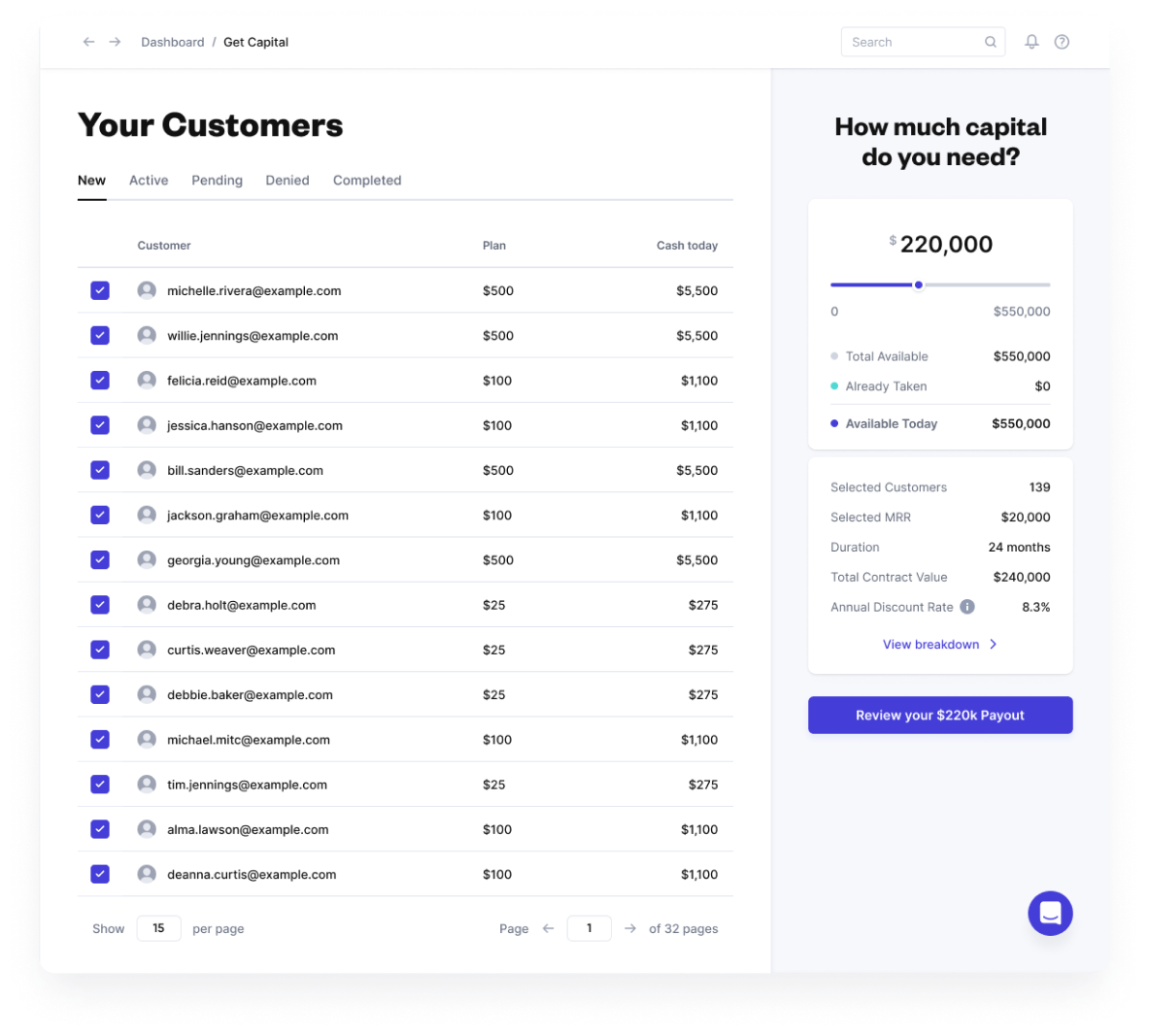
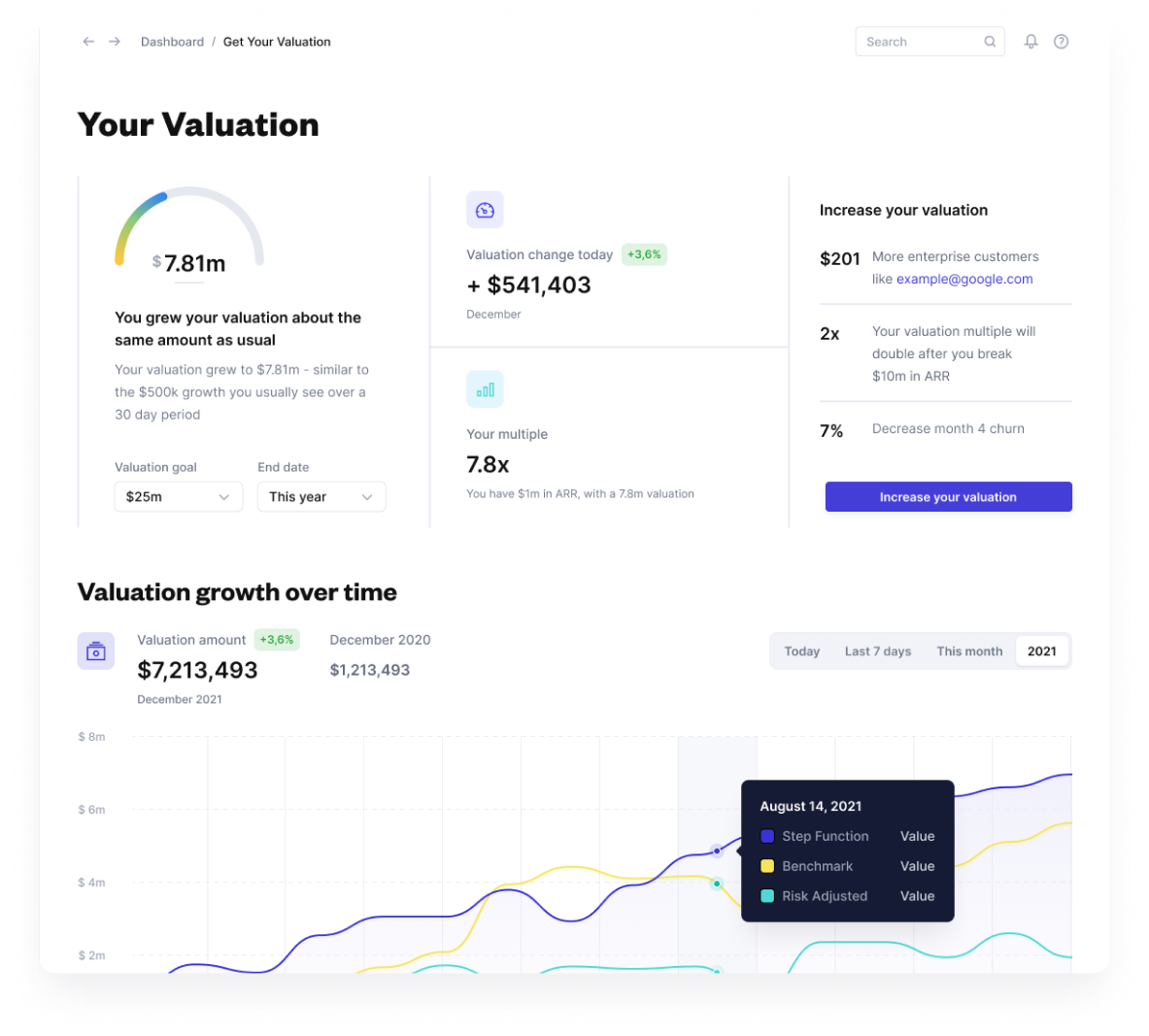
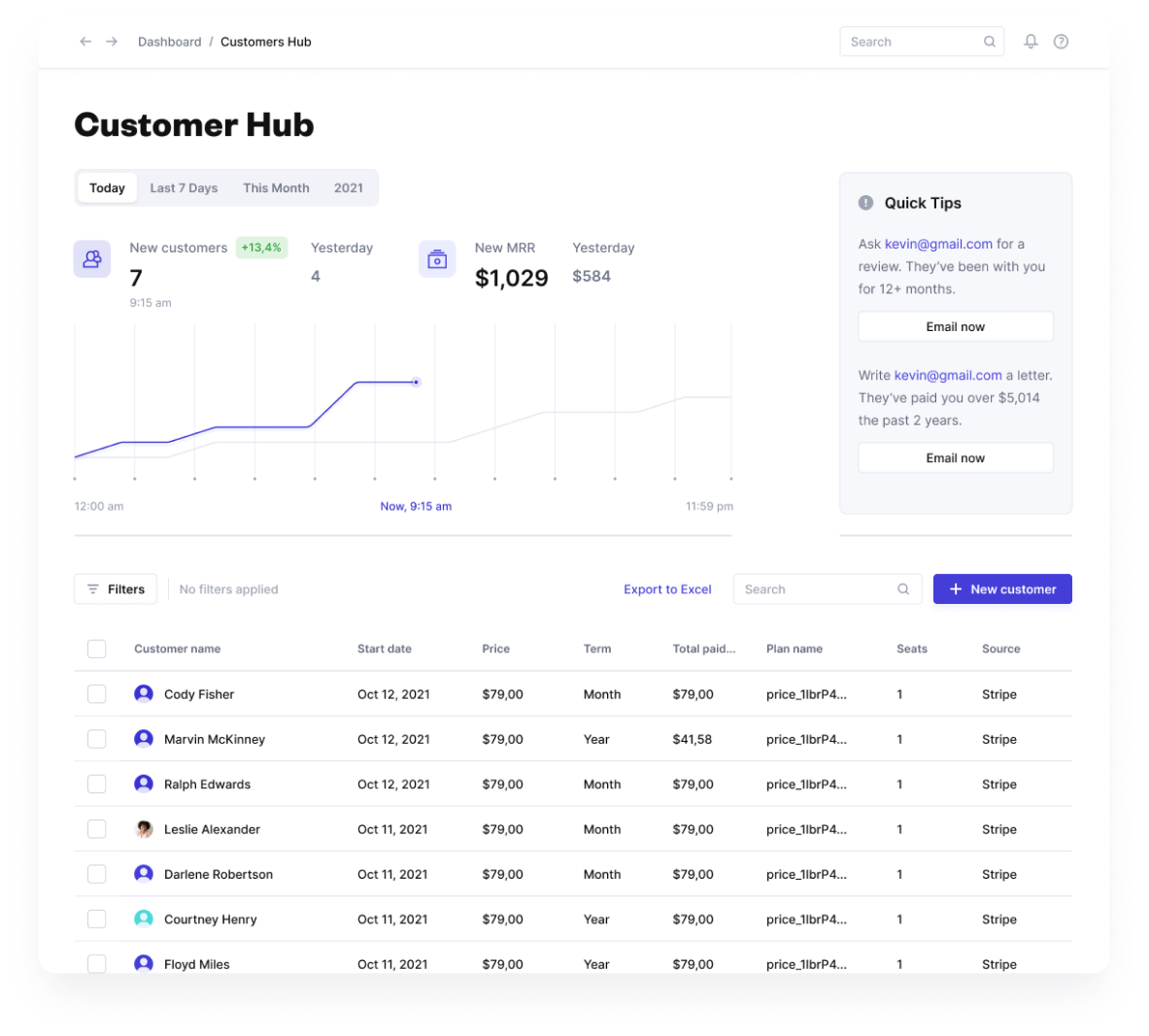
Founderpath is the Fastest Growing Stripe Capital Alternative
Frequently Asked Questions About Stripe Capital
Pros: deeply integrated with Stripe Dashboard, automated underwriting based on processing data (no manual application), no interest/origination/late/prepayment fees (just a flat fee), funds in 1 business day, fully non-dilutive (no warrants/equity/board seat).
Cons: invitation-only — cannot apply directly, must use Stripe as payment processor to qualify, 60-day minimum auto-debit on bank account in US, faster repayment = higher effective APR (10–45% range per Finder), $250K maximum loan size, personal guarantee in UK/FR/DE/AU, and pricing not negotiable.
This comparison was written by the Founderpath team — direct operators with $281M deployed to 760+ SaaS and ecommerce founders — based on Stripe Capital's publicly available information (stripe.com/capital marketing page, docs.stripe.com/capital documentation, Stripe newsroom announcements, partner-bank disclosures) and independent third-party reporting including TechCrunch, PYMNTS, Hacker News, Finder, and United Capital Source. Public sources are cited with links throughout and below the comparison table.
Disclaimer: All figures in the comparison table are based on publicly available information and independent third-party sources. Stripe Capitaldoes not publish a standard rate card on its direct-merchant marketing page — the 8%–19.99% premium range is documented in the Stripe Capital for Platforms section, and actual fees, payment rates, and repayment terms are set algorithmically per offer based on Stripe's underwriting model. The full Customer Agreement is provided in the Stripe Dashboard when an offer is presented. We recommend that all founders review the complete financing agreement before accepting any offer. Founderpath is not affiliated with Stripe, Inc. or any Stripe Capital partner bank. If you believe any information on this page is inaccurate, please contact us at hello@founderpath.com and we will promptly review and update.
Get a Founderpath Offer in Under 24 Hours
Connect your integrations, get a real offer with no commitment, and see your monthly payment before you decide. No closing costs, no personal guarantee, no covenants — and an open application on any billing platform vs Stripe Capital's invitation-only, Stripe-processor-only model.
Keep comparing
More Founderpath comparisons
Tired of one-at-a-time comparisons?
Enter your amount and term once — see all 27+ lenders ranked by total cost and effective APR.
SVB
3–4 yr·Venture debt (warrants)No PGSilicon Valley Bank venture debt with warrants and covenants, priced around prime + 4% all-in.
Read comparison →
Merchant Growth
6–18 mo·MCA / term loanPG: YesCanadian small-business MCA and term-loan provider for retail and service businesses.
Read comparison →
Capchase
6–12 mo·ARR advance (flat fee)PG: VariesARR-based advances with shorter 6–12 month payback; Founderpath offers up to 48 months.
Read comparison →
Clearco
6–12 mo·Merchant cash advanceNo PG50% daily revenue sweep on Cash Advance, 5–8% flat Invoice Funding fees; no early-payoff discount.
Read comparison →
Pipe
6–12 mo·MCA via partnersPG: VariesRecurring-revenue marketplace pivoted to merchant cash advance via Stripe and Shopify partners.
Read comparison →
Wayflyer
3–9 mo·Merchant cash advancePG: VariesEcommerce-focused MCA with daily revenue percentages; Founderpath funds SaaS at lower disclosed rates.
Read comparison →



© 2026 Founderpath, Inc. All Rights Reserved.