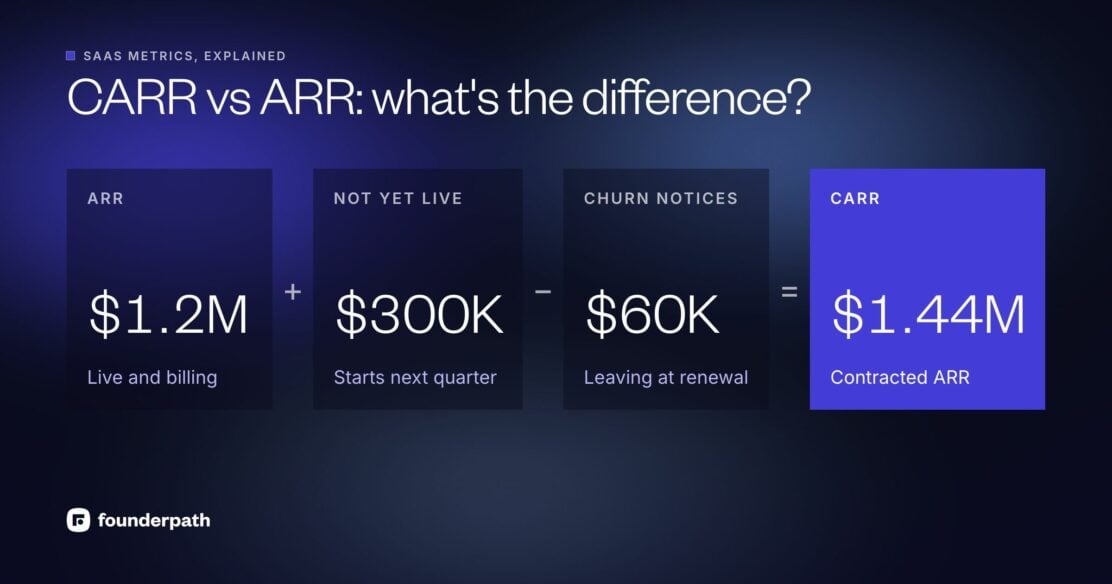

CARR (contracted annual recurring revenue, also called committed ARR) is your ARR plus the annualized recurring value of contracts that are signed but not live yet, minus signed downgrades and churn your customers have already told you about. ARR counts only the subscriptions that are live today, so ARR shows where the business is now and CARR shows where your signed contracts will take it.
If a $1.2M ARR company signs two customers worth $300,000 a year that go live next quarter, and one $60,000 customer has given notice, its CARR is $1.44M while its ARR is still $1.2M. When customers go live the day they sign, as in most self-serve SaaS, CARR and ARR are the same number.
Key Takeaways
- ARR is monthly recurring revenue from live subscriptions times 12, and it excludes one-time fees, services and contracts that haven’t started (SaaS Metrics Standards Board).
- CARR adds signed but not yet live recurring value: in the Standards Board’s own example, $1.5M of MRR times 12 plus $400,000 of signed, not yet live ARR is $18.2M of CARR.
- Stem, a listed energy software company that reports both, had CARR of $69.0M against ARR of $62.4M at the end of Q2 2026, a gap of 10.6% (company filing, August 2026).
- In a study of 74,871 contracts at one B2B SaaS provider, onboarding averaged 9.57 months, the window in which contracted revenue isn’t live and customers can still cancel (Journal of the Academy of Marketing Science, 2025).
- Neither ARR nor CARR is a GAAP figure: the audited number for signed but undelivered revenue is remaining performance obligations (RPO) under ASC 606.
- In 2026 TechCrunch reported AI startups presenting CARR as ARR, and one VC said he had seen CARR 70% higher than ARR.
What is CARR?
CARR stands for contracted annual recurring revenue. The SaaS Metrics Standards Board defines it as “contracted annual recurring revenue, whether in production or not yet in production” and says committed ARR is a synonym. Bessemer Venture Partners describes CARR as adding “committed but not yet live contract values to total ARR and netting out forecasted churn or downsell” (Bessemer, Scaling to $100 Million).
In practice CARR answers one question: if every contract we have signed were live today, what would our ARR be? It is a point-in-time number, like ARR, and it only includes recurring subscription value that a customer has signed for. A deal in late-stage negotiation, a verbal yes or a renewal that hasn’t been signed is pipeline, not CARR.
What is ARR?
ARR, annual recurring revenue, is the annualized value of the recurring subscription revenue that is live at a point in time, usually your current MRR times 12. The Standards Board’s ARR standard says it “should not include one-time fees or professional services” and “does not include contracted but not yet live ARR”. A multi-year contract counts at one year’s value, not its full contract value.
Public companies define it the same way. When the SEC asked Similarweb in 2025 to explain how its ARR handles cancellations, the company answered that “Our ARR includes only active contracts as of the end of a period” and that only one year of a multi-year contract is included (Similarweb response to SEC staff, September 2025). To work out your own number from monthly and annual plans, use our ARR calculator.
CARR vs ARR at a glance
| ARR | CARR | |
|---|---|---|
| What it measures | Recurring revenue live today, annualized | Recurring revenue signed for, annualized, live or not |
| When a new contract counts | When the customer goes live and billing starts | When the contract is signed |
| Churn notice from a customer | Still counted until the contract ends | Subtracted at notice or at contract end, depending on your rule |
| One-time, setup and services fees | Excluded | Excluded |
| Multi-year contract | One year’s value | One year forward, at that year’s contracted price |
| GAAP or audited? | No, a management metric | No, a management metric |
| Best used for | Valuation, current scale, growth rate | Hiring and capacity plans, sales performance, backlog |
The difference between the two numbers is your signed backlog of recurring revenue, net of known churn. CARR should normally be higher than ARR. As Ben Murray of The SaaS CFO puts it, if it isn’t, “something is wrong in your business.”
How to calculate CARR
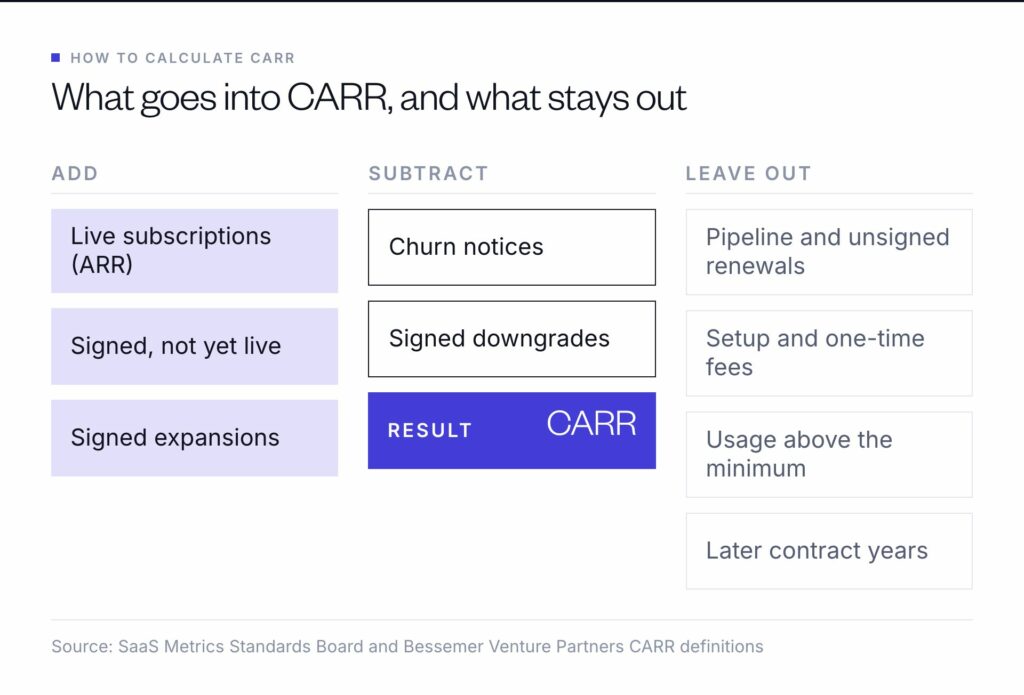
Start from live ARR and adjust it only for contracts that are signed:
- Start with ARR: current MRR from live subscriptions times 12.
- Add signed contracts that aren’t live yet: the first year of annual recurring value for each new customer who has signed but not started.
- Add signed expansions that haven’t started: upgrades and extra seats a customer has signed for, starting on a future date.
- Subtract signed downgrades and churn notices: the annual value a customer has agreed to drop or has told you won’t renew.
Leave out everything that isn’t a signed, recurring commitment: unsigned renewals, weighted pipeline, implementation and other one-time fees, usage above a contracted minimum, and the later years of a multi-year deal.
A worked example
A company bills $100,000 of MRR from live customers. Two new customers have signed annual contracts worth $300,000 a year between them, with go-live dates next quarter and $25,000 of implementation fees. One customer paying $60,000 a year has sent notice that it won’t renew.
| Item | ARR | CARR |
|---|---|---|
| Live subscriptions ($100,000 MRR times 12) | $1,200,000 | $1,200,000 |
| Two signed customers, live next quarter | Not counted yet | +$300,000 |
| Customer that gave notice not to renew | Still counted until it leaves | -$60,000 |
| Implementation fees on the new contracts | Excluded | Excluded |
| Total | $1,200,000 | $1,440,000 |
Our committed MRR guide runs the same calculation monthly: committed MRR times 12 is committed ARR, the same number as CARR.
The edge cases that change the number
- Churn notices: the Standards Board subtracts churn only in the period the contract actually ends, while many finance teams, including The SaaS CFO, take it out when the customer gives notice. We recommend subtracting it at notice, because that money is no longer contracted for the future, and saying which rule you use.
- Ramped multi-year deals: if a contract steps up from $1M in year one to $3M in year three, CARR includes only the next year’s contracted amount. Reporting the year-three price as today’s figure is the abuse at the center of the 2026 debate below.
- Usage-based pricing: only a contracted minimum counts. With no minimum commitment, the Standards Board says there is no CARR.
- Free pilots: a pilot with no paid commitment isn’t CARR, even if a paid contract is likely to follow. Count it when the paid contract is signed.
Why CARR and ARR drift apart
The gap exists because enterprise customers take time to go live. In a study of 74,871 subscription contracts signed with one B2B SaaS provider between 2015 and 2018, the onboarding period averaged 9.57 months, with a standard deviation of 8.18 months (Steinhoff, Kim, Kanuri and Palmatier, Journal of the Academy of Marketing Science, 2025). The authors note that during onboarding, customers decide whether to roll the service out across the organization or cancel it. So the longer your implementation, the bigger the gap, and the more of your CARR is still at risk.
Ben Borden of PodPlay, which sells software and hardware to sports venues and had about $3M of contracted ARR, was asked whether that meant about $240,000 a month of revenue. He explained the lag by customer type:
If you’re a software client, on average it takes kind of one to two months from kind of signing to going live. For the hardware enabled clubs, we have a longer lead time, both because it’s kind of a more involved process and because we have a backlog on that side. So I’d say the average on that side is somewhere between four and six months.
Ben Borden, Co-founder, PodPlay ($3M contracted ARR). Watch at 14:47
CARR vs bookings, billings and RPO
CARR is often confused with three other numbers that also move when a contract is signed. A single contract enters each of them at a different moment:
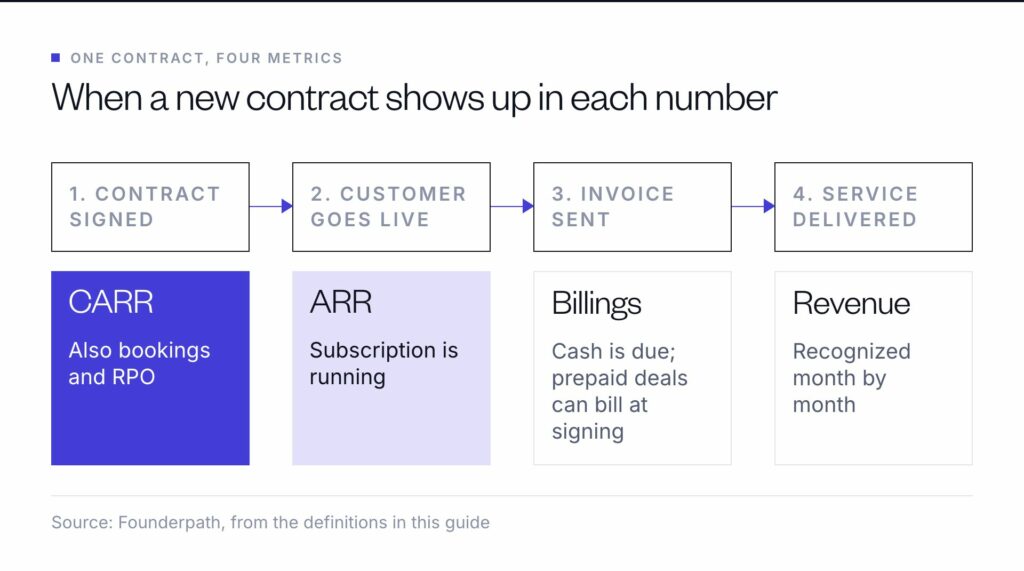
- Bookings are the contracts signed in a period, often at total contract value and including services. The Standards Board warns that bookings “do not have a common definition and should not be used interchangeably with Contracted ARR.” Bookings are a flow over a period; CARR is a balance at a point in time.
- Billings are what you invoice. An annual prepaid contract can be billed in full at signing, before the customer is live, so billings can run ahead of both ARR and CARR.
- RPO (remaining performance obligations) is the GAAP disclosure of contracted revenue not yet recognized, required under ASC 606-10-50-13. Deloitte notes that many call it the “backlog” disclosure (Deloitte, ASC 606 roadmap). Unlike CARR, it covers the full remaining contract term, includes non-recurring items and is audited.
Kevin Houston, Founderpath’s CFO, showed the gap in a talk on capital allocation: a three-year contract with a $50,000 annual contract value, prepaid with a 10% discount, collects $135,000 of cash in year one while MRR stays at $3,750 a month, or $45,000 of ARR (see slide 8). That one contract is a $135,000 booking and $135,000 of billings, but only $45,000 of ARR. Our guide to bookings vs billings walks through the same contract in each metric.
How public companies report CARR
Some listed companies publish CARR next to ARR, each with its own definition. Stem, an energy software company, reported “Contracted annual recurring revenue (‘CARR’) of $69.0 million” and ARR of $62.4 million for the second quarter of 2026. Its CARR covers subscription contracts “with executed purchase orders signed in the period for systems that are not yet operating” plus all operating contracts (Stem Q2 2026 results, August 2026). That puts CARR 10.6% above ARR.
Restaurant software company PAR Technology reported ARR of $88.2 million at the end of 2021 and “Total Contracted ARR” of more than $111 million, defining CARR as “ARR that includes signed/booked sites that have yet to be activated” (PAR Technology Q4 2021 results). That gap was at least 26%, made up of signed restaurant sites still waiting to be activated.
Regulators look at these definitions closely. In the Similarweb review above, SEC staff asked the company to “Clarify how ARR reflects new and existing customers and any actual or anticipated reductions of revenue due to contract non-renewals or cancellations” and to “Disclose whether ARR is indicative of future revenue”. Those are the questions an investor or lender will ask about your CARR, too.
Why CARR became controversial in 2026
In April 2026, Spellbook CEO Scott Stevenson accused fast-growing AI startups of reporting CARR as if it were ARR, often counting the full price of ramped contracts years before customers pay it. TechCrunch followed up with more than a dozen founders, investors and finance professionals (TechCrunch, May 2026). One VC said he had seen companies where CARR was 70% higher than ARR, “even though a significant chunk of that contracted revenue will never actually materialize.” That is one investor’s account, not a measured average.
The reason many AI startups are crushing revenue records is because they are using a dishonest metric. The biggest funds in the world are supporting this and misleading journalists for PR coverage.
Scott Stevenson, CEO, Spellbook, on X, April 2026, as quoted by TechCrunch
CARR itself isn’t the problem. It is a useful planning number when it is labelled and defined. The problem is calling it ARR.
Which number do investors and lenders use?
Valuations are built on ARR. The Standards Board notes that “Investors for both private and public SaaS companies use a multiple of ARR as one primary calculation component for company valuation.” Revenue-based lenders, Founderpath included, connect to your billing, banking and accounting data, so the revenue they see is what customers are paying today, not contracts that haven’t started.
Pest Share, which embeds pest-control coverage in residential leases, finished 2025 with just over $10M in ARR, up from $5M in 2024 (per GetLatka). Because each home only activates as its lease renews, co-founder Justin Clements tracks a top-line contracted revenue number and a live ARR. When the company raised its Series A, he said, investors paid ARR multiples rather than multiples of contracted revenue, and the contracted number was discounted:
When you’re raising, the contracted revenue is unvalidated… There’s a lot of skepticism around that contract or GMV ultimately.
Justin Clements, Co-Founder, Pest Share ($10M revenue). Watch at 11:52
Watch the full interview with Justin Clements, with transcript.
How to report CARR without misleading anyone
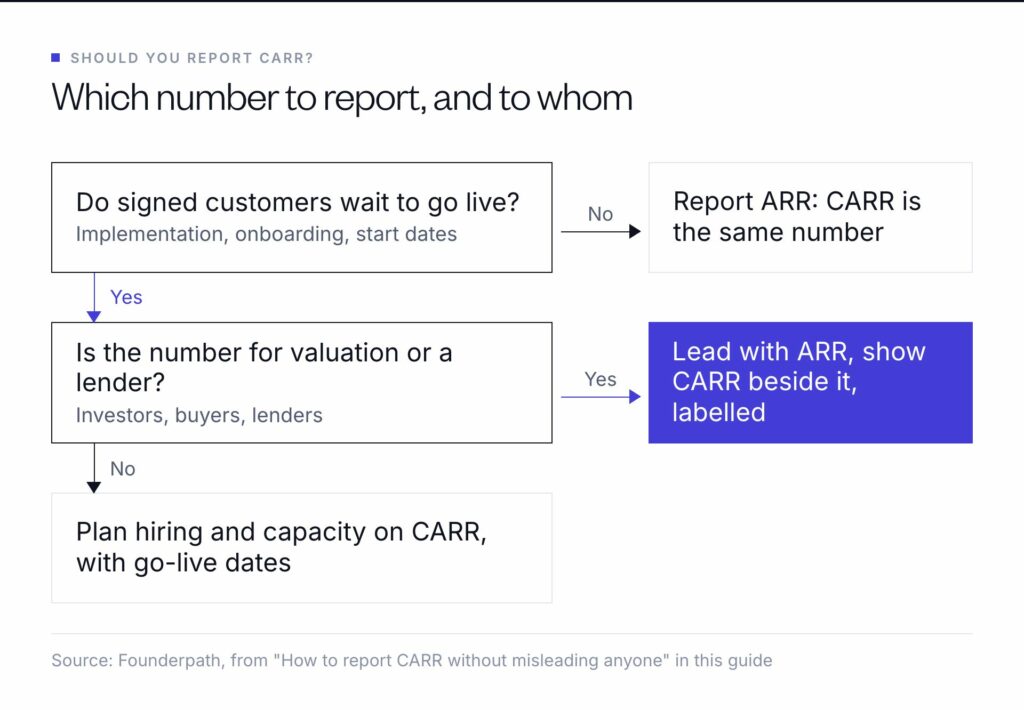
If your customers take weeks or months to go live, CARR is worth tracking. Report it so nobody mistakes it for ARR:
- Label it and show both. Put ARR and CARR side by side with one line defining each, as Stem and PAR do.
- State your churn rule. Say whether churn notices come out at notice or at contract end.
- Show the conversion. Track how much of last quarter’s signed, not yet live ARR went live on schedule, and how much is overdue.
- Count only collectible revenue. Kevin Houston’s deck asks: “Can You Really Count Customer Revenue Committed But Not Paid For 90+ Days?” In his example, removing $200,000 of long-overdue receivables takes a company from $1.4M to $1.2M of ARR (see slide 13).
In short: if customers go live the day they sign, report ARR alone. If they don’t, lead with ARR for investors and lenders, show CARR beside it with its label, and plan hiring and capacity on CARR with a go-live date for every contract.
Fund growth from the revenue you already have
Contracts waiting to go live will show up in your ARR soon. The revenue customers already pay you can fund growth now.
Founderpath provides non-dilutive capital for B2B SaaS companies with at least $10K MRR. There’s no equity, no warrants, no board seats and no personal guarantees. Connect your billing, banking and accounting data, and most founders see funds within 24-48 hours.
Check what you qualify for. It takes less than 5 minutes.
Frequently asked questions
What does CARR stand for?
In SaaS, CARR stands for contracted annual recurring revenue, also called committed ARR: the annualized recurring value of every signed contract, live or not, minus signed downgrades and known churn. CARR is also the New York Stock Exchange ticker of Carrier Global, the heating and air-conditioning company, which is a different thing entirely.
Is CARR the same as bookings?
No. Bookings are the contracts signed during a period, often at their total contract value and including services and other one-time items. CARR is a point-in-time total of annualized recurring value only. A three-year contract worth $50,000 a year can be a $150,000 booking but adds only $50,000 to CARR.
Is contracted ARR the same as committed ARR?
Yes. The SaaS Metrics Standards Board says committed ARR is used as a synonym for contracted ARR, and both are abbreviated CARR. Bessemer Venture Partners uses “committed ARR”; the Standards Board and companies such as Stem and PAR Technology use “contracted ARR”.
Should CARR include customers who have given notice to churn?
Sources disagree. The SaaS Metrics Standards Board deducts churn only in the period the contract actually ends, while many finance teams subtract it as soon as the customer gives notice. Subtracting it at notice is more conservative, because that revenue is no longer contracted for the future. Whichever rule you use, state it next to the number.
Can CARR be lower than ARR?
Yes, when the churn and downgrades customers have already signed or announced are larger than the new contracts waiting to go live. Normally CARR is higher than ARR, so a CARR below ARR is an early warning that recurring revenue is about to shrink.
Is CARR a GAAP metric?
No. Neither CARR nor ARR is defined by GAAP or audited. Public companies present them as operating metrics with their own definitions. The audited figure for contracted revenue not yet recognized is remaining performance obligations (RPO), disclosed under ASC 606.
What is the difference between CARR and RPO?
RPO is the GAAP disclosure of all contracted revenue not yet recognized, over the full remaining term of each contract, including non-recurring items such as services. CARR annualizes only one year of recurring subscription value. A company with many multi-year contracts can have RPO well above its CARR.
Why use ARR instead of revenue?
ARR shows the recurring revenue a SaaS company is running at today, while GAAP revenue shows what it earned over a past period, including one-time fees. Bessemer Venture Partners calls ARR the primary metric for measuring scale in cloud companies because it gives full credit for the annualized recurring contract and nets out non-recurring revenue.
What does CARR mean in sales?
In sales reporting, CARR is the recurring revenue customers have signed for, including deals that haven’t gone live yet. It lets a sales team get credit at signing, before the revenue shows up in ARR. Deals still in negotiation are pipeline and don’t count.
Recent Articles

CARR vs ARR: What Contracted ARR Is and How It Differs
CARR is your ARR plus signed contracts that aren't live yet, minus churn notices. How to calculate CARR, how it differs from ARR, bookings and RPO, and how to report it honestly.

What Is a UCC Filing? What It Means When a Lender Files One
A UCC filing is a public notice that a lender has a lien on some or all of your business assets. What a UCC-1 contains, how long it lasts, how it affects new financing and how to remove one.

What Are Debt Warrants? How Venture Debt Warrants Work
Debt warrants give a lender the right to buy shares at a fixed price alongside a loan. How warrant coverage works, what it costs in dilution, and which lenders take warrants.