Bootstrapping a Startup: The Complete Guide for SaaS Founders

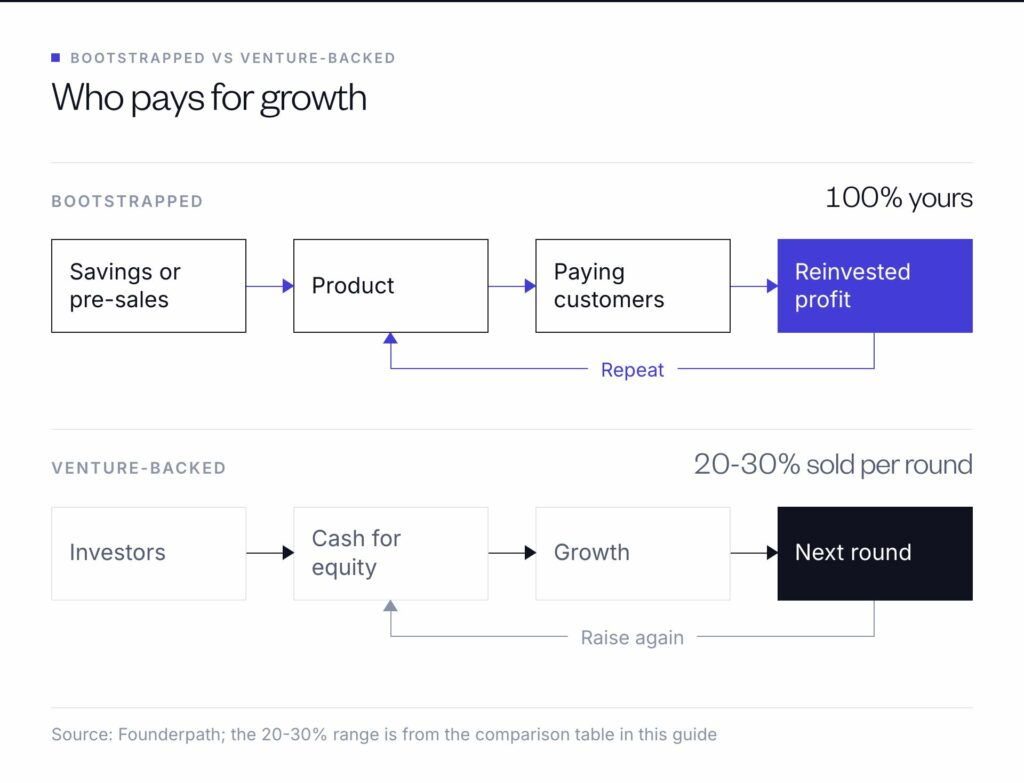
Bootstrapping a startup means building and growing the company with your own money and the revenue it earns from customers, instead of raising outside investment from venture capitalists or angels. You keep all of the equity and every decision, and customers, not investors, pay for growth.
Key Takeaways
- Bootstrapping is the norm, not the exception: only about 0.05% of startups ever raise venture capital, according to Fundera.
- SaaS suits bootstrapping because subscriptions bring in predictable recurring revenue, and serving one more customer costs very little.
- Top-quartile bootstrapped SaaS companies reach $1M ARR in about two years, only four months slower than VC-backed companies, according to ChartMogul.
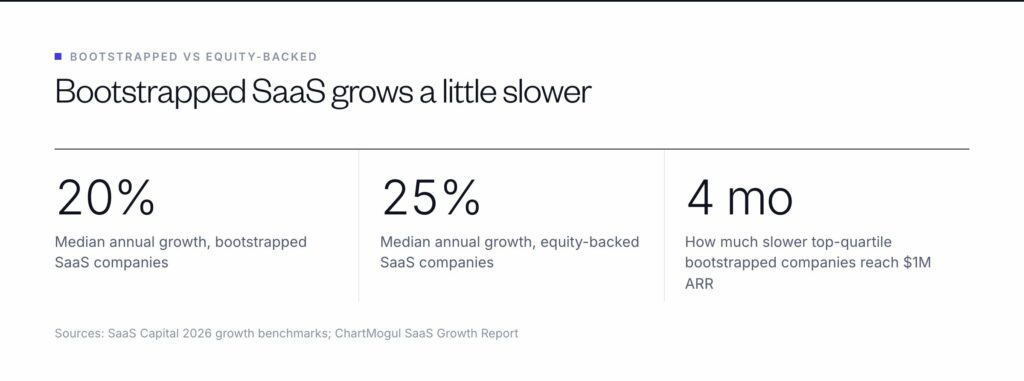
- The trade-off is speed: SaaS Capital’s 2026 survey puts median annual growth at 20% for bootstrapped SaaS companies and 25% for equity-backed ones.
- Bootstrapped doesn’t mean capital-free: once a SaaS company has recurring revenue, non-dilutive options such as revenue-based financing can fund growth without selling equity.
What Is Bootstrapping a Startup?
A bootstrapped startup pays its way with personal savings, early customer revenue and reinvested profit. Some founders add personal credit or pre-sales to customers. There are no investors to answer to, no board seats to fill and no equity to give away.
That makes bootstrapping the default path. A 2019 Fundera analysis estimated that only about 0.05% of startups ever raise venture capital. The rest fund themselves, borrow or shut down.
For B2B SaaS companies, bootstrapping usually means funding the first version of the product and the first sales from the founders’ own money, until recurring revenue covers the costs. It doesn’t mean staying small. Mailchimp, Atlassian and Zoho all bootstrapped for years and became industry leaders.
Why SaaS Is the Best Model to Bootstrap
Not every business model works without outside capital. SaaS is an exception, for four reasons:
- Predictable recurring revenue: Monthly and annual subscriptions create cash flow you can plan around. Once you have a base of paying customers, you know what next month looks like.
- High gross margins: Software has no inventory to buy, so most of every subscription dollar stays in the business.
- Low marginal cost: Serving your 1,000th customer costs little more than serving your 100th. Infrastructure scales and the cost per user drops.
- Lean, remote teams: No warehouse, inventory or retail locations. Your biggest costs are people and servers.
The data backs this up. ChartMogul’s SaaS growth report found that top-quartile bootstrapped companies reach $1M ARR in about two years, only four months slower than VC-backed businesses.
Pros and Cons of Bootstrapping
Pros
- Full ownership and control: You keep 100% of the equity, answer to no board, and decide when or whether to sell.
- Built-in discipline: Customers fund the business, so you learn early what people will pay for and run toward profitability from the start.
- Success at any size: Venture investors need a 10x-plus outcome. A bootstrapped company can be a great result at $2M ARR or $200M.
Cons
- Slower growth on average: SaaS Capital’s 2026 benchmarks put median annual growth at 20% for bootstrapped companies and 25% for equity-backed companies.
- Personal financial risk: Early costs often come from savings or credit cards. Atlassian started on $10,000 of credit card debt.
- Fewer resources: Hires, marketing and big product bets have to wait until revenue can pay for them.
- No built-in network: Investors bring introductions and advice. Bootstrapped founders have to build their own circle of mentors and peers.
How to Bootstrap a SaaS Startup: Stage by Stage
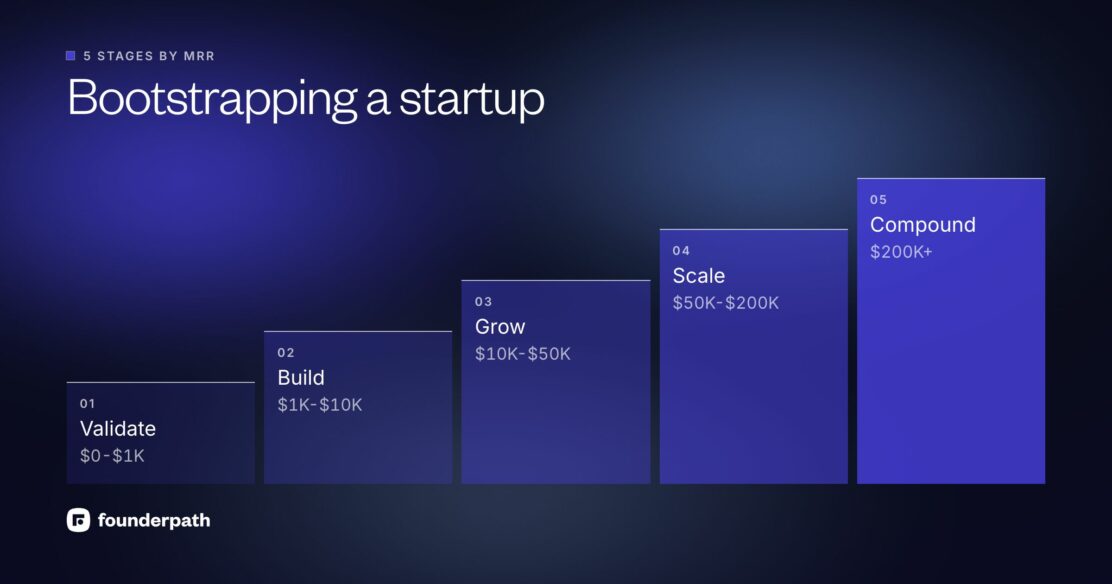
Bootstrapping is a progression through distinct stages, each with its own priorities. Here’s what to focus on at each level of monthly recurring revenue (MRR).
| Stage | MRR | Goal | What to watch |
|---|---|---|---|
| Validate | $0-$1K | Prove someone will pay | 20+ customer conversations |
| Build | $1K-$10K | Ship a product that retains | Churn, GRR above 90% |
| Grow | $10K-$50K | Find a repeatable channel | CAC payback in 12-18 months |
| Scale | $50K-$200K | Hire and systematize | Burn multiple |
| Compound | $200K+ | Grow without dilution | Non-dilutive options |
Stage 1: Validate ($0-$1K MRR)
Goal: Prove someone will pay for your product. Talk to at least 20 potential customers and confirm the problem is real and worth solving before you build much. Use no-code tools, landing pages and manual processes to test demand before writing code.
Budget: Keep it small. Based on its data from more than 40,000 startups, Carta typically sees founders invest about $10,000 in the bootstrapping phase and spend four to six months building the foundation before looking for outside capital. Keep your personal burn rate low: this stage is about learning, not spending.
Running out of money is what forces the discipline. ZoomInfo’s founder describes the early days of the company, then called DiscoverOrg:
The business was profitable because … we didn’t have an option otherwise, and so you had to build a profitable business, because after the 25,000 [dollars] of Chase financing ran out, there was no more money to run the business. So we ran the business in this really profitable way.
Henry Schuck, CEO and founder, ZoomInfo ($1.2B revenue). Watch at 5:45
Stage 2: Build ($1K-$10K MRR)
Goal: Ship a product that retains customers. Focus on a narrow use case and solve it better than anyone else. Your first 50 customers will tell you what to build next, so listen to them.
Key metric: Churn rate. If customers leave faster than you can win them, you have a product problem, not a growth problem. Aim for gross revenue retention above 90%.
Stage 3: Grow ($10K-$50K MRR)
Goal: Find a repeatable acquisition channel. If customers are staying and expanding, you have product-market fit. Now invest in the one or two channels that bring in customers consistently: usually content marketing, outbound sales or product-led growth.
Key metric: CAC payback period. A bootstrapped company needs to recover what it spends to win a customer within 12-18 months. You can’t afford to wait 24 months or more, as a VC-funded competitor might. Track your SaaS KPIs closely at this stage.
Stage 4: Scale ($50K-$200K MRR)
Goal: Build a team and systematize operations. This is where bootstrapping gets hard: you need to hire, but revenue pays for every hire, not a fundraise. Prioritize roles that directly drive revenue or retention: first a few engineers, then sales or customer success.
Key metric: Burn multiple (net burn divided by net new ARR). Build hiring plans into your SaaS financial model so each new salary is covered by revenue you can see coming.
Stage 5: Compound ($200K+ MRR)
Goal: Compound growth without dilution. You now have real revenue, real margins and real options: self-fund expansion into new markets, launch adjacent products, or use non-dilutive funding to accelerate without giving up equity.
This is also where many bootstrapped founders face the “growth ceiling” question: raise venture capital to grow faster, sell, or stay independent? Customer.io’s founder frames it this way:
If you’re bootstrapped and you get to 10 million [in ARR], incredible, but you can sell the business and it can be life-changing for you. But if you keep going and you keep building, there has to be some other reason.
Colin Nederkoorn, founder and CEO, Customer.io ($70M revenue). Watch at 22:08
Bootstrapping vs. Venture Capital
The choice isn’t binary, but the trade-offs are real. Here’s how the two paths compare on the points that matter most to SaaS founders:
| Factor | Bootstrapped | Venture-Backed |
|---|---|---|
| Equity dilution | 0% | 20-30% per round |
| Decision speed | Fast, no board approval needed | Slower, investor alignment required |
| Growth pace | Sustainable, revenue-funded | Fast, capital-funded |
| Profitability focus | From day one | Often deferred for growth |
| Exit flexibility | Sell when you want, at any size | Pressure to 10x+ return |
| Failure risk | Lower, you spend what you earn | 75% never return cash to investors (HBS) |
| Personal financial risk | Higher early on | Lower, you use investor money |
| Access to mentors | Must build own network | Comes with investor network |
The 75% figure comes from Harvard Business School professor Shikhar Ghosh, whose research found that about three-quarters of venture-backed companies don’t return investors’ capital, as The Wall Street Journal reported. Raising VC doesn’t guarantee survival; it adds pressure to grow fast.
That risk is why some founders choose to stay bootstrapped even when well-funded competitors surround them:
We chose to stay bootstrapped, and the reason for that is, number one, over the years I’ve heard stories of founders starting companies, getting investments, and if they don’t get traction, they’re just in for a whole lot of hurt. And we weren’t sure if we would get traction.
Michael Cooney, co-founder, WhatConverts ($3.5M revenue). Watch at 3:21
For founders who want growth capital without the venture trade-offs, revenue-based financing offers a middle path: funding tied to your recurring revenue, with no equity exchanged.
Bootstrapped SaaS Companies That Made It Big
These companies show how far bootstrapping can go. Some took outside money later; what they have in common is how far they got first.
- Mailchimp: Founded in 2001 and never took venture capital. Intuit agreed to buy it for about $12 billion in 2021, when it had 13 million users and 800,000 paying customers. It is widely described as the largest bootstrapped exit ever.
- Zoho: Has never raised outside funding. The 2024 Burgundy Private Hurun India 500 valued it at ₹1,03,760 crore (about $12 billion), second among India’s bootstrapped companies, Outlook Business reported.
- Atlassian: Founded in Sydney in 2002 with $10,000 of credit card debt and profitable from its first year. It took its first venture money, $60 million from Accel, eight years later, after a year with $59 million in revenue (TechCrunch).
- GitHub: Bootstrapped and profitable for more than four years before raising $100 million from Andreessen Horowitz in 2012 (Forbes). Microsoft acquired it for $7.5 billion in 2018.
- Calendly: Nearly bootstrapped. It had raised only $550,000 when, after doubling its 2020 subscription revenue to $70 million, it raised $350 million in January 2021 at a valuation above $3 billion (SiliconANGLE).
- Basecamp (37signals): Has never raised venture capital. In 2006 Jeff Bezos bought a small, no-control stake directly from the founders (DHH), and the company has stayed independent ever since.
The common thread: each focused on profitability and product-market fit before chasing growth.
Common Bootstrapping Mistakes to Avoid
- Hiring too fast: Justify every hire with revenue, not optimism. At a bootstrapped company a bad hire isn’t just expensive; it can be existential. Keep the team lean until the unit economics work.
- Ignoring unit economics: Signups mean nothing if your LTV:CAC ratio is underwater. Know your customer acquisition cost, payback period and gross margin before scaling any channel.
- Underpaying yourself: Burnout ends many bootstrapped companies. Pay yourself a livable salary. If you can’t, your pricing or market may be wrong.
- Building in isolation: Without investors, you lose a built-in network of advisors. Seek out founder communities, peer groups and mentors.
- Refusing all outside capital: Bootstrapping means keeping control, not rejecting money forever. SaaS financing options such as revenue-based financing provide growth capital without giving up equity or decision-making power.
When Bootstrapping Is Not the Right Path
Bootstrapping works for most B2B SaaS companies, but not for every situation:
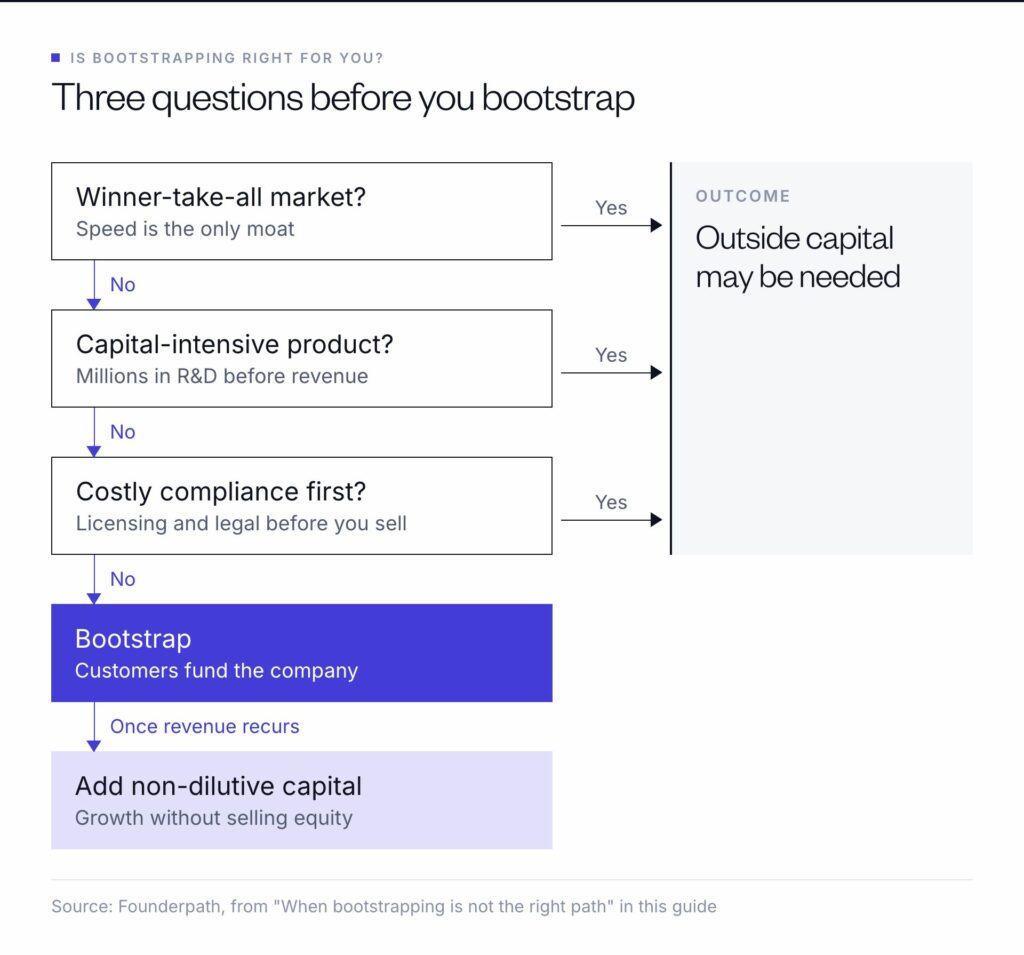
- Winner-take-all markets: If your market will consolidate to one or two players and speed is the only moat, you may need venture capital to outpace competitors. Think ride-sharing, not accounting software.
- Capital-intensive products: Hardware, deep tech, biotech and AI infrastructure often need millions in R&D before they earn any revenue. Bootstrapping is impractical when the product costs more than customers can fund.
- Regulated industries with high compliance costs: Fintech, healthcare and insurance products may need significant upfront spending on compliance, licensing and legal work before you can sell.
If your SaaS startup doesn’t fall into these categories, bootstrapping is usually a viable path.
How to Fund a Bootstrapped Startup Without Giving Up Equity
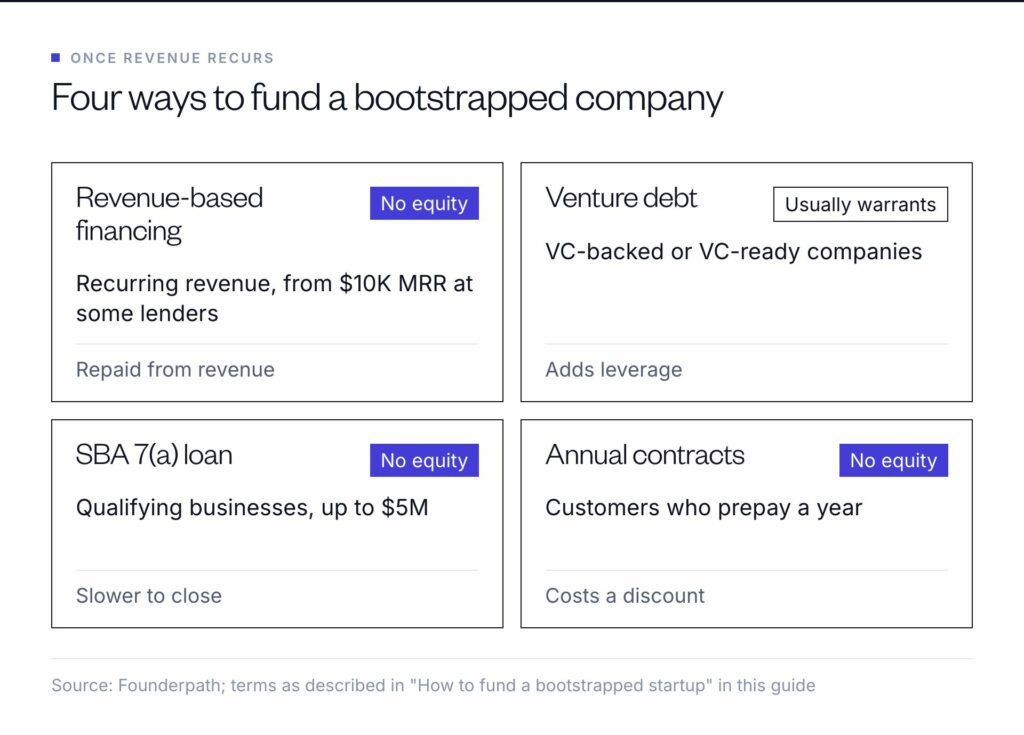
Bootstrapping doesn’t force a choice between slow growth and dilution. Once you have recurring revenue, these options fund growth without selling equity (see our guide to bootstrap financing for a fuller comparison):
- Revenue-based financing (RBF): Borrow against your recurring revenue, with repayment tied to what you earn and no equity given up. Some SaaS lenders, Founderpath among them, start at $10K MRR.
- Venture debt: Available to companies that have raised, or could raise, venture capital. It adds leverage with little dilution, though it usually comes with warrants. See our guide to venture debt.
- SBA loans: Government-backed 7(a) loans of up to $5 million, priced at the prime rate plus a spread. Slower to close, but with favorable terms for businesses that qualify.
- Annual contracts: Offering customers a discount for paying a year upfront brings in cash that funds growth. It is the simplest form of non-dilutive capital.
Bootstrapping a Startup FAQ
What percentage of startups are bootstrapped?
Almost all of them. Fundera estimates that only about 0.05% of startups ever raise venture capital. The rest fund themselves, borrow or close.
How much money do you need to bootstrap a SaaS startup?
Less than you might think. Carta, drawing on more than 40,000 startups, typically sees founders invest about $10,000 in the bootstrapping phase. Your main costs are development (or your own time), hosting and basic tools. The key is reaching revenue quickly so the business funds itself.
How long does it take a bootstrapped SaaS company to reach $1M ARR?
Top-quartile bootstrapped SaaS companies reach $1M ARR in about two years, according to ChartMogul, only four months slower than VC-backed companies. Most companies take longer than the top quartile.
What are the downsides of bootstrapping?
Slower growth, personal financial risk and fewer resources. SaaS Capital’s 2026 survey puts median growth at 20% for bootstrapped SaaS companies versus 25% for equity-backed ones. Founders often fund the early months from savings or credit cards, and every hire has to wait until revenue can cover it.
Can you bootstrap and still access funding?
Yes. Bootstrapping means keeping control, not rejecting all outside capital. Non-dilutive options like revenue-based financing let you borrow against recurring revenue without giving up equity, so you can speed up growth at key moments and keep full ownership.
What is the difference between bootstrapping and self-funding?
They’re closely related but not identical. Self-funding means investing your own money in the business. Bootstrapping is broader: it includes self-funding, but also reinvesting revenue, staying lean and reaching profitability without outside investors. A self-funded founder can still burn through savings quickly; a bootstrapped founder builds toward sustainability from day one.
Start Building Without Giving Up Equity
Bootstrapping keeps the company yours. The hard part usually comes later: funding growth once customers are paying.
Founderpath provides non-dilutive capital for B2B SaaS companies with at least $10K MRR. There’s no equity, no warrants, no board seats and no personal guarantees. Connect your billing, banking and accounting data, and most founders see funds within 24-48 hours.
Check what you qualify for. It takes less than 5 minutes.
Recent Articles

CARR vs ARR: What Contracted ARR Is and How It Differs
CARR is your ARR plus signed contracts that aren't live yet, minus churn notices. How to calculate CARR, how it differs from ARR, bookings and RPO, and how to report it honestly.

What Is a UCC Filing? What It Means When a Lender Files One
A UCC filing is a public notice that a lender has a lien on some or all of your business assets. What a UCC-1 contains, how long it lasts, how it affects new financing and how to remove one.

What Are Debt Warrants? How Venture Debt Warrants Work
Debt warrants give a lender the right to buy shares at a fixed price alongside a loan. How warrant coverage works, what it costs in dilution, and which lenders take warrants.