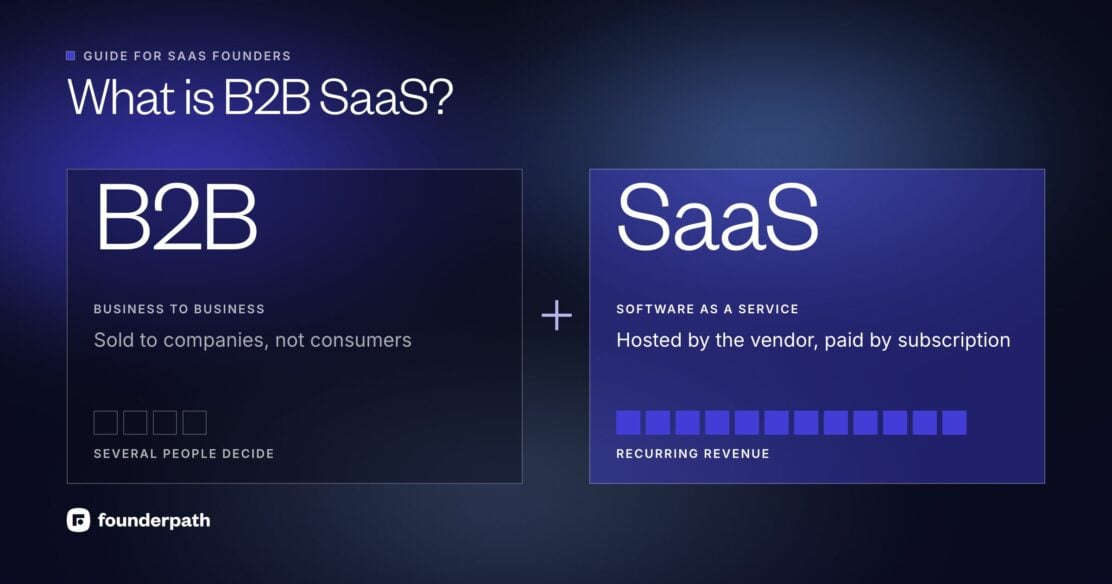

B2B SaaS (business-to-business software as a service) is cloud software that a vendor hosts and sells to other companies, not consumers, for a recurring monthly or annual subscription. Customers use it through a browser instead of installing it on their own servers, and the vendor runs the infrastructure, security and updates. Salesforce, HubSpot, Slack and QuickBooks Online are well-known examples.
Key Takeaways
- B2B SaaS customers rent access to software on a subscription instead of buying a license, so the vendor earns recurring revenue for as long as the customer stays.
- The market is large: Gartner forecast worldwide SaaS spending at $299 billion in 2025, up from $251 billion in 2024.
- The median private B2B SaaS company keeps about 80% of its software revenue as gross margin, according to Benchmarkit’s 2026 report on 342 companies.
- The same report puts median net revenue retention at 102%, which means existing customers spend slightly more each year even after churn and downgrades.
- SaaS Capital’s 2026 survey of more than 1,000 private SaaS companies puts median annual growth at 22%, and at 20% for bootstrapped companies.
What Does B2B SaaS Mean?
The term joins two ideas. B2B (business to business) means the buyer is a company, not an individual. SaaS (software as a service) means the software is delivered as a hosted service and paid for as a subscription, instead of being sold once as a license and installed on the customer’s own computers.
In practice, a B2B SaaS company runs one version of its product in the cloud and serves every customer from it. Customers log in, pay per user, per account or per amount of usage, and get new features automatically. If they stop paying, they lose access. That’s why the whole business revolves around keeping customers, not just winning them.
Most of the software a modern company uses is B2B SaaS:
- CRM: Salesforce, HubSpot, Pipedrive
- Project management: Asana, Monday.com, Jira
- Communication: Slack, Zoom, Microsoft Teams
- Accounting: QuickBooks Online, Xero, FreshBooks
- HR and payroll: Workday, BambooHR, Gusto
- Engineering and IT: Datadog, ServiceNow, GitHub
B2B SaaS Examples
These are among the largest B2B SaaS companies, with the revenue each one reported for its latest full fiscal year:
| Company | What it sells | Type | Annual revenue |
|---|---|---|---|
| Salesforce | CRM and customer software | Horizontal | $41.5B (FY2026) |
| ServiceNow | IT and workflow automation | Horizontal | $13.3B (2025) |
| Shopify | Commerce platform for merchants | Horizontal | $11.6B (2025) |
| Atlassian | Jira, Confluence and team tools | Horizontal | $6.6B (FY2026) |
| Toast | Restaurant point of sale and payments | Vertical | $6.2B (2025) |
| Datadog | Cloud monitoring | Horizontal | $3.4B (2025) |
| Veeva Systems | Software for life sciences | Vertical | $3.2B (FY2026) |
| HubSpot | CRM and marketing software | Horizontal | $3.1B (2025) |
A few details in those numbers are worth knowing:
- Revenue isn’t ARR. Annual recurring revenue counts only subscriptions. Toast reported $6.2 billion of revenue for 2025 but about $2.0 billion of ARR, because most of its revenue comes from payment processing and hardware.
- Expansion drives the best companies. Datadog reported a trailing 12-month net revenue retention rate in the low 120%s as of June 2026: its existing customers spent more than 20% more than a year earlier.
- Enterprise software is sticky. ServiceNow reported a 98% renewal rate in each of 2023, 2024 and 2025.
- Bottom-up adoption can scale fast. Slack crossed a $1 billion revenue run rate in its 2021 fiscal year, and Salesforce bought it at an enterprise value of about $27.7 billion.
Horizontal vs Vertical SaaS
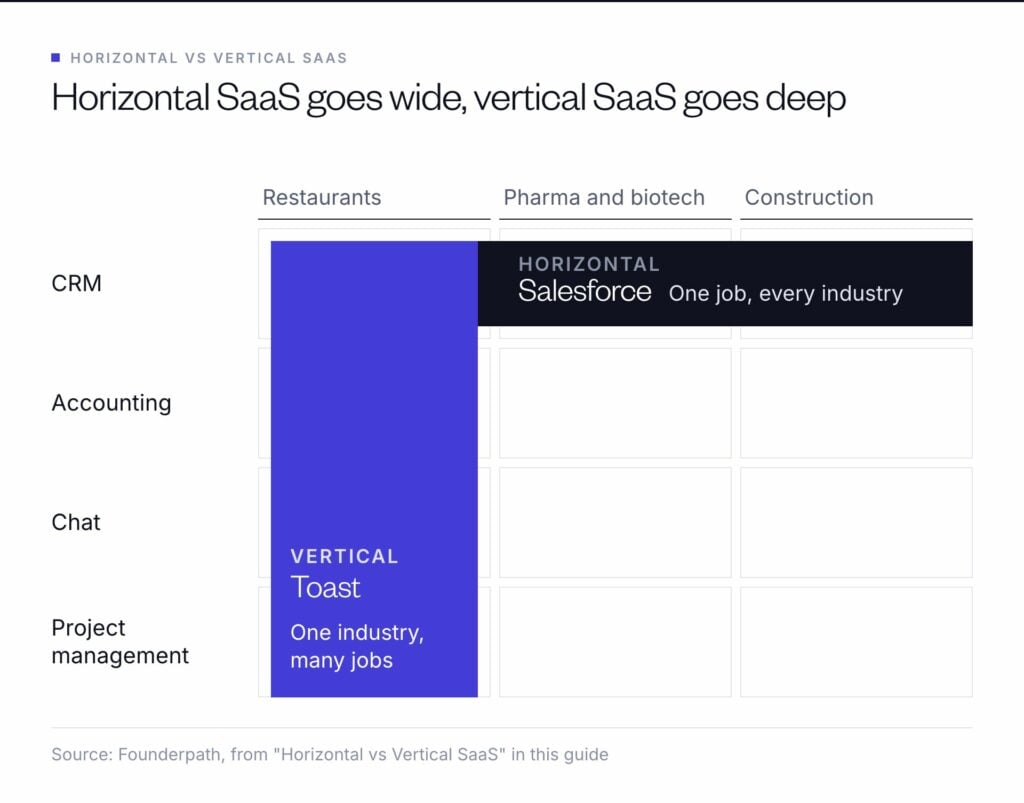
Horizontal SaaS does one job for companies in any industry: CRM, accounting, chat, project management. Salesforce and Slack are horizontal. The market is huge, but so is the competition, so products win on user experience, integrations or price.
Vertical SaaS is built for one industry and covers many of its jobs. Toast serves restaurants, Veeva serves pharma and biotech, and Procore serves construction. The market is smaller, but deep industry knowledge makes the product harder to copy and harder to leave.
Benchmarkit’s 2026 report shows the trade-off in numbers. Vertical SaaS companies take longer to earn back what they spend to win a customer (an 18-month median CAC payback versus 14 months for horizontal SaaS), but they earn more over the customer’s lifetime: a median lifetime value of 5.6 times acquisition cost versus 4.1 times.
| Median | Horizontal SaaS | Vertical SaaS |
|---|---|---|
| CAC payback | 14 months | 18 months |
| Lifetime value to CAC | 4.1x | 5.6x |
For a founder with deep knowledge of one industry, starting vertical is often the stronger bet. OnBoard’s CEO, whose board software grew by selling to financial institutions first, put it this way:
First of all, stick with the niche. Niches will bring riches… If you have 200 customers in the same vertical, you’re going to be more investable than… being spread over lots of different verticals.
Paroon Chadha, co-founder and CEO, OnBoard ($38M revenue). Watch at 23:00
B2B SaaS vs B2C SaaS
The difference is the customer. B2B SaaS sells to companies, so a sale is larger, slower and involves more people. B2C SaaS sells to individuals, so a sale is small, fast and usually self-serve.
| Factor | B2B SaaS | B2C SaaS |
|---|---|---|
| Customer | Businesses, from small teams to large enterprises | Individual consumers |
| Who decides | Several people: users, managers, finance, IT | One person |
| Price | Per account or per seat, often on annual contracts | A low monthly fee per person |
| Sales cycle | Days for small teams, months for enterprises | Minutes |
| Why they buy | Save time, cut costs or grow revenue | Entertainment, convenience, personal productivity |
| Examples | Salesforce, HubSpot, Slack, Workday | Netflix, Spotify, Duolingo |
Retention is where the gap shows most. Crystal sold the same personality-insights product to individuals and to companies, and its founder measured very different results:
I was expecting roughly similar usage and retention patterns, but what we saw was a jump from like 55 [percent] retention rate to about 120. And that was pretty much the same product, except when it was an individual use case, you lose half of them over a year, versus the same exact product in a B2B use case where we’ve got a customer success team, people actually responsible for maintaining the revenue, expansion opportunities.
Drew D’Agostino, founder and CEO, Crystal ($7.4M revenue). Watch at 11:02
B2B SaaS vs Enterprise SaaS
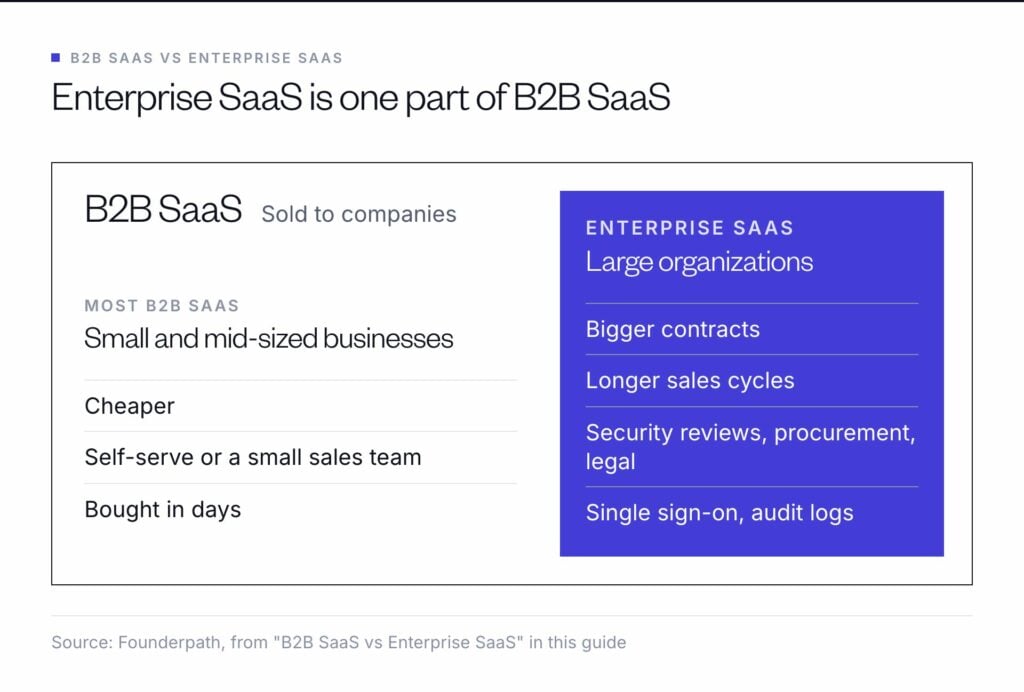
Enterprise SaaS is the part of B2B SaaS sold to large organizations. Every enterprise SaaS product is B2B, but most B2B SaaS isn’t enterprise. Selling to enterprises means bigger contracts and longer sales cycles, with security reviews, procurement, legal negotiation and features such as single sign-on and audit logs. SaaS sold to small and mid-sized businesses is usually cheaper, sold self-serve or by a small sales team, and bought in days.
How B2B SaaS Companies Make Money
Every B2B SaaS company charges a subscription, but what the subscription is based on varies. Most companies combine two or more of these models:
| Pricing model | How customers pay | Examples |
|---|---|---|
| Per seat | A fee for each user | Slack, Asana, Zoom |
| Usage-based | By consumption: API calls, data, messages | Twilio, Snowflake, Datadog |
| Tiered | Packages with rising features and limits | HubSpot, Semrush |
| Flat rate | One price, unlimited users | Basecamp’s Pro Unlimited plan |
| Freemium | A free plan, with paid upgrades | HubSpot’s free CRM, Slack’s free plan |
The choice affects how revenue grows after the first sale. In Benchmarkit’s 2026 data, usage-priced companies had a median net revenue retention of 108% against 98% for seat-priced companies, because usage rises with the customer’s business while seat counts can be cut.
Pricing also decides how big a deal can get. Proposify’s CEO describes the fix that let the company sell larger contracts:
The third really big thing was pricing. So we did, again, the classic startup mistake of, like, put everything on the enterprise plan, give it all away, and so we were just capping our ability to sell larger deals. Once we were moved to a per seat price, that also became easier.
Kyle Racki, CEO and co-founder, Proposify ($10M revenue). Watch at 5:50
B2B SaaS Metrics and Benchmarks
Because revenue arrives month by month, B2B SaaS companies are judged on a handful of metrics that show whether that revenue is growing, profitable and durable. These are the current medians for private B2B SaaS companies:
| Metric | What it measures | Median | Source |
|---|---|---|---|
| ARR growth | Year-over-year growth in recurring revenue | 22% (bootstrapped: 20%) | SaaS Capital 2026 |
| Gross margin | Revenue left after hosting, support and other delivery costs | 80% on software revenue | Benchmarkit 2026 |
| Net revenue retention | Revenue kept from last year’s customers, including upgrades | 102% (top quartile: 110%) | Benchmarkit 2026 |
| Gross revenue retention | Revenue kept from last year’s customers, excluding upgrades | 84% | Benchmarkit 2026 |
| CAC payback | Months of gross profit needed to earn back the cost of winning a customer | 16 months | Benchmarkit 2026 |
Bootstrapped companies tend to keep customers better. SaaS Capital’s 2026 data for bootstrapped companies with $3M-$20M ARR shows median net revenue retention of 103% and gross revenue retention of 91%, with the top 10% reaching about 118% net retention.
How to calculate the core metrics:
- MRR and ARR: monthly recurring revenue is the subscription revenue you bill each month. ARR is MRR × 12.
- CAC: total sales and marketing spend ÷ new customers won in the same period.
- LTV: average revenue per account × gross margin ÷ churn rate. David Skok’s SaaS Metrics 2.0 sets the rule of thumb: the best SaaS businesses have an LTV above 3 times CAC.
- CAC payback: CAC ÷ (monthly revenue per customer × gross margin). Skok’s guide treats payback beyond 12 months as a warning sign.
- Net revenue retention: (starting MRR + expansion − contraction − churn) ÷ starting MRR, for the same group of customers a year apart.
- Churn rate: customers or revenue lost in a period ÷ the total at the start. Small monthly churn compounds: losing 2% of revenue a month means losing about 22% over a year.
For more benchmarks, see our guides to SaaS growth rates, EBITDA margin and SaaS valuation multiples, or the definitions in our SaaS glossary.
How to Build a B2B SaaS Company
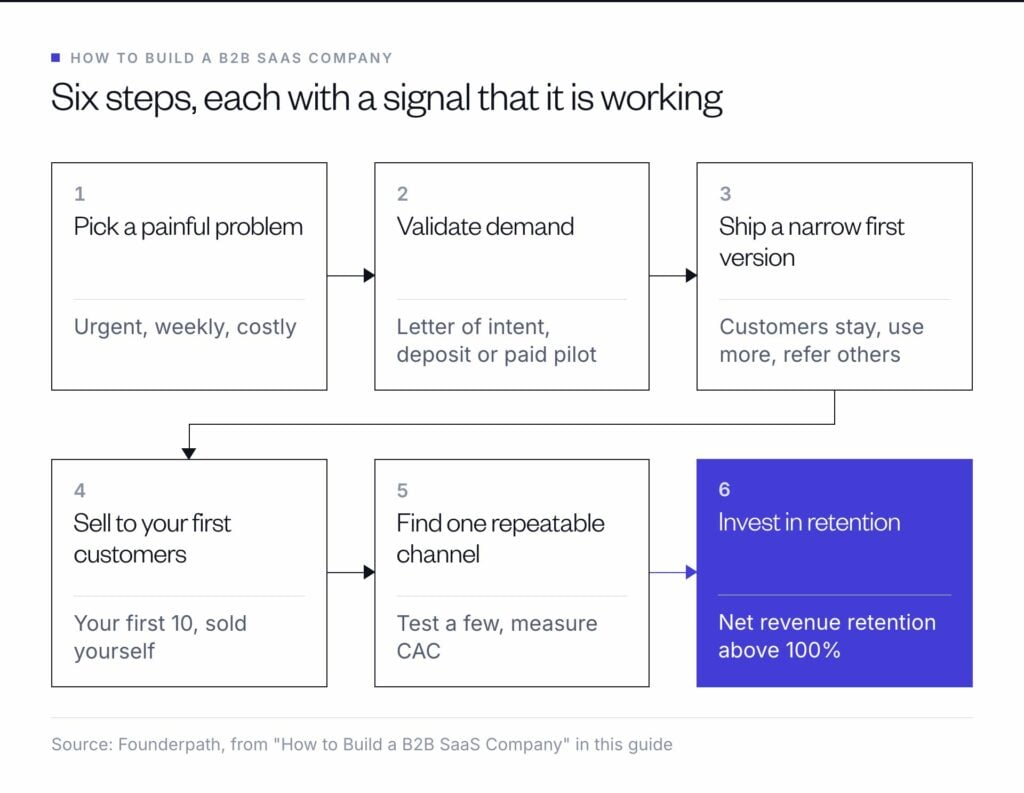
1. Pick a painful, frequent problem
The best B2B SaaS ideas come from a problem the founder has seen at work: a manual process, a spreadsheet everyone hates, data stuck in separate tools. Look for a problem that is urgent, happens every week and costs the business real time or money.
2. Validate demand before you build
Talk to potential buyers about how they handle the problem today and what it costs them. The strongest signal is money: a letter of intent, a deposit or a paid pilot. A free “yes, I’d use that” is not validation.
3. Ship a narrow first version and find product-market fit
Build the smallest product that solves the core problem well, then improve it with your first customers. Product-market fit shows up as customers who stay, use the product more over time and refer others. Marc Andreessen, who popularized the term, described what its absence feels like in “The only thing that matters” (2007):
You can always feel when product/market fit isn’t happening. The customers aren’t quite getting value out of the product, word of mouth isn’t spreading, usage isn’t growing that fast, press reviews are kind of “blah”, the sales cycle takes too long, and lots of deals never close.
Marc Andreessen, co-founder, Andreessen Horowitz. The only thing that matters
4. Sell to the first customers yourself
Your first 10 customers usually come from direct outreach, your network and pilots, not from marketing. Founder-led sales teaches you the buyer’s language, the objections and the price they’ll accept, which you need before you hire anyone to sell.
5. Find one repeatable acquisition channel
The common B2B SaaS channels are content and SEO, product-led growth (a free plan or trial), outbound sales, paid ads and partnerships. Test a few, measure CAC for each, then put most of your effort into the one that works. Acquisition keeps getting more expensive: ProfitWell research found in 2020 that B2B customer acquisition costs were up roughly 60% compared with five years earlier.
6. Invest in retention and expansion
In B2B SaaS, the first sale is only the start of the revenue. Onboarding, customer success and features that grow with the customer’s team are what lift net revenue retention above 100%. Watch the early signs of churn, like falling usage, unanswered check-ins and failed payments, and act before the renewal date.
How to Fund a B2B SaaS Company
SaaS companies spend money to win a customer up front and earn it back over months of subscription payments, so growth often needs capital before the revenue arrives. The main options:
- Bootstrapping: fund the company with your own money and customer revenue. You keep all the equity, and growth is only a little slower: SaaS Capital’s 2026 survey puts median growth at 20% for bootstrapped companies against 25% for equity-backed ones.
- Venture capital: sell equity to investors in exchange for capital to grow fast. It suits companies chasing very large markets, at the cost of dilution, a board and pressure to grow at any cost.
- Revenue-based financing: borrow against your recurring revenue and repay from future revenue. It’s non-dilutive, so you keep your equity.
- Term loans: a fixed amount repaid over a set term, usually for more mature SaaS companies with steady revenue.
For a full comparison of the non-dilutive options, see our guide to SaaS financing.
Frequently Asked Questions
What is B2B SaaS in simple terms?
It’s software that companies rent from another company instead of buying and installing it. The vendor hosts the software in the cloud, the customer’s team logs in through a browser, and the customer pays a monthly or annual subscription.
What are examples of B2B SaaS companies?
Salesforce (CRM), HubSpot (marketing and CRM), Slack (team chat), ServiceNow (IT workflows), Atlassian (Jira and Confluence), Datadog (cloud monitoring), Workday (HR) and QuickBooks Online (accounting). Toast and Veeva are examples of vertical SaaS built for one industry.
What is the difference between B2B and B2C SaaS?
B2B SaaS sells to businesses, with larger contracts, several decision makers and longer sales cycles. B2C SaaS sells to individuals, usually for a low monthly fee with a self-serve signup. Netflix and Spotify are B2C; Salesforce and Slack are B2B.
What is the difference between B2B SaaS and enterprise SaaS?
Enterprise SaaS is the segment of B2B SaaS sold to large organizations. It involves bigger contracts, security and procurement reviews, and longer sales cycles. B2B SaaS also includes software for small and mid-sized businesses, which is usually cheaper and sold self-serve.
Is ChatGPT a SaaS?
Yes. OpenAI hosts ChatGPT and sells it as a subscription that people use in a browser or app, which is the SaaS model. Its individual plans are B2C SaaS, and its business and enterprise plans, sold to companies, are B2B SaaS.
How do B2B SaaS companies make money?
Through recurring subscriptions, priced per seat, by usage, in tiers or at a flat rate. Revenue grows by winning new customers and by expansion: existing customers adding seats, upgrading plans or using more. The median private B2B SaaS company keeps about 80% of software revenue as gross margin, according to Benchmarkit’s 2026 report.
What metrics matter most for B2B SaaS?
ARR and its growth rate, gross margin, net and gross revenue retention, CAC payback and the ratio of customer lifetime value to acquisition cost. Current medians for private companies are about 22% annual growth, 80% software gross margin, 102% net revenue retention and a 16-month CAC payback.
How can I fund a B2B SaaS company without giving up equity?
Bootstrap from customer revenue, or use non-dilutive financing such as revenue-based financing or term loans, which lend against your recurring revenue instead of buying shares. Founderpath, for example, funds B2B SaaS companies with at least $10K MRR without taking equity.
Grow Your B2B SaaS Company Without Giving Up Equity
Recurring revenue is what makes B2B SaaS valuable, and it’s also something you can borrow against instead of selling shares.
Founderpath provides non-dilutive capital for B2B SaaS companies with at least $10K MRR. There’s no equity, no warrants, no board seats and no personal guarantees. Connect your billing, banking and accounting data, and most founders see funds within 24-48 hours.
Check what you qualify for. It takes less than 5 minutes.
Tags
Recent Articles

CARR vs ARR: What Contracted ARR Is and How It Differs
CARR is your ARR plus signed contracts that aren't live yet, minus churn notices. How to calculate CARR, how it differs from ARR, bookings and RPO, and how to report it honestly.

What Is a UCC Filing? What It Means When a Lender Files One
A UCC filing is a public notice that a lender has a lien on some or all of your business assets. What a UCC-1 contains, how long it lasts, how it affects new financing and how to remove one.

What Are Debt Warrants? How Venture Debt Warrants Work
Debt warrants give a lender the right to buy shares at a fixed price alongside a loan. How warrant coverage works, what it costs in dilution, and which lenders take warrants.