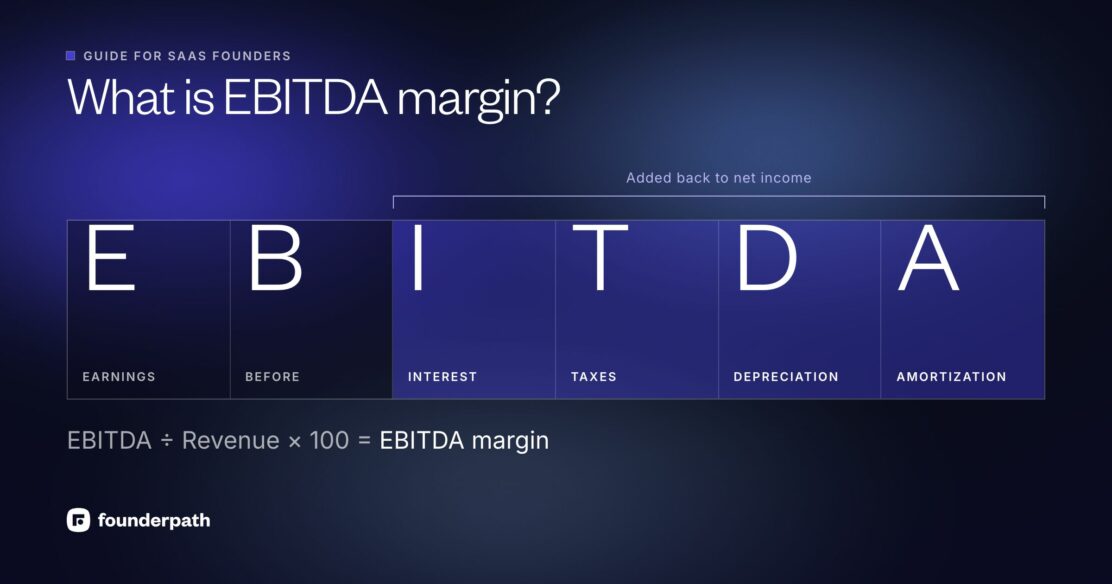

EBITDA margin is a company’s earnings before interest, taxes, depreciation and amortization (EBITDA) divided by its revenue, shown as a percentage. It measures how much of each dollar of revenue is left as operating profit before financing costs, taxes and non-cash charges: a 20% EBITDA margin means the business keeps 20 cents of every revenue dollar.
Key Takeaways
- The formula is EBITDA margin = EBITDA ÷ revenue × 100, so $2M of EBITDA on $10M of revenue is a 20% EBITDA margin.
- There is no universal “good” EBITDA margin: across all US public companies it was 16.6% in January 2026, against 35.9% for system and application software, according to NYU professor Aswath Damodaran’s industry data.
- Public SaaS companies are only modestly profitable on this measure: the median EBITDA margin in Software Equity Group’s SaaS Index was 9.1% in 2025.
- Bootstrapped SaaS companies run closer to profit: in SaaS Capital’s 2026 survey, 83% of bootstrapped companies were within two points of breakeven or profitable, against 52% of equity-backed companies.
- Investors judge margin together with growth through the Rule of 40, and McKinsey found that only about a third of software companies reach it.
What Is EBITDA Margin?
EBITDA margin is a profitability ratio. It shows how efficiently a business turns revenue into operating profit, before the effects of how it is financed (interest), where it pays tax (taxes) and how it accounts for past investments (depreciation and amortization).
Because it strips out those items, EBITDA margin makes it easier to compare companies with different debt levels, tax situations and asset bases. That is why buyers, lenders and investors use it as a quick read on operating efficiency, especially when comparing companies within the same industry.
EBITDA Margin Formula
EBITDA margin = (EBITDA ÷ total revenue) × 100
You can calculate EBITDA two ways, and both should give the same answer:
- From net income: EBITDA = net income + interest + taxes + depreciation + amortization.
- From operating income: EBITDA = operating income (EBIT) + depreciation + amortization.
Worked Example
A SaaS company with $10M of revenue and $1.2M of net income paid $0.2M of interest and $0.3M of taxes, and recorded $0.3M of depreciation and amortization (D&A):
| Line | Amount |
|---|---|
| Net income | $1.2M |
| + Interest | $0.2M |
| + Taxes | $0.3M |
| + Depreciation and amortization | $0.3M |
| = EBITDA | $2.0M |
| ÷ Revenue | $10.0M |
| = EBITDA margin | 20% |
The company keeps 20 cents of operating profit from every dollar of revenue. To run your own numbers, use our free EBITDA margin calculator, which works from revenue and EBITDA or builds EBITDA up from net income.
EBITDA vs. Adjusted EBITDA
Many SaaS companies report adjusted EBITDA, which also adds back stock-based compensation and one-time costs such as restructuring or acquisition fees. Adjusted EBITDA margin is usually the higher number, so check which definition a benchmark uses before you compare yours with it.
What Is a Good EBITDA Margin?
A good EBITDA margin is one that is higher than your peers in the same industry, at a similar stage. There is no single number, because cost structures differ: a software company has no inventory or factories, so far more of its revenue reaches EBITDA than a retailer’s.
EBITDA Margin by Industry
Aswath Damodaran’s January 2026 dataset at NYU Stern gives the EBITDA margin (EBITDA/Sales) of US public companies by industry:
| Industry (US public companies) | EBITDA margin |
|---|---|
| Software (system and application) | 35.9% |
| Computers and peripherals | 25.3% |
| Financial services (non-bank and insurance) | 21.0% |
| Healthcare products | 20.3% |
| Machinery | 19.6% |
| Restaurants and dining | 19.5% |
| Business and consumer services | 15.7% |
| Retail (general) | 10.1% |
| Software (internet) | 9.5% |
| Total US market | 16.6% |
Two cautions before you compare. These are aggregate figures (total EBITDA divided by total revenue for each industry), so the largest companies dominate them. And they describe public companies, mostly far larger than a private SaaS business with a few million dollars of ARR.
SaaS EBITDA Margin Benchmarks
For SaaS specifically, the benchmarks that matter depend on whether you compare yourself with public companies or with private companies like yours:
- Public SaaS: the median EBITDA margin across the SEG SaaS Index rose to 9.1% in 2025, according to Software Equity Group’s 2026 Annual SaaS Report. By SaaS Capital’s measure, the median public SaaS company’s operating margin climbed from negative 21% in mid-2022 to positive 3% in February 2026 (SaaS Capital, March 2026).
- Private equity-backed SaaS: SaaS Capital’s 2025 analysis found the median equity-backed company still unprofitable, though improving: companies with $1M to $3M of ARR went from a median profitability of negative 53% to negative 8% between the 2023 and 2025 surveys.
- Private bootstrapped SaaS: in the same analysis, the median bootstrapped company was breakeven or profitable at every revenue scale.
SaaS Capital’s 2026 spending benchmarks show the gap from another angle. The median bootstrapped company spends 96% of ARR across all departments and the median equity-backed company 101%. By that measure, 83% of bootstrapped companies are within two percentage points of breakeven or profitable, compared with 52% of equity-backed companies.
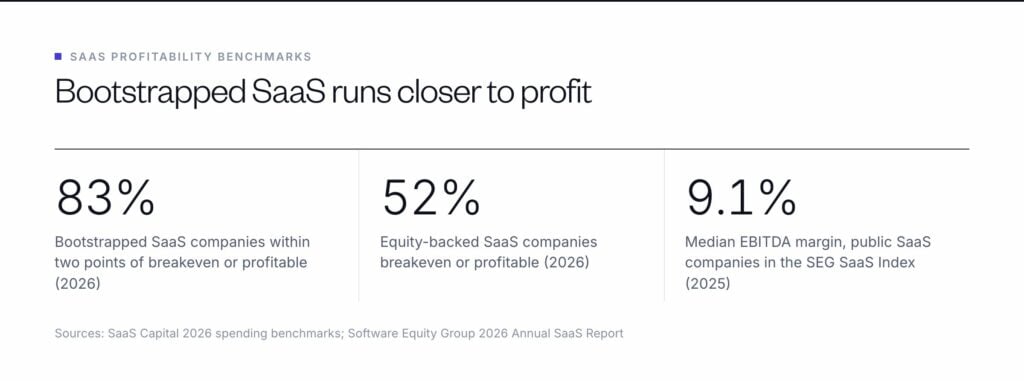
So a positive EBITDA margin already puts a private SaaS company ahead of the median equity-backed peer, and a margin above 9.1% is higher than the median public SaaS company’s. Whether your number is good enough depends on how fast you are growing, which is what the Rule of 40 measures.
Why EBITDA Margin Matters for SaaS Founders
Even if you never plan to sell, EBITDA margin shapes three decisions:
- What the company is worth. Once a business is profitable, buyers, especially private equity firms, usually price it as a multiple of EBITDA. A higher margin on the same revenue means more EBITDA to multiply.
- What you can borrow. Many lenders size loans and set covenants off EBITDA, so a business with consistent EBITDA has more financing options.
- How much growth you can fund yourself. EBITDA is a rough proxy for the cash your operations generate, which is the money a bootstrapped company reinvests.
Henry Schuck bootstrapped DiscoverOrg, the company that became ZoomInfo, on a small amount of credit card financing. He describes how profitability decided who wanted to buy it:
So we ran the business in this really profitable way, and then we started getting calls … from venture capital firms and private equity firms. The private equity firms ended up being the ones most interested in us because we had profitability, and that’s what they would give a multiple off of.
Henry Schuck, CEO and founder, ZoomInfo ($1.2B revenue). Watch at 5:45
EBITDA Margin and the Rule of 40
The Rule of 40 is the most common way to judge growth and profitability together:
Rule of 40 score = revenue growth rate (%) + EBITDA margin (%)
Some investors use free cash flow margin instead of EBITDA margin; the logic is the same.
A score of 40 or more signals a healthy balance. It lets a fast-growing company run at a loss and a slower one make it up in profit:
| Revenue growth | EBITDA margin | Rule of 40 score | Result |
|---|---|---|---|
| 50% | -10% | 40 | Passes: growth pays for the losses |
| 30% | 10% | 40 | Passes: balanced |
| 15% | 25% | 40 | Passes: profit makes up for slower growth |
| 20% | 10% | 30 | Falls short |
Few companies clear the bar. In an August 2021 study, McKinsey found that barely one-third of software companies achieve the Rule of 40; across more than 200 software companies from 2011 to 2021, they exceeded it only 16% of the time. Those that did were rewarded: top-quartile SaaS companies earned nearly three times the enterprise value to revenue multiples of those in the bottom quartile.
Mark Douglas built LCPTracker without outside debt or equity, and he uses the margin side of the rule deliberately: hold profit at a set level and put the rest into growth.
I said, look, I’m going to manage my profit margin right around 10%, everything else goes into growth. So we’ve been investing consistently … but we are now at a point … where I can really start accelerating my profit, because I feel like I can scale at the same pace with this infrastructure and the people.
Mark Douglas, CEO, LCPTracker (bootstrapped, no outside debt or equity). Watch at 5:20
Check your own score with our Rule of 40 calculator.
How EBITDA Margin Affects SaaS Valuation
Profitable SaaS companies are often valued on a multiple of EBITDA, and the multiple itself depends heavily on size. Small private deals trade at far lower multiples than public companies or large acquisitions:
| Company size | EBITDA multiple | Source |
|---|---|---|
| Under $1M ARR, owner-operated | 2x to 4x profit | Flippa, 2026 |
| $1M to $3M EBITDA | 8.7x (average) | First Page Sage, H1 2025 |
| $3M to $5M EBITDA | 11.1x (average) | First Page Sage, H1 2025 |
| $5M to $10M EBITDA | 12.4x (average) | First Page Sage, H1 2025 |
| B2B SaaS companies | about 29.7x (median) | SEG, year-end 2025 |
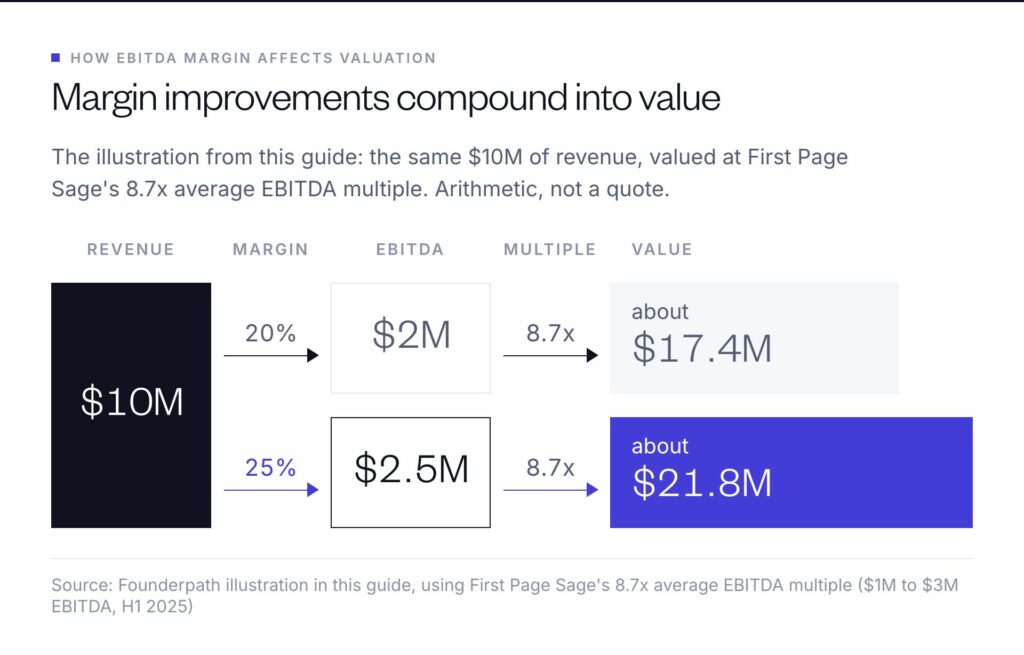
Because the multiple applies to EBITDA, margin improvements compound into value. As an illustration: a company with $10M of revenue and a 20% margin has $2M of EBITDA, worth about $17.4M at First Page Sage’s 8.7x average. Lift the margin to 25% on the same revenue and EBITDA becomes $2.5M, worth about $21.8M at the same multiple. Real multiples move with growth, retention and gross margin, so treat this as arithmetic, not a quote.
Thomas Smale, whose firm FE International advises on software acquisitions, said in a 2024 talk that FE’s deal data showed buyers now pay for margin and growth together:
Rule of 40 is your revenue growth rate plus your [EBITDA] margin. If that exceeds 40 … those businesses are selling for higher multiples. … If you go back three years ago … buyers did not necessarily care about your profitability, but today a combination of the two is important.
Thomas Smale, CEO, FE International ($39M revenue). Watch at 6:44
To estimate what your company could be worth, try our SaaS valuation calculator.
SDE vs. EBITDA for Smaller SaaS Businesses
Smaller businesses are often valued on seller’s discretionary earnings (SDE) instead. SDE adds the owner’s salary and discretionary expenses back to profit, because the buyer will usually run the business themselves; EBITDA assumes a paid management team. According to business broker Midstreet (2021):
- Businesses with under $1M in earnings are usually valued on SDE, typically at 2x to 3x, and up to 4x near $1M of SDE.
- Businesses with $1.5M or more in earnings are usually valued on EBITDA: 3x to 6x for $1M to $2M of earnings, and 4x to 7x or more above $2M.
- Between $1M and $1.5M of earnings, buyers may use either.
Midstreet’s figures cover businesses in general, not only SaaS, but the rule of thumb holds: once a buyer would need to hire someone to replace you, they will look at EBITDA.
EBITDA Margin vs. Operating, Net and Gross Margin
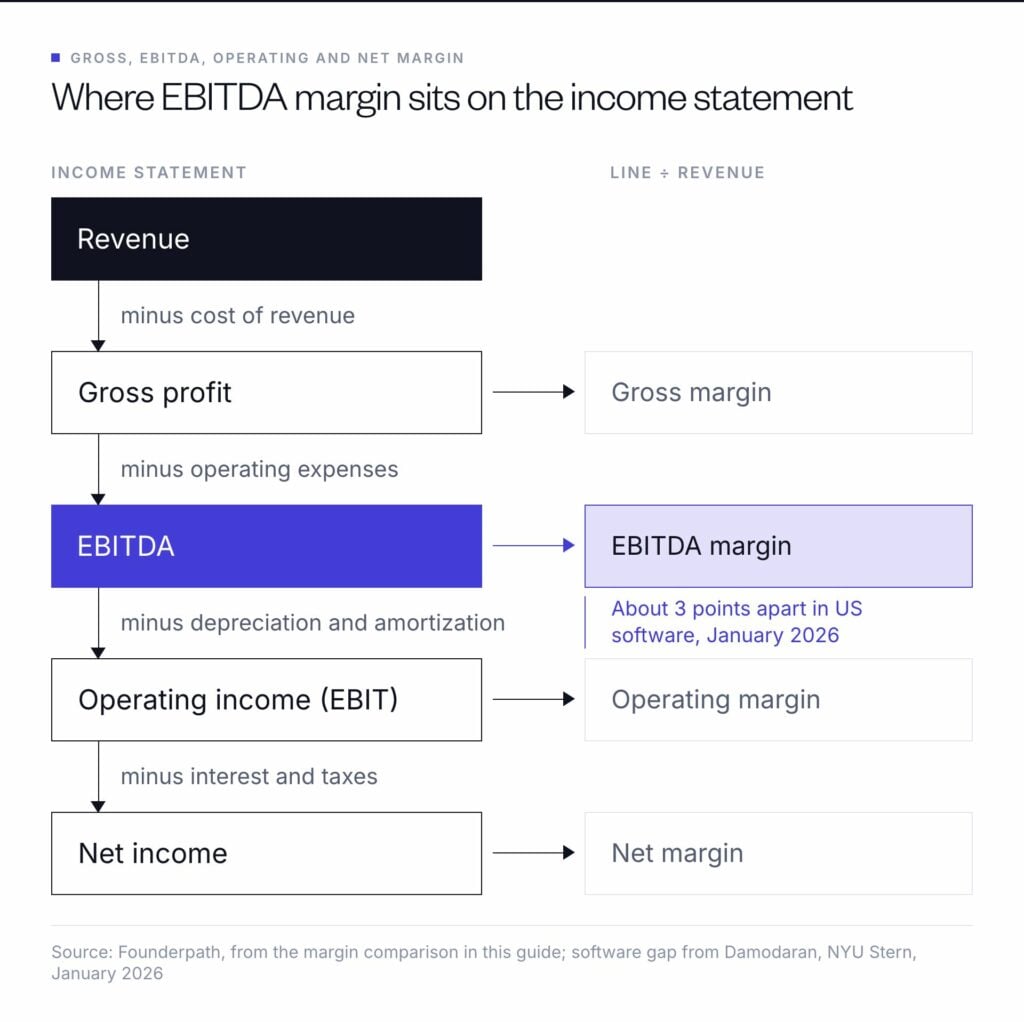
EBITDA margin sits between gross margin and net margin on the income statement. Each one answers a different question:
| Margin | Formula | What it tells you |
|---|---|---|
| Gross margin | (Revenue minus cost of revenue) ÷ revenue | How much each sale contributes after the direct cost of delivering it |
| EBITDA margin | EBITDA ÷ revenue | Operating profit before financing, taxes and non-cash charges |
| Operating margin | Operating income (EBIT) ÷ revenue | Operating profit after depreciation and amortization |
| Net margin | Net income ÷ revenue | What is left after every cost, including interest and taxes |
For asset-light software companies, EBITDA margin and operating margin are usually close, because depreciation and amortization are small. In Damodaran’s January 2026 data, US system and application software companies had a 72% gross margin, a 33% operating margin and a 36% EBITDA margin: a gap of about 3 percentage points between the last two. The gap widens if a company capitalizes a lot of software development or has acquired intangible assets to amortize.
To see all four margins for your own company, use our SaaS profit margin calculator.
How to Improve Your EBITDA Margin
The goal is to convert more revenue into profit without starving growth. For SaaS companies, the biggest levers are:
- Keep the customers you have. Every churned dollar has to be replaced with new sales, which costs far more. SaaS Capital’s 2026 benchmarks for bootstrapped companies put median gross revenue retention at 91% and net revenue retention at 103% for those with $3M to $20M of ARR. Track yours with our churn rate and NRR calculators.
- Review pricing. A price increase on customers who already get value flows almost entirely to EBITDA, because the cost of serving them does not change.
- Spend on acquisition with discipline. SaaS Capital’s 2026 survey found equity-backed companies spend 100% more on marketing and 70% more on sales than bootstrapped ones, relative to revenue. Cut channels whose customer acquisition cost does not pay back.
- Watch hosting and delivery costs. The median private SaaS company spends 5% of ARR on hosting, according to SaaS Capital’s 2026 survey. Compare each department with the medians in our SaaS spending benchmark.
Cutting costs that drive growth can lift this year’s margin and lower next year’s revenue. Use the Rule of 40 as the check: a margin gain that costs more in growth than it adds in profit leaves the score, and usually the valuation, worse.
Limitations of EBITDA Margin
EBITDA margin is useful, but it leaves out real costs:
- Capital spending: EBITDA ignores what a company spends on equipment and capitalized software development. For most SaaS companies this is small, but not always.
- Stock-based compensation: adjusted EBITDA adds it back, which can flatter the margin of a company that pays employees heavily in equity.
- Working capital: a company can show positive EBITDA and still burn cash if customers pay late.
- Debt: two companies with the same EBITDA margin can be in very different health if one carries heavy interest payments.
Warren Buffett made the depreciation point in his 2002 letter to Berkshire Hathaway shareholders:
Trumpeting EBITDA (earnings before interest, taxes, depreciation and amortization) is a particularly pernicious practice. Doing so implies that depreciation is not truly an expense, given that it is a “non-cash” charge. That’s nonsense.
Warren Buffett, Chairman, Berkshire Hathaway. 2002 shareholder letter
For asset-light SaaS companies the criticism matters less than for capital-intensive industries, but it is a good reason to look at cash flow next to EBITDA margin.
EBITDA Margin and Funding Growth
Interest and other financing costs sit below the EBITDA line. That makes debt a way to fund growth without diluting ownership, and the financing cost itself does not reduce EBITDA margin. Lenders that lend against EBITDA generally want a business that is already consistently profitable; revenue-based financing is underwritten on recurring revenue instead, so it is open to SaaS companies that are still reinvesting most of their margin. See our guide to bootstrap financing for how the options compare.
EBITDA Margin FAQ
What is a good EBITDA margin?
It depends on the industry. Across all US public companies the aggregate EBITDA margin was 16.6% in January 2026, and 35.9% for system and application software, according to Aswath Damodaran’s NYU Stern data. For SaaS, the median EBITDA margin in Software Equity Group’s public SaaS Index was 9.1% in 2025, and the median private bootstrapped company is breakeven or profitable. Judge your margin together with your growth rate using the Rule of 40.
Is a 20% EBITDA margin good?
Yes, for most businesses. A 20% EBITDA margin means the company keeps 20 cents of every revenue dollar as operating profit before interest, taxes, depreciation and amortization. That is above the 16.6% aggregate for US public companies in Damodaran’s January 2026 data and more than double the 9.1% median for public SaaS companies in 2025.
Is a 30% EBITDA margin good?
Yes. A 30% EBITDA margin is more than three times the 9.1% median for public SaaS companies in 2025 and well above the 16.6% aggregate for US public companies. Large public software companies run higher, at 35.9% in aggregate, because they combine high gross margins with scale.
How do you calculate EBITDA margin?
Divide EBITDA by total revenue and multiply by 100. First calculate EBITDA by adding interest, taxes, depreciation and amortization back to net income, or by adding depreciation and amortization to operating income. For example, $2M of EBITDA on $10M of revenue is a 20% EBITDA margin.
What does EBITDA margin tell you?
It tells you how efficiently a company turns revenue into operating profit, before financing decisions, taxes and non-cash accounting charges. Because it removes those items, it is useful for comparing companies in the same industry. It does not show cash flow, capital spending or the cost of debt.
What is the Rule of 40 for EBITDA?
The Rule of 40 adds a company’s revenue growth rate to its EBITDA margin. A score of 40 or more is considered healthy, for example 30% growth with a 10% EBITDA margin. McKinsey found that barely one-third of software companies achieve it, and that top-quartile SaaS companies on the measure earn nearly three times the revenue multiples of the bottom quartile.
What is the difference between EBITDA margin and operating margin?
Operating margin is operating income divided by revenue, so it includes depreciation and amortization as costs. EBITDA margin adds them back, so it is always equal to or higher than operating margin. For asset-light software companies the gap is small: about 3 percentage points for US public software companies in January 2026.
What is the difference between SDE and EBITDA?
Seller’s discretionary earnings (SDE) adds the owner’s salary and discretionary expenses back to profit, while EBITDA assumes the business pays a management team. Businesses with under about $1M in earnings are usually valued on SDE, and businesses with $1.5M or more on EBITDA.
Grow Without Giving Up Equity
A strong EBITDA margin gives you choices: reinvest, borrow on good terms or sell from a position of strength. Funding the next stage of growth shouldn’t mean giving up the ownership that margin has earned.
Founderpath provides non-dilutive capital for B2B SaaS companies with at least $10K MRR. There’s no equity, no warrants, no board seats and no personal guarantees. Connect your billing, banking and accounting data, and most founders see funds within 24-48 hours.
Check what you qualify for. It takes less than 5 minutes.
Recent Articles

CARR vs ARR: What Contracted ARR Is and How It Differs
CARR is your ARR plus signed contracts that aren't live yet, minus churn notices. How to calculate CARR, how it differs from ARR, bookings and RPO, and how to report it honestly.

What Is a UCC Filing? What It Means When a Lender Files One
A UCC filing is a public notice that a lender has a lien on some or all of your business assets. What a UCC-1 contains, how long it lasts, how it affects new financing and how to remove one.

What Are Debt Warrants? How Venture Debt Warrants Work
Debt warrants give a lender the right to buy shares at a fixed price alongside a loan. How warrant coverage works, what it costs in dilution, and which lenders take warrants.