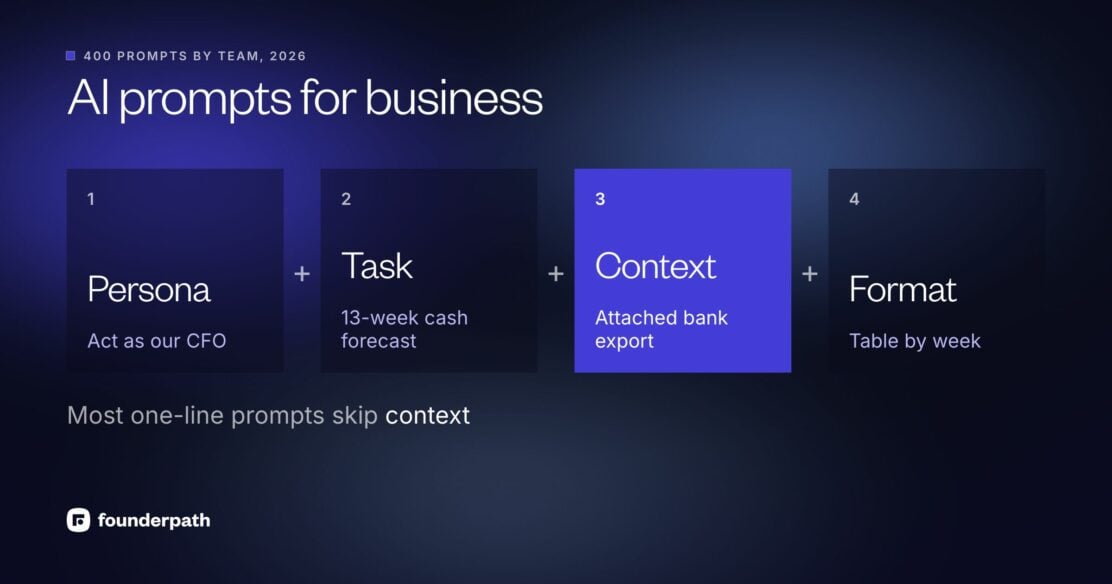

AI prompts for business are written instructions you give an AI assistant such as ChatGPT, Claude, Gemini or Copilot to do a work task: draft an investor update, analyze a sales export, answer a support ticket. The ones that work name a role for the AI, the task, the context (ideally your own data, attached) and the format you want back.
Below are 400 prompts sorted by team, from finance to HR, plus the four-part method for turning any of them into a prompt that returns something you can use.
Key Takeaways
- A strong business prompt has four parts: persona, task, context and format, the structure Google’s Gemini for Workspace prompting guide teaches.
- Google found the most useful prompts averaged about 21 words with relevant context, while the prompts people actually tried were usually under nine words (Gemini for Workspace prompt guide, October 2024).
- Writing is the most common work use of ChatGPT, at 40% of work-related messages in June 2025, and about two-thirds of those messages ask it to edit text the user already has (NBER working paper 34255, 2025).
- Current models matched or beat industry experts on 84.9% of well-specified tasks in OpenAI’s GDPval test (GPT-5.5, April 2026) but delivered client-ready work on only about 21% of real freelance projects on the Remote Labor Index (October 2026).
- About one in five US businesses (19.8%) used AI in a business function in the two weeks to May 3, 2026 (US Census Bureau Business Trends and Outlook Survey).
- In Anthropic’s analysis of about 400,000 Claude Code sessions from October 2025 to April 2026, people outside software jobs reached verified success in 29% of code-producing sessions, against 34% for software occupations.
How to write an AI prompt for business
A prompt is the input you give the model to get a specific response, as Google Cloud defines it. For business work, Google’s prompting guide for Gemini in Workspace breaks a good prompt into four parts:
- Persona: who the AI should act as. “You are the CFO of a B2B SaaS company” gets a different answer than no role at all.
- Task: one clear job, with a verb. “Build a 13-week cash forecast” rather than “help with cash”.
- Context: the facts the AI can’t know: your numbers, your customer, your constraints. In 2026 that usually means attaching the file.
- Format: what you want back. A table with named columns, a 150-word email, five bullet points.
Most one-line prompts skip the context, which is why the 2026 starter prompts below say what to attach. Google found the prompts that worked best averaged about 21 words with relevant context, while the prompts people actually typed were usually under nine words (Gemini for Workspace prompt guide, October 2024). Anthropic gives the same advice for Claude:
Think of Claude as a brilliant but new employee who lacks context on your norms and workflows. The more precisely you explain what you want, the better the result.
Anthropic, Claude prompting best practices
OpenAI’s guidance says the same in fewer words: make prompts “clear, specific” and give “enough context for the model to understand what you are asking” (OpenAI Help Center).
Worked example: one line to four parts
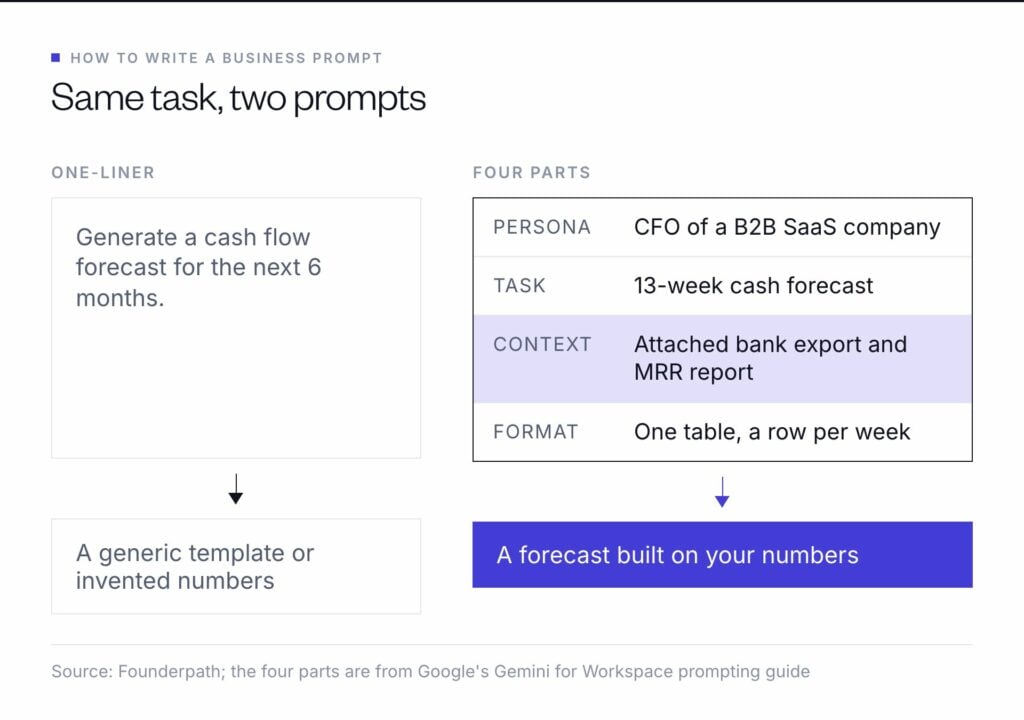
Here is the cash flow prompt as it appeared in the 2025 version of this list, a one-liner:
Generate a cash flow forecast for the next 6 months.
With nothing to work from, the AI can only return a generic template or make up numbers. The same task with all four parts:
You are the CFO of a B2B SaaS company with [$ARR] in annual recurring revenue.
Build a 13-week cash flow forecast from the attached bank export and MRR report.
Assume [X]% monthly growth in new MRR, and use the payroll and rent dates listed below.
Return one table with a row per week: opening cash, cash in, cash out, closing cash.
Then name the three weeks with the lowest balance and what drives each one.
Three habits that make any prompt better
- Give it your draft. Editing beats starting from nothing. About two-thirds of work-related writing messages to ChatGPT ask it to modify text the user supplies, such as editing, critiquing or translating, according to an NBER working paper by OpenAI, Duke and Harvard researchers (June 2025 data).
- Show an example of good output. Paste one or two past emails, posts or reports you liked and ask for the same structure and tone.
- Ask for the format you’ll paste somewhere. A table for a spreadsheet, plain text for an email, bullet points for a slide.
What changed for business prompts in 2026
The biggest change is that the assistants now work on your files and tools, not just on what you type. That is why every data-heavy prompt in the 2026 list says what to attach.
- Files and spreadsheets. “ChatGPT can work with documents, spreadsheets, presentations, images, and audio files you attach to a conversation” (OpenAI). Claude reads PDF, DOCX, CSV and XLSX uploads (Anthropic), and Gemini works inside Google Sheets to “create tables, formulas, and analyze your data” (Google).
- Connected apps. ChatGPT apps “connect ChatGPT to services you already use, such as Google Drive or Slack” (OpenAI), and Claude connectors let it “access your apps and services, retrieve your data, and take actions” (Anthropic). A prompt can now say “using our CRM” instead of pasting a list.
- Research that runs for minutes, not seconds. ChatGPT deep research “can work with uploaded files, search the public web or specific sites, and use enabled ChatGPT apps” (OpenAI). Use it for competitor, market and pricing research prompts.
Most businesses haven’t caught up. The US Census Bureau’s survey put AI use at 19.8% of US businesses as of May 3, 2026, and below 20% for firms with four or fewer employees (Census Bureau, May 2026). Larger companies are further along: in McKinsey’s 2026 survey, “nearly nine in ten respondents report regular use of AI in at least one business function” (McKinsey, The State of AI), though McKinsey’s sample skews toward companies with over $1B in revenue.
One rule hasn’t changed: only put company or customer data into an AI tool your company has approved, on a plan whose data settings you’ve checked.
Non-technical founders now ship code with coding agents
The biggest shift for non-technical leaders in 2026 is that a prompt no longer has to end in a document. With a coding agent such as Claude Code or OpenAI Codex, a CEO, product owner or marketer can describe a change in plain words and get back a pull request against the company’s real codebase, once the tech team has set the repository up for agents.
Anthropic’s data points the same way. Across about 400,000 Claude Code sessions from October 2025 to April 2026, code-producing sessions by people outside software jobs reached what Anthropic calls verified success 29% of the time, against 34% for software occupations, and Anthropic concluded that “coding agents are making a coding background less relevant to successful programming” (Anthropic, June 2026). Knowing the business still matters: novices reached verified success only 15% of the time.
Founderpath’s own CEO is one of these founders. Asked how he uses AI, Nathan Latka answered on LinkedIn:
My best answer: 1,241 pull requests since March.
Nathan Latka, CEO, Founderpath, September 2, 2026. See the post on LinkedIn
How it works: the tech team writes the rules once
The setup is the tech team’s job, and it happens once. They add a guidelines file to the repository, usually AGENTS.md, an open format “used by over 60k open-source projects”, or CLAUDE.md, which Claude Code “reads at the start of every session” (Anthropic). It holds what an engineer would tell a new hire: how pages are built, which components and brand rules to use, and which checks must pass before work is handed back. The agent treats it as context, not as enforced rules, so an engineer still reviews every pull request.
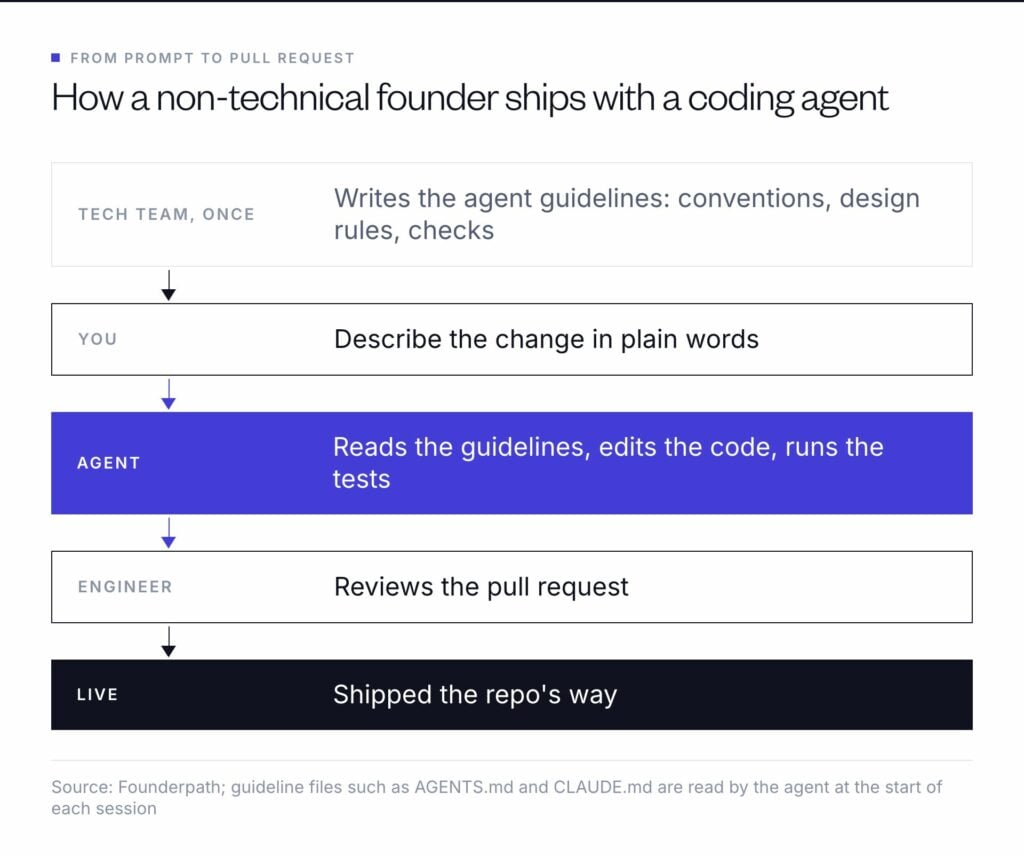
Marketing is the easiest place to start. Landing page copy, FAQ sections, free tools and SEO fixes are contained changes with clear rules, and the repository’s own checks run before anyone reviews the result. A prompt for a coding agent has the same four parts as any other, with the repository as the context:
Read AGENTS.md first.
Add an FAQ section to the pricing page with the five questions below,
using the site's existing FAQ component and brand rules.
Run the lint, type check and tests, and fix anything that fails.
Then open a pull request with a one-paragraph summary of what changed.
[questions]
Use a frontier model and an agent workspace
The model matters more for code than for copy, because the output has to run. On Terminal-Bench 2.1, an independent benchmark that gives credit only when all of a task’s tests pass, the top models, Claude Opus 5.5 and GPT-6 Astra, passed about 87% of tasks (Vals AI, September 2026), though Opus 5.5 leaned on older fallback models for 26 of the 267 tasks. Use the current top model from Anthropic or OpenAI, not a cheaper default.
To run several agents at once without them getting in each other’s way, use an agent workspace app. Conductor “lets you run Claude Code, Codex, Cursor, and OpenCode in parallel” and gives each task its own workspace and branch; local use on a Mac is free. Paseo is a free, open-source alternative for Claude Code, Codex and more than 30 other agents, on desktop and phone. If the terminal is new to you, ask someone technical on your team for a 30-minute walkthrough: install the app, connect the repository and ship one small change together.
The 10 AI prompts to start with
If you only try ten, try these. Each one uses all four parts, so it works as written once you fill in the brackets and attach the file.
- Finance: 13-week cash forecast. “You are the CFO of a B2B SaaS company with [$ARR] in ARR. Build a 13-week cash flow forecast from the attached bank export and MRR report. Return one table with a row per week: opening cash, cash in, cash out, closing cash. Then name the three weeks with the lowest balance and what drives each.”
- Fundraising: monthly investor update. “Act as our head of investor relations. Write this month’s investor update from the attached metrics sheet and my notes below. Use four sections: highlights, key metrics (MRR, net new MRR, churn, cash, runway), lowlights and asks. Keep it under 300 words and copy every number exactly as it appears in the sheet.”
- Marketing: on-brand first draft. “Act as a B2B content marketer. Here are three of our best-performing posts [attach]. Write a first draft on [topic] for [ideal customer] in the same structure and tone. Give me three headline options, then the draft with subheadings, under 1,200 words.”
- Sales: RFI answer. “You are a sales engineer for [product]. Using only the attached product docs and case studies, answer this RFI question in under 500 words: [question]. If a requirement isn’t covered by the documents, flag it instead of guessing.”
- Customer success: churn risk list. “Act as a customer success manager. From the attached usage export, list the 10 accounts most likely to churn next quarter, the signal behind each (logins, seats, support tickets) and one action to take this week. Return a table.”
- Support: ticket reply from your help center. “Using only the attached help-center articles, draft a reply to this ticket: [ticket]. Keep it under 150 words, link the article you used, and tell me if the articles don’t answer the question.”
- Product: feature request themes. “You are a product manager. Group the attached feature requests into themes. For each theme, count the requests and unique customers, and total the ARR of the accounts asking (column [X]). Return a table ranked by ARR and a two-sentence summary.”
- Engineering: pull request review. “You are a senior engineer. Review the attached diff for bugs, security issues and missing tests. List each issue with the file and line, how serious it is and a suggested fix. Skip style comments.”
- Leadership: stress-test the plan. “Act as a skeptical board member. Read our attached plan for next year and list the five assumptions most likely to be wrong, why each might be wrong, and what data would settle it.”
- People: job description. “Write a job description for a [role] at a [team size]-person bootstrapped SaaS company. Include the outcomes expected in the first 90 days, must-have and nice-to-have skills, and the salary range [range]. Under 400 words, no buzzwords.”
400 AI prompts for business, by team
The starter prompts below are short on purpose, so you can scan them. Square brackets mark what to fill in, and “attached” marks the file to give the AI. To get a usable answer, add the persona, context and format from the method above. Jump to a team:
- Finance
- Fundraising and investor relations
- Marketing
- Growth
- Sales
- Content and media
- Leadership and strategy
- Customer success
- Support
- Product
- Engineering
- People and HR
AI prompts for finance
Prompts for reporting, bookkeeping, forecasting and the SaaS revenue metrics a founder or finance lead tracks every month. (36 prompts)
AI is fast at finance drafts and unreliable at arithmetic it can’t see, so check its numbers against a fixed tool: the runway calculator for burn and runway prompts, the SaaS financial model template for forecasts, the deferred revenue schedule for revenue recognition and the SaaS chart of accounts to paste into the transaction categorizing prompt.
Financial analysis and reporting
- Monthly finance update: “Write a monthly finance update for internal stakeholders from the attached income statement, balance sheet and bank balances.”
- Quarterly finance summary: “Write a quarterly financial summary for internal stakeholders from the attached income statement and budget, covering revenue, margins, spend and cash.”
- Balance sheet summary: “Turn the attached balance sheet into a plain-English summary of our assets, liabilities and what changed since last month.”
- Tax return summary: “Summarize the key points of the attached tax return: income, deductions, liabilities and anything I should ask my accountant about.”
- Deferred revenue explainer: “Explain deferred revenue to a founder without a finance background, using a simple example of an annual contract paid upfront.”
- Budget vs. actuals review: “Summarize our budget vs. actuals for last quarter from the attached spreadsheet, and explain the three biggest variances.”
- Board financial update deck: “Create a monthly financial performance update deck for the board from the attached income statement and KPI sheet.”
- SaaS metrics dashboard: “Create a SaaS metrics dashboard presentation covering ARR, CAC, LTV and churn from the attached data, with one chart and one takeaway per metric.”
Bookkeeping and controls
- Monthly reconciliation: “Reconcile this month’s QuickBooks transactions in the attached export against the attached bank statement, and list every unmatched item.”
- Income statement anomaly check: “Highlight anomalies in the attached income statement that could signal an error or fraud, and say what I should check for each one.”
- Expense report review: “Review the attached expense report for policy breaks, duplicate claims and suspicious items.”
- Transaction categorizer: “Categorize the transactions in the attached export using SaaS-specific categories such as hosting, software, payroll, marketing and COGS, and flag any you are unsure about.”
- Overdue invoice reminder: “Write a polite but firm reminder email to a customer whose invoice is 30 days overdue, with [invoice number], [amount] and [payment link] as placeholders.”
- Payroll summary: “Draft a payroll summary for this quarter from the attached payroll report, with totals by department, headcount changes and anything unusual.”
- Vendor risk assessment: “Create a vendor risk assessment for [software tool] covering data access, security certifications, contract terms and the cost of switching away.”
- Top customers by margin: “List our top 10 customers by revenue and gross margin from the attached billing export, and flag any customer concentration risk.”
Forecasting and planning
- Three-statement model: “Build a 3-statement financial model for a SaaS company at [$ARR] from the attached historicals, with clear assumptions for growth, churn and hiring.”
- Cash flow forecast: “Generate a 6-month cash flow forecast from the attached bank history, receivables and payables, and list the assumptions behind it.”
- Runway forecast: “Chart our cash runway at the current burn rate from the attached bank balances and monthly expenses, and show how hiring [number] people would change it.”
- ARR projections deck: “Build a slide deck explaining our ARR growth and projections from the attached revenue data, with all assumptions on one slide.”
- Three-year KPI forecast: “Chart our key financial KPIs (ARR, gross margin, burn and headcount) across the 3-year forecast in the attached model.”
- Unit economics presentation: “Create a unit economics presentation from the attached data covering CAC, LTV, payback period and gross margin per customer.”
- Path to profitability: “Write a narrative for our financial projections that explains our path to profitability, using the attached model.”
- CAC reduction plan: “Build a deck outlining a plan to reduce CAC and extend runway, using the attached channel spend and conversion data.”
Revenue and metrics tracking
- MRR movement chart: “Chart MRR movement by month from the attached billing export, split into new, expansion, contraction and churned MRR.”
- LTV by cohort: “Graph customer lifetime value by signup cohort from the attached revenue data.”
- Revenue vs. expenses: “Compare revenue and expenses month by month from the attached income statement, and show the trend toward breakeven.”
- Gross margin by quarter: “Plot gross margin for the last 8 quarters from the attached income statement, and explain what drove the changes.”
- Deferred revenue by month: “Graph deferred revenue by month from the attached billing data.”
- Receivables aging: “Plot accounts receivable aging by customer from the attached AR report, and flag accounts more than 60 days overdue.”
- Gross vs. net revenue: “Show gross vs. net revenue by month from the attached data, with refunds, discounts and payment fees broken out.”
- Burn multiple by quarter: “Calculate and chart our burn multiple by quarter from the attached income statement and ARR data.”
- CAC payback by cohort: “Calculate CAC payback period by customer cohort from the attached spend and revenue data, and chart it.”
- LTV to CAC trend: “Chart our LTV to CAC ratio over time from the attached data, and explain what moved it.”
- ARPU by plan: “Show average revenue per user by plan tier and customer segment from the attached billing export.”
- Revenue by product line: “Chart revenue contribution by product line from the attached revenue data.”
AI prompts for fundraising and investor relations
Prompts for raising equity or debt, telling the company story to investors, modelling dilution and keeping investors informed. (30 prompts)
Before a debt or dilution prompt, get the real numbers: the debt capacity calculator and the dilution calculator give you figures to attach, so the AI explains your scenario instead of inventing one.
Planning a raise
- Debt capacity analysis: “Using the attached financials, estimate how much debt we could raise and the terms to expect, including interest rate range, payback period and covenants.”
- Debt vs. equity comparison: “Compare raising [$amount] as an equity round vs. revenue-based financing for our company, using the attached metrics, and show dilution, total cost of capital and repayment for each.”
- Fundraising readiness check: “Using the attached metrics, list the benchmarks investors typically expect for a [stage] round and show where we meet or miss each one.”
- Fundraising strategy deck: “Draft a fundraising strategy deck showing how much we plan to raise, the use of funds and the milestones it gets us to, from the attached plan.”
- Fundraising timeline: “Create a week-by-week fundraising plan for a [stage] raise, from preparing materials to closing.”
- Strategic investor shortlist: “From the attached list of investors, identify which could add value beyond capital to a [category] company, and explain why for each.”
- Warm intro request: “Write a short, forwardable email asking [contact] for an intro to [investor], with a 3-line blurb about our company.”
- Lender questions prep: “List the questions a revenue-based financing provider is likely to ask about our business, and draft answers from the attached metrics.”
Pitch and narrative
- Pitch deck outline: “Outline a fundraising pitch deck with traction slides built from the attached metrics.”
- Growth and burn deck: “Design an investor pitch deck focused on revenue growth and burn rate, using the attached financials.”
- Investor one-liner: “Write five one-line pitches for [company] that explain what we do and why now, each under 20 words.”
- Founding team story: “Write a short story about our founding team’s unique advantages in [market], based on the attached bios.”
- Technical advantage pitch: “Outline a pitch deck that leads with our technical advantage, based on the attached product and architecture notes.”
- Competitive moat: “Explain our competitive moat in a way that shows defensibility, based on the attached notes on our product, data and customers.”
- Market sizing: “Calculate TAM, SAM and SOM for [product] in [market], showing every assumption and source so I can check them.”
- Market size by region: “Chart our TAM, SAM and SOM estimates by region from the attached market model.”
- Investor objection responses: “Write responses to these investor objections about our business model: [objections].”
- Reply to an investor who passed: “Write a gracious reply to an investor who passed, asking for their feedback and keeping the door open for our next round.”
Cap table and dilution
- Cap table scenarios: “Create a cap table scenario analysis from the attached cap table for [number] different funding outcomes.”
- Series A dilution summary: “Summarize the attached cap table and show ownership by holder before and after a Series A of [$amount] at a [$valuation] pre-money valuation.”
- Dilution by funding path: “Chart founder dilution across different funding paths, such as equity rounds, revenue-based financing and venture debt, using the attached cap table.”
- Valuation multiples: “Compare the valuation multiples from our past rounds using the attached round history and the ARR at each round.”
- Unit economics before and after funding: “Compare our unit economics before and after our last funding round using the attached data.”
Diligence and investor updates
- Data room checklist: “Generate a data room checklist for our [Series A] due diligence.”
- Technical diligence answers: “Draft answers to these technical due diligence questions using the attached architecture notes: [questions].”
- Investor highlights: “Prepare investor-ready financial highlights from the attached metrics.”
- Investor update email: “Write a monthly investor update email from the attached metrics and notes, covering progress, challenges and specific asks.”
- Investor update workflow: “Design a monthly investor update template and a workflow to fill it with KPIs from our [accounting tool] and [CRM] data.”
- Board summary bullets: “Summarize the attached investor update into 3 bullets for a board meeting.”
- Seed round press release: “Write a press release announcing our [$amount] seed round from these facts: [investors, use of funds, founder quote].”
AI prompts for marketing
Prompts for positioning, web copy, email, social, paid ads, events and marketing reporting. (55 prompts)
Examples beat instructions for marketing copy. Arcads had $6M in ARR, 4,000 paid customers and five employees in May 2025 (per GetLatka), and its growth work ran through about 100 AI workflows. Founder Romain Torres told Nathan Latka his main content prompt gives the AI a list of ten proven posts plus the new topic, then tells it to pick the closest one and write something similar (watch at 18:16).
Positioning and messaging
- Ideal customer profile: “Build an ideal customer profile from the attached data on our 50 best customers, covering firmographics, buying triggers, pains and buying process.”
- Positioning statement: “Write a positioning statement for [persona] in [industry] that says who it is for, the problem we solve and why us over [alternative].”
- Value propositions: “Write 5 value propositions for [product], each under 20 words.”
- Competitive positioning deck: “Design a competitive positioning deck with messaging examples, based on the attached notes on [competitors].”
- Brand strategy deck: “Build a brand strategy presentation for our upcoming rebrand, covering audience, positioning, voice and visual direction.”
- Creative brief: “Write a creative brief for an agency for [campaign], with the objective, audience, key message, deliverables and deadline.”
- Review testimonial bank: “Summarize the attached G2 reviews into a testimonial bank grouped by theme, keeping each quote word for word with the reviewer’s name and role.”
Website and landing pages
- Landing page draft: “Write a landing page for [product] targeting [audience], with a headline, subhead, benefits, social proof and CTA.”
- Feature headlines: “Write 10 landing page headlines for [product feature].”
- Benefit bullets: “Write bullet points for a landing page explaining how [product] solves [problem].”
- Pricing page subheadlines: “Write benefit-driven subheadlines for each plan on our pricing page, using the attached plan details.”
- Free trial page: “Write copy for a landing page promoting a [14-day] free trial, including what happens when the trial ends.”
- Competitor comparison section: “Write a section comparing [product] to [competitor] from the attached feature list, using only claims we can back up.”
- Testimonial block: “Turn this real customer quote into a landing page testimonial block without changing its meaning: ‘[quote]’.”
- CTA button copy: “Write 10 CTA button variations for a lead capture form, some urgency-based and some low-commitment.”
Email marketing
- Trial drip campaign: “Write a 5-email drip campaign for new trial users of [product] that moves them to [activation milestone].”
- Nurture sequences: “Write email nurture sequences for leads at the awareness, consideration and decision stages for [product].”
- Re-engagement email: “Write a re-engagement email for leads who have not opened our last 5 campaigns, with 5 subject line options.”
- Feature launch email: “Write a launch email announcing [feature] to existing customers.”
- Pricing change announcement: “Write an email announcing our new pricing model to existing customers, explaining what changes, when, and how it affects them.”
- Upgrade email: “Write an email encouraging current [plan] users to upgrade to our premium plan, based on the features they would gain.”
- Limited-time offer email: “Write a limited-time offer email for [promotion] with the real deadline of [date] and one clear CTA.”
- Case study email: “Write an email announcing our latest case study to prospects in [industry], based on the attached case study.”
- Subject line options: “Write 10 email subject lines for [campaign], half based on curiosity and half on urgency.”
Social media
- LinkedIn post ideas: “Generate 10 LinkedIn post ideas for [audience] based on the questions our customers ask most: [questions].”
- Case study carousel: “Turn the attached customer case study into a 7-slide LinkedIn carousel.”
- Growth milestone post: “Write a LinkedIn post about how we grew from [$X] to [$Y] ARR in [timeframe], using only the real numbers and lessons in these notes: [notes].”
- Feature thread: “Write an X thread breaking down [feature]: the problem it solves, how it works and who it is for.”
- Founder PMF post: “Write a founder-style LinkedIn post reflecting on how we found product-market fit, based on these notes: [notes].”
- Testimonial post: “Turn this customer testimonial into a LinkedIn post: [testimonial].”
- Behind-the-scenes post: “Draft a behind-the-scenes post about how we built [feature], based on these notes from the team: [notes].”
- Short video script: “Write a 15-second TikTok or Reels script for [product] that shows one customer problem and how we fix it.”
Paid ads
- Pain point ad variants: “Write Facebook ad variations for [product], each built around a different customer pain point: [pain points].”
- Search ad headlines: “Write Google Search ad headlines and descriptions for a campaign targeting ‘[keyword]’.”
- LinkedIn CTA test: “Write 3 variations of LinkedIn ad copy for [offer] that test different CTAs.”
- Integration carousel ad: “Write carousel ad copy announcing our new integration with [tool].”
- Retargeting ad copy: “Write retargeting ad copy for visitors who viewed our [pricing page] but did not sign up.”
- Display ad for a feature: “Write a headline and subheadline for a display ad promoting [feature].”
Events and webinars
- Webinar topic and outline: “Suggest 5 webinar titles for prospects who match our current customers ([ICP]), then write a 9-point outline for the strongest one.”
- Webinar landing page headline: “Write a landing page headline and subhead for our webinar on [topic].”
- Webinar promo emails: “Write a 3-email sequence promoting our webinar on [topic] to [persona].”
- Webinar intro script: “Write a 60-second intro script for our webinar on [topic] that tells attendees what they will walk away with.”
- Webinar follow-up email: “Write a follow-up email to webinar attendees with the key takeaways and the replay link.”
- Own event ideas: “Suggest 3 event formats we could run to attract [ICP] in [cities], with a rough budget and format for each.”
- Fireside chat promo: “Write bullet points promoting our founder fireside chat with [guest] on [topic].”
Launches and partnerships
- Product Hunt launch: “Write a Product Hunt tagline, description and maker’s first comment for launching [product].”
- Product marketing launch deck: “Build a product marketing launch deck for [feature]: audience, message, channels, assets and timeline.”
- Partner shortlist: “Suggest types of companies that sell to [ICP] without competing with us, and the partnership we could offer each one.”
- Partnership pitch deck: “Create a partnership pitch deck for [partner], showing the shared customer, the joint offer and what each side gets.”
- Affiliate program options: “Suggest 5 affiliate or referral program structures for [product], with the payout model for each.”
Marketing reporting
- Monthly marketing report: “Write a monthly marketing report from the attached data with impressions, cost per lead and conversion rates, plus the 3 things to change next month.”
- Campaign review deck: “Create a campaign review deck for [quarter] from the attached KPIs: what worked, what did not and what we will change.”
- Paid channel performance: “Summarize the performance of our paid acquisition channels from the attached ad platform exports.”
- Attribution model choice: “Explain the main marketing attribution models and recommend one for our [sales cycle length] sales cycle, using the attached funnel data.”
- Email campaign comparison: “Compare open and click-through rates across the campaigns in the attached email export, and say what the best performers have in common.”
AI prompts for growth
Prompts for growth planning, experiments, conversion copy, acquisition channels, SEO and referral loops. (34 prompts)
Growth strategy and planning
- 90-day growth levers: “Identify 5 growth levers we can pull in the next 90 days based on the attached funnel metrics, with expected impact and effort for each.”
- Growth experiment plan: “Draft a growth experimentation plan with a prioritized test backlog, using the attached funnel data.”
- Quarterly growth review: “Build a quarterly growth review from the attached data covering acquisition, activation, retention, revenue and referral.”
- Channel prioritization: “Rank our acquisition channels by results from the attached data and recommend where to put the next [$budget].”
- Growth benchmark: “Compare our growth rate with [benchmark source] figures for SaaS companies at our ARR, using the attached metrics.”
- B2B growth ideas: “Generate 15 growth ideas for a B2B SaaS product sold to technical buyers, ranked by effort and expected impact.”
Experiments and conversion
- Signup test hypotheses: “Generate A/B test hypotheses for improving our signup conversion rate, based on the attached funnel data and signup page copy.”
- Retention hypotheses: “Generate hypotheses for why our user retention is [X]% and suggest an experiment to test each one.”
- A/B test summary: “Summarize the attached A/B test results in a short deck: hypothesis, result, confidence and decision.”
- Onboarding optimization proposal: “Draft a proposal to improve user onboarding, using the attached activation funnel and session notes.”
- Freemium conversion strategy: “Build a freemium-to-paid conversion strategy for [product], based on the attached usage data by plan.”
- Interactive demo ideas: “Generate ideas for interactive demos that show off [product]’s technical capabilities to prospects.”
- Pain point hooks: “Write 10 hooks that speak to [pain point] for [audience].”
- Benefits vs. features block: “Create a website block that pairs each feature in the attached list with the benefit it delivers.”
- Social proof copy: “Turn the attached feature list into landing page copy that leads with customer proof, using the attached testimonials and case study results.”
Acquisition and SEO
- Keyword targets: “Using the attached keyword export from [SEO tool], suggest keywords to target for [product category], grouped by search intent, with the page type that should rank for each.”
- Competitor content gaps: “From the attached list of competitor blog posts and traffic estimates, identify the topics that perform best and the gaps we could cover.”
- Title and meta description: “Write a title tag and 3 meta description options for this page: [URL or page copy].”
- SEO performance and roadmap: “Summarize our SEO performance from the attached Search Console export and propose a roadmap for next quarter.”
- Low CTR queries: “From the attached Search Console export, find queries with high impressions and low click-through rate, and suggest new titles for those pages.”
- Channel ROI comparison: “Compare campaign ROI across channels from the attached spend and revenue data.”
- Trial-to-paid by channel: “Track trial-to-paid conversion rate by acquisition channel from the attached data.”
- Landing page conversion: “Compare signup conversion rates by landing page from the attached analytics export, and suggest what the weakest pages should borrow from the best.”
- CAC by channel: “Build a chart showing customer acquisition cost by channel from the attached spend and new customer data.”
- LTV by signup source: “Plot customer lifetime value by signup source cohort from the attached data.”
- Paid vs. organic acquisition: “Visualize paid vs. organic user acquisition over the last 12 months from the attached data.”
- Month-over-month user growth: “Plot month-over-month user growth from the attached data, and flag the months that broke trend.”
- Newsletter growth: “Chart newsletter subscriber growth and the sources of new subscribers from the attached export.”
Referral, community and virality
- Referral program design: “Design a referral program that uses [product]’s network effects, with the reward, trigger and tracking for each step.”
- Virality loop: “Map a virality loop and product-led growth model for [product], showing where each new user brings in the next one.”
- Viral coefficient trend: “Calculate and chart our viral coefficient over time from the attached invites and signups data.”
- Community strategy: “Create a community strategy for [product] users: where it lives, what members get and how we measure it.”
- Community invite email: “Write an email inviting users to join our Slack or Discord community, with what they get from joining.”
- Reactivation campaign: “Plan a reactivation campaign for users inactive for [60 days], with segments, messages and a success metric.”
AI prompts for sales
Prompts for cold outreach, LinkedIn prospecting, demos and objections, proposals, enablement and pipeline reporting. (49 prompts)
Inflectra, a software testing company past $10M in ARR, uses the RFI pattern from the top 10 list. CEO Adam Sandman’s team asks ChatGPT why its product fits the buyer’s use case within the buyer’s length limit, drawing on Inflectra’s own content, then checks the draft and sends it. His September 2024 slides estimate that cut a response from 20 person-hours to 8, a 60% saving (see slide 9).
Cold email
- Cold email to CFOs: “Write a cold email to CFOs at B2B SaaS companies about [problem we solve], with one clear ask.”
- Cold email sequence: “Write a 3-email cold sequence for [role] at [$5M+ ARR] companies, each email with a different angle.”
- Subject lines and preview text: “Write 10 subject line and preview text pairs for our cold email to [persona].”
- Follow-up after no reply: “Write a short follow-up to a cold email that has had no reply after 5 days: [original email].”
- Case study cold email: “Write a cold email built around the results in the attached case study, for prospects similar to that customer.”
- Mutual connection email: “Write a cold email to [prospect] that references our mutual connection [name] and asks for a short call.”
- One-sentence value prop email: “Write a cold email with a one-sentence value proposition and a single CTA.”
- Cold email A/B variants: “Write 3 variations of this cold email to A/B test open and reply rates: [email].”
- Screenshot-led cold email: “Write a cold email built around one product screenshot of [feature], with 3 benefit bullets.”
- Personalized from public posts: “Personalize this cold email using the prospect’s recent public LinkedIn posts that I paste below: [email] [posts].”
- ROI calculator outreach: “Write a cold email offering our ROI calculator as a free resource for [persona].”
- Webinar invite email: “Write a cold email inviting [persona] to our webinar on [topic], with the one thing they will learn and a registration link.”
LinkedIn outreach
- Connection request: “Write a concise LinkedIn connection note to a VP of Sales at [company type].”
- InMail intro: “Write a cold InMail introducing [product] to [persona], under 100 words.”
- DM after a post like: “Write a LinkedIn DM to someone who recently liked our company post about [topic].”
- InMail follow-up: “Write a follow-up to a prospect who has not replied to our InMail: [original message].”
- Shared group message: “Write a LinkedIn message to a prospect that references the group we are both in, [group], and opens a conversation about [topic].”
- Webinar thank-you DM: “Write a DM thanking someone for attending our webinar on [topic] and offering the replay.”
- Free audit offer: “Write a DM offering a free 15-minute audit of [area] with no sales pitch.”
- Meeting request with booking link: “Write a short LinkedIn DM asking for a 20-minute call, with [booking link].”
- Congrats on funding: “Write a message to a founder who just announced a funding round, congratulating them and connecting it to [problem we solve].”
- Resource share DM: “Write a DM introducing our free [eBook or guide] on [topic] to [persona].”
Demos, calls and objections
- Demo script: “Write a sales demo script for [product] that highlights our biggest advantages for [persona].”
- Sales call review: “Analyze the attached sales call transcript and identify missed opportunities, unanswered objections and next steps.”
- Build it internally objection: “Write objection handling responses for prospects who say ‘we’ll build it internally’.”
- Technical buyer qualification: “Write qualifying questions that identify the technical decision makers in a deal.”
- Call summary workflow: “Design a workflow that turns our recorded customer calls into summaries with pain points, next steps and CRM fields.”
- Demo environment guide: “Create a guide for sales engineers on setting up a demo environment for [product].”
- Competitive battlecard: “Create a competitive battlecard comparing [product] with [competitor] from the attached notes: strengths, weaknesses, questions to ask and objections.”
- API battlecard: “Create a battlecard comparing our API with [competitor]’s API for technical buyers, from the attached docs.”
- Competitor win-back campaign: “Write a win-back email sequence for customers who switched to [competitor], addressing the reasons they left: [reasons].”
Proposals and deals
- Enterprise proposal template: “Write a proposal template for custom enterprise implementations of [product].”
- ROI narrative: “Write an ROI narrative for our enterprise pricing, based on the attached customer results and pricing sheet.”
- SMB pitch deck: “Build a pitch deck for small business prospects of [product].”
- Pricing analysis deck: “Create a pricing model analysis deck from the attached revenue by plan, discounting and win/loss data.”
- Cross-sell and upsell plan: “Create a slide deck of cross-sell and upsell opportunities in our current accounts, using the attached account and usage data.”
- Customer proof deck: “Build a sales deck section of customer testimonials and case studies from the attached quotes and results.”
Sales team and enablement
- Sales enablement deck: “Draft a sales enablement deck for new reps covering our ICP, product, pricing and top objections.”
- Sales rep onboarding plan: “Outline a 30-day onboarding process for new sales reps, with goals and checkpoints for each week.”
- Sales comp plan: “Draft a sales compensation plan overview for [role] with [quota] and [OTE], including how commission is calculated.”
- Sales performance review: “Create a sales performance review deck for the leadership team from the attached CRM export.”
Pipeline and reporting
- Pipeline coverage and forecast: “Design a presentation on pipeline coverage and forecast from the attached CRM export.”
- Lost deal analysis: “Summarize the lost deals in the attached CRM export by reason, competitor and stage, and suggest what to change.”
- Pipeline by stage: “Visualize pipeline value by sales stage from the attached CRM export.”
- Time to close by deal size: “Plot time to close by deal size from the attached closed deals data.”
- Lead heatmap: “Create a heatmap of leads by industry and geography from the attached lead list.”
- Inbound vs. outbound mix: “Graph the inbound vs. outbound lead mix over time from the attached CRM data.”
- Demo-to-close by rep: “Track demo-to-close rate by rep from the attached CRM export.”
- Rep performance chart: “Build a bar chart of each rep’s quota attainment, win rate and average deal size from the attached CRM data.”
AI prompts for content and media
Prompts for planning content, writing articles and press pitches, and turning one piece of content into many. (24 prompts)
Use AI to help writers, not replace them. Omnisend, an email marketing company with $50M in revenue, tested a fully AI-written section of its website, and CEO Rytis Lauris described the result in September 2024:
There were so many websites penalized, and we had one experimental branch of website which was a full AI written. It just got down to zero, no results at all, like penalized to zero. … That is our experience, and my advice would be not to rely too much on AI writing your content.
Rytis Lauris, CEO and co-founder, Omnisend ($50M revenue). Watch at 18:16
Content strategy
- Content calendar: “Create a quarterly content calendar with SEO titles and publish dates for [audience], based on the attached keyword list.”
- Blog title ideas: “Generate 10 SEO-focused blog titles about [topic] for [audience].”
- Developer content strategy: “Create a content strategy for developers who search for [problem].”
- Content distribution plan: “Create a content distribution plan for [content piece] across our owned, earned and paid channels.”
- Content channel performance: “Make a deck showing reach, engagement and conversions by content channel from the attached analytics export.”
Creating content
- Engineering blog post: “Write a technical blog post explaining how we solved [engineering challenge], based on these notes from the team: [notes].”
- Founder story pitch: “Write a pitch email to a [publication] reporter telling our founder story, with the angle, why now and why it matters to their readers.”
- Podcast concept: “Suggest 10 podcast concepts for our niche, then 10 names, 6 descriptions and the types of guests we should invite first.”
- YouTube description: “Write a YouTube video description for [topic of the video] using these keywords: [keywords].”
- Blog translation: “Translate the attached blog post into [languages], keeping product names and technical terms in English.”
- Podcast media kit: “Build a podcast media kit for potential sponsors, with audience, formats and rates from these stats: [stats].”
Repurposing content
- Podcast to blog post: “Turn the attached podcast transcript into a blog post with pull quotes.”
- Blog to email and LinkedIn: “Turn the attached long-form blog post into a teaser email and a LinkedIn post.”
- Product update thread: “Turn the attached product update into an X thread.”
- Webinar to nurture email: “Write nurture email copy from the attached recording transcript of our past webinar.”
- Case study newsletter: “Summarize the attached 5 customer case studies into a top takeaways newsletter.”
- Sales call to blog post: “Turn the attached sales call transcript into an anonymized blog post about the customer’s problem, with a CTA.”
- Demo to carousel: “Turn the attached demo walkthrough into a LinkedIn carousel post.”
- Monthly product newsletter: “Write a ‘What’s new this month’ newsletter from the attached release notes.”
- Founder AMA to content: “Turn the attached founder AMA transcript into a blog post and a social post.”
- Podcast quote graphics: “Pick 3 quotes from the attached podcast transcript for quote graphics and write a caption for each.”
Lead magnets
- Toolkit landing page: “Write a landing page promoting a downloadable toolkit for [persona].”
- Lead magnet CTA block: “Create a CTA block for our [lead magnet] to place at the end of blog posts.”
- Playbook download email: “Write email copy promoting our [product-led growth playbook] download.”
AI prompts for leadership and strategy
Prompts for company strategy, board and team communication, executive hiring and a founder’s own time and decisions. (33 prompts)
Strategy and planning
- Three-year growth plan: “Write a consulting-style 3-year plan for growing from [$current revenue] to [$target revenue], with the bets, hires and milestones for each year.”
- 12-month strategic plan: “Build a strategic planning deck for the next 12 months from the attached goals and metrics.”
- Leadership offsite deck: “Design a deck for a leadership offsite strategic planning session, with the decisions we need to make.”
- Vision and mission refresh: “Draft 3 versions of an updated vision and mission for [company], based on how the business has changed: [notes].”
- OKR framework: “Create a simple OKR framework for our leadership team, with 3 example objectives for [goal].”
- OKRs vs. actuals: “Create a dashboard comparing our OKRs with actual results from the attached tracker.”
- Strategic initiative timeline: “Build a timeline of our strategic initiatives for [period] with the KPI each one should move.”
- Risk map: “Place the risks in the attached list on a 2×2 matrix of likelihood and impact, with a mitigation for each.”
- SWOT analysis: “Create a SWOT analysis for [product] using the attached notes on our market, customers and competitors.”
- Competitive threat summary: “Summarize the competitive threats in these 3 recent news articles and what they mean for us: [articles].”
- Acquisition rationale: “Prepare a presentation on the rationale for acquiring or merging with [company], including risks.”
- Innovation proposals: “Build a slide deck template for teams to pitch internal innovation proposals.”
- Pre-mortem: “Run a pre-mortem on [initiative]: assume it failed after 12 months, list the likely reasons and what we can do now to prevent each one.”
- Decision memo: “Write a one-page decision memo on [decision] with the options, trade-offs, my recommendation and what would change my mind.”
- Hiring plan within runway: “Using the attached budget, build a 12-month hiring plan that keeps at least [18] months of runway.”
Board and company communication
- Board update deck: “Draft a board update deck covering company performance and strategy from the attached metrics and notes.”
- Board question prep: “List the questions our board is likely to ask about the attached board deck, and draft short answers.”
- CEO memo: “Draft a CEO memo on last month’s performance for my team and board, from the attached metrics.”
- All-hands deck: “Create a company all-hands presentation from the attached metrics, wins and priorities.”
- All-hands growth update: “Write a 5-minute script for the growth section of our all-hands meeting, using the attached metrics.”
- Company retrospective: “Draft a company-wide retrospective deck covering wins, losses and lessons from [period].”
- Org change announcement: “Build a slide deck explaining our org changes and new hires: [changes].”
- Weekly leadership meeting: “Create an agenda and a one-page metrics review template for a weekly leadership meeting at a [team size] company.”
Building the leadership team
- COO interview questions: “Generate questions I should ask a candidate for Chief Operating Officer.”
- Advisory board plan: “Write a plan to recruit a personal board of advisors, covering the gaps to fill, who to approach and what to offer.”
- Delegation framework: “Create a framework for deciding which tasks I should delegate and which I should keep.”
- Co-founder conversations: “Write conversation outlines for difficult topics with a co-founder, such as roles, equity and performance.”
Personal leadership
- Burnout prevention: “Suggest practical strategies for managing founder stress and avoiding burnout, given this weekly schedule: [schedule].”
- CEO daily routine: “Create a daily routine that balances hands-on product work with CEO responsibilities.”
- Staying technical: “Create a learning plan to stay technical while scaling the business.”
- Founder personal brand: “Create a personal brand plan that positions me as a thought leader on [topic].”
- Calendar time audit: “Analyze the attached calendar export and suggest how to reclaim 5 hours of deep work time each week.”
- Technical vs. business trade-offs: “Create a decision-making framework for trade-offs between technical and business priorities.”
AI prompts for customer success
Prompts for onboarding customers, spotting churn risk, driving renewals and expansion, and reporting on customer health. (28 prompts)
Customer onboarding
- Onboarding playbook: “Write a customer success playbook for onboarding [enterprise] customers in [industry].”
- Success plan template: “Create a success plan template for enterprise customers, with goals, milestones, owners and review dates.”
- Customer kickoff agenda: “Write an agenda for a kickoff call with [customer], covering goals, success criteria, timeline and owners on both sides.”
- Sales to CS handoff: “Create a sales-to-customer-success handoff template that captures goals, stakeholders, promises made and risks.”
- New CSM onboarding plan: “Write a 30-60-90 day onboarding plan for a new customer success manager.”
- Onboarding impact: “Compare customer product usage before and after onboarding from the attached usage data.”
Retention and churn
- At-risk accounts: “Identify at-risk accounts from the attached product usage data, and give the reason for each.”
- Churn reasons: “Summarize and chart the top churn reasons from the attached exit survey responses.”
- Health score model: “Create a customer health score model based on product usage, support and billing data, with the weight for each signal.”
- Churn warning signals: “Identify churn warning signals in the attached customer behavior data.”
- Low usage check-in: “Write a check-in email to an account whose usage dropped [X]% this month, offering help without sounding alarmed.”
- Win-back emails: “Write email templates for re-engaging churned customers, based on the churn reasons in the attached list.”
- Retention metrics deck: “Create a presentation of customer retention metrics from the attached data, including gross and net revenue retention.”
- Churn by plan and contract: “Chart churn by plan type and contract length from the attached data.”
- Contract renewal risks: “Review the attached contract for renewal risks such as notice periods, auto-renewal terms and price caps.”
Renewals and expansion
- Upsell emails: “Write 3 upsell email templates for customers who have been with us for 3 months.”
- Expansion signals: “Identify expansion opportunity signals from the attached product usage data.”
- Renewal reminder: “Write a renewal email to [customer] 60 days before their contract ends, summarizing the value they got from the attached usage report.”
- Renewal playbook: “Make a playbook deck for account renewals and expansions.”
- Expansion by customer age: “Chart expansion revenue by customer age from the attached data.”
- CSM impact on retention: “Design a deck showing how CSM activities affected net revenue retention, using the attached activity and revenue data.”
Customer insights and reviews
- QBR template: “Create a quarterly business review template for enterprise customers.”
- Quarterly NPS report: “Summarize the attached survey responses into a quarterly NPS report with themes and quotes.”
- NPS by cohort: “Show NPS by customer cohort from the attached survey data.”
- Customer journey map: “Draft a customer journey map for [persona] from first touch to renewal, based on the attached interview notes.”
- Case study interview questions: “Write case study interview questions that capture a customer’s implementation story and results.”
- CSAT by segment: “Compare CSAT scores across customer segments from the attached data.”
- Feedback themes: “Group the comments in the attached customer feedback export into themes, with a count and an example quote for each.”
AI prompts for support
Prompts for help center content, everyday replies and macros, and running and reporting on a support team. (21 prompts)
Help center and documentation
- Help article: “Write a help center article explaining how to reset a password in [product], with numbered steps and a troubleshooting section.”
- Ticket to help article: “Turn the attached resolved support ticket into a help center article a customer could follow without contacting us.”
- Help center gaps: “Compare the attached list of top ticket topics with our help center article titles, and list the articles we are missing.”
- FAQ answers: “Draft answers to the 20 most common questions in the attached export of our Intercom chats.”
- Support assistant prompt: “Write a system prompt for our internal AI support assistant, based on the attached tone guide and top help articles.”
- Helpful error messages: “Rewrite these error messages so they say what went wrong and what to do next: [error messages].”
Replies and macros
- Macro reply: “Draft a macro reply for [issue] that acknowledges the problem, gives the fix in numbered steps and says what to do if it does not work.”
- Upset customer reply: “Write a reply to an upset customer about [issue] that acknowledges their frustration, explains what happened and gives the next step and timing.”
- Refund request reply: “Write a reply to a refund request that falls outside our policy, explaining the policy, offering an alternative and keeping the tone warm.”
- Clearer reply: “Rewrite this support reply to be clearer, shorter and kinder without changing the facts: [reply].”
- Engineering escalation: “Draft an escalation note to engineering for [bug] with steps to reproduce, impact, affected accounts and urgency.”
- Status page updates: “Write status page updates for [incident] for the investigating, identified and resolved stages.”
- Downtime apology: “Write an apology email to customers after a major outage, explaining what happened, what we fixed and what we are changing.”
- SLA breach reply: “Write a reply for when we miss an SLA, acknowledging the breach, giving the resolution time and any credit owed under [SLA terms].”
Support operations and reporting
- Weekly support summary: “Summarize this week’s tickets from the attached export: volume, top issues, new bugs and what customers repeatedly ask for.”
- Ticket tagging taxonomy: “Propose a ticket tagging taxonomy from the attached sample of 200 tickets, with a definition for each tag.”
- Support SLAs and benchmarks: “Create a slide deck outlining our support SLAs and performance against them, from the attached helpdesk report.”
- Ticket volume by category: “Visualize support ticket volume by category from the attached helpdesk export.”
- Response time by tier: “Show average first response time for support tickets by customer tier from the attached data.”
- Support load after releases: “Chart support ticket volume before and after each major release from the attached data.”
- Tickets to feature requests: “Turn the attached support tickets into a feature request table with counts, affected accounts and example quotes.”
AI prompts for product
Prompts for product strategy, requirements, roadmaps, user research and product analytics. (36 prompts)
Product strategy
- Product vision: “Write a product vision statement that explains our unique value proposition in under 100 words.”
- Pivot opportunities: “Identify potential pivot opportunities based on the attached usage analytics and market notes.”
- Positioning vs. competitor: “Create a product positioning statement that differentiates us from [competitor].”
- Technical competitive matrix: “Generate a competitive analysis matrix comparing our product to [competitors] on technical capabilities, using the attached product notes.”
- Feature go-to-market plan: “Create a go-to-market plan for launching [feature] to our existing users.”
- Working-backwards press release: “Write an Amazon-style working-backwards press release for [product] as if it launched today, followed by an internal FAQ.”
Requirements and delivery
- PRD: “Write a PRD for [feature] with the problem, users, requirements, non-goals, success metrics and open questions.”
- User stories: “Write user stories with acceptance criteria for a new billing dashboard.”
- Launch checklist: “Build a launch checklist for new product releases.”
- QA test cases: “Generate QA test cases for the feature set described in the attached spec.”
- Design to dev tickets: “Turn the attached Figma mockup into dev tickets with acceptance criteria.”
- Deprecation plan: “Create a deprecation plan and communication strategy for [legacy feature], including the migration path for affected customers.”
- Pricing migration checklist: “Create a migration checklist for moving customers to our new pricing model.”
- Changelog entry: “Write an app store changelog entry from the attached release notes.”
Roadmap and prioritization
- Two-quarter roadmap: “Build a product roadmap presentation for the next 2 quarters from the attached plan.”
- Roadmap from requests: “Create a product roadmap for the next 6 months based on the attached feature requests and technical constraints.”
- RICE prioritization: “Score the backlog items in the attached list with RICE and explain the top 5.”
- Feature request summary: “Summarize the top 10 feature requests from this month’s attached feedback.”
- Bugs to fix first: “List the 5 bugs we should prioritize fixing, based on the user complaints in the attached export.”
User research and feedback
- Personas from interviews: “Create user personas for our B2B SaaS product based on the attached customer interviews.”
- Research findings deck: “Make a deck summarizing the findings from the attached user research and usability study notes.”
- PMF signals: “Analyze the attached user feedback comments and identify the top 3 product-market fit signals.”
- Ticket-driven fixes: “Analyze the attached support tickets and identify the product improvements that would remove the most tickets.”
- Pain points vs. features: “Create a presentation comparing the customer pain points in the attached research with our current feature set.”
Product analytics
- Dashboard review: “Analyze the attached product metrics dashboard, and identify areas of concern with recommended actions.”
- Feature success metrics: “Define success metrics and KPIs for our new [feature].”
- Feature adoption: “Show feature adoption by customer cohort from the attached usage data.”
- Onboarding drop-off: “Graph where users drop off in our onboarding flow from the attached funnel data.”
- Stickiness trend: “Plot DAU, MAU and DAU/MAU stickiness over time from the attached usage data.”
- Time to first value: “Chart average time to first value by signup cohort from the attached event data.”
- Signup-to-paid funnel: “Build a funnel chart from signup to paid conversion from the attached data.”
- Feature usage by plan: “Visualize the most used features by plan tier from the attached usage data.”
- Upgrade rate by cohort: “Chart upgrade rate by signup cohort and plan from the attached billing data.”
- Retention curves: “Create cohort retention curves by signup month from the attached usage data.”
- Signup friction fixes: “Suggest how to reduce friction in our sign-up flow, based on the attached screenshots and funnel data.”
- Onboarding tooltips: “Write in-app onboarding tooltips for first-time users of [feature].”
AI prompts for engineering
Prompts for architecture, code quality, debugging, documentation and running an engineering team. (31 prompts)
I think, like a lot of founders, I have a computer science degree, I was not involved, and since the beautiful world of Claude Code, I’m back involved. … And I think the one thing which in this world of AI is the reality is also not everything needs to be AI. A lot of the thing is deterministic, right?
Carl Turner, founder and CEO, Swipeby ($3.5M revenue). Watch at 4:05
Architecture and system design
- Architecture review deck: “Create a technical architecture review deck from the attached system diagram and notes.”
- Scalability review: “Review the attached system architecture and identify potential scalability bottlenecks.”
- Design document: “Write a technical design document for implementing [feature] at scale.”
- Database schema: “Design a database schema for a [type of application], following best practices.”
- Disaster recovery plan: “Create a disaster recovery plan for our cloud infrastructure on [cloud provider].”
- Security audit checklist: “Create a security audit checklist for our [tech stack] application.”
- AI model explainer: “Explain how our AI model makes predictions to a non-technical stakeholder, based on the attached model notes.”
- API rate limiting: “Create an API rate limiting strategy that balances user experience and system protection.”
Code quality and process
- Code review guidelines: “Write code review guidelines for our [tech stack], including how to give constructive feedback.”
- Unit tests: “Write unit tests for this [language] function, following best practices: [code].”
- CI/CD pipeline: “Generate a CI/CD pipeline configuration for our [tech stack].”
- Refactoring opportunities: “Analyze the attached code and suggest refactoring opportunities for better maintainability.”
- SOC 2 readiness checklist: “Generate a SOC 2 readiness checklist for a [team size] startup on [tech stack].”
- API documentation: “Write documentation for the attached API endpoint that developers will actually read, with a working example request and response.”
- Developer docs structure: “Propose a structure for our developer documentation site that gets new developers to a first successful API call quickly.”
- API version migration guide: “Summarize the differences between v1 and v2 of our API from the attached specs, and write a migration guide for developers.”
- Sprint planning deck: “Build a sprint planning deck from the attached backlog and the velocity of our last [6] sprints.”
Debugging and performance
- Slow query fix: “Suggest optimizations for this slow database query, given the attached query plan: [query].”
- Error log root cause: “Analyze the attached error logs, identify the root cause and recommend a fix.”
- Tech debt prioritization: “Prioritize the technical debt items in the attached list by impact and effort, and say how they affect the roadmap.”
- Incident postmortem: “Draft a blameless incident postmortem for [incident] from the attached timeline and logs.”
- Bug resolution time: “Graph average bug resolution time by priority from the attached issue tracker export.”
Engineering team
- Engineering hiring plan: “Design an engineering hiring plan and team structure for the next 12 months, based on the attached roadmap.”
- Senior engineer job description: “Write an inclusive job description for a senior [type] engineer.”
- Engineering interview process: “Create an engineering interview process that assesses both technical skills and how candidates work with a team.”
- Remote engineer onboarding: “Generate an onboarding checklist for new remote engineers.”
- Sprint velocity: “Chart weekly sprint velocity over the last 12 sprints from the attached data.”
- Engineer ramp-up time: “Track how long new engineers take to ship their first meaningful change, from the attached data.”
- Engineering review framework: “Create a performance review framework for engineering teams.”
- Recognizing technical work: “Generate ideas for recognizing and rewarding technical contributions.”
- Engineering culture doc: “Write an engineering culture document that reflects our technical values: [values].”
AI prompts for people and HR
Prompts for recruiting, onboarding, culture, compensation, performance and hard conversations. (23 prompts)
Prompts like these are how small teams stay small. Submagic’s co-founder David Zitoun told Nathan Latka in June 2025 that AI is the reason the company could stay bootstrapped:
We are able to be bootstrapped because AI is helping us a lot. Without AI, we should have been maybe 40 in the company or 50 people to do what we do. So I will say use AI as much as possible. We try to push all the teams to use AI for everything they do. For marketing, for customer support, for products.
David Zitoun, co-founder and CEO, Submagic ($8M revenue, 13 people). Watch at 36:12
Watch the full interview with David Zitoun, with transcript.
Recruiting and hiring
- Product manager interview questions: “Draft interview questions for a Product Manager role at a [stage] SaaS company.”
- Job ad: “Write a job ad for a remote [role] that explains the job, the team and what success looks like after 6 months.”
- Candidate outreach: “Write a personalized outreach message to a senior [role] based on the public profile I paste below: [profile].”
- Startup mindset questions: “Generate interview questions that assess a candidate’s fit for an early-stage startup.”
- Hiring pipeline deck: “Design a presentation on our recruiting pipeline and open roles from the attached ATS export.”
- Hiring funnel conversion: “Visualize hiring funnel conversion rates by stage from the attached ATS data.”
- Offer acceptance by source: “Compare hiring sources by offer acceptance rate from the attached data.”
- Hiring announcement post: “Write a post announcing our open roles: [roles].”
Onboarding and culture
- Employee onboarding deck: “Create a slide deck for new employee onboarding, covering our story, how we work and the first week.”
- Culture deck: “Create a culture deck for a Series A company scaling to [50] people.”
- Culture while scaling: “Suggest ways to keep our culture intact during rapid scaling, based on these values: [values].”
- Remote work policy: “Write a remote work policy that supports productivity and collaboration.”
- Remote team building: “Suggest team building activities for a distributed team across [time zones].”
Compensation and policies
- Compensation benchmark: “Build a compensation benchmark report for [roles] using the attached public salary data.”
- Compensation philosophy: “Write a compensation philosophy that balances cash and equity.”
- PTO policy summary: “Write a policy summary for PTO and sick leave.”
- Benefits deck: “Generate a deck outlining our benefits, perks and retention programs: [benefits].”
Performance and engagement
- Performance review templates: “Generate quarterly performance review templates for managers and employees.”
- Engineering career framework: “Create a career progression framework for engineers at our startup.”
- Glassdoor review summary: “Summarize the attached Glassdoor reviews into top strengths and issues.”
- Engagement survey results: “Summarize the attached engagement survey results in a deck, with trends since the last survey.”
- Headcount by department: “Plot headcount growth by department from the attached HR data.”
- Layoff communication: “Draft a layoff announcement that is clear and empathetic, covering what is happening, why, and the support offered: [details].”
How to check AI output before you use it
Treat AI output as a first draft from a fast, confident new hire. OpenAI’s own help center tells ChatGPT users to check it:
Always verify quotes, data, technical information or references to external documents.
OpenAI, Does ChatGPT tell the truth?
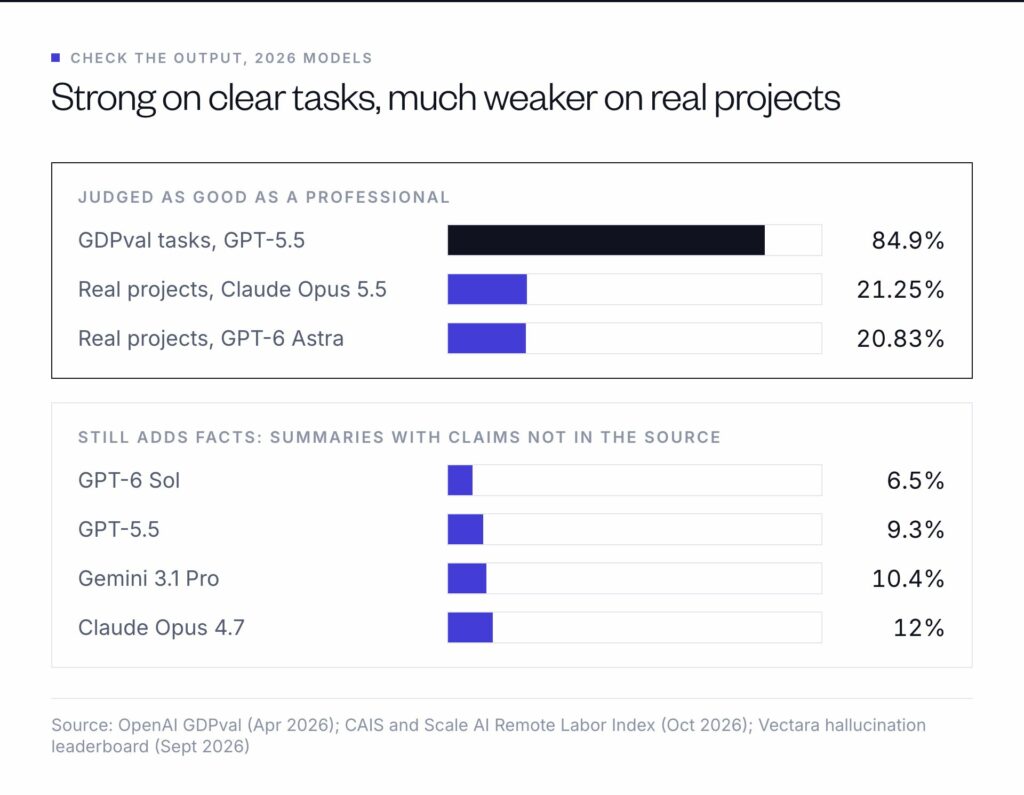
Today’s models are good enough that checking their work feels optional, and that is the trap. In OpenAI’s GDPval test, where industry experts grade work blind across 44 occupations, GPT-5.5 matched or beat the experts on 84.9% of well-specified tasks (April 2026; OpenAI runs this benchmark on its own models). On the independent Remote Labor Index, where human judges decide whether a client would accept the work on real freelance projects, the best models scored 21.25% (Claude Opus 5.5) and 20.83% (GPT-6 Astra) as of October 2026.
Faithfulness to your own documents isn’t solved either. Told to summarize only the passage in front of them, current frontier models added claims that weren’t in it to 6.5%-12% of summaries on Vectara’s hallucination leaderboard (September 2026). That is exactly the job of a prompt that summarizes your P&L, a Stripe export or a contract.
- Check every number against its source. Revenue against Stripe or your billing system, costs against QuickBooks or Xero, metrics against the export you attached.
- Ask it to show its working. “Show the formula and the rows you used” makes errors visible.
- Compare against a fixed tool. For finance prompts, run the same inputs through a calculator and compare.
- Keep a person on anything customer-facing. Emails, replies, contracts and published content get read before they go out.
Fund growth without giving up equity
The fundraising prompts above help you prepare a raise. If you’d rather not sell equity at all, there is another option for SaaS companies with recurring revenue.
Founderpath provides non-dilutive capital for B2B SaaS companies with at least $10K MRR. There’s no equity, no warrants, no board seats and no personal guarantees. Connect your billing, banking and accounting data, and most founders see funds within 24-48 hours.
Check what you qualify for. It takes less than 5 minutes.
AI Prompts for Business FAQ
What are the best AI prompts for business?
The best AI prompts for business give the assistant a role, one clear task, the context it needs (usually your own data, attached) and the output format. A cash forecast built from your bank export, an investor update written from your metrics sheet and a support reply drawn only from your help center are good places to start. The 10 prompts near the top of this list follow that structure.
What are the top 10 AI prompts?
For a business, ten prompts that cover the main teams are: a 13-week cash forecast, a monthly investor update, an on-brand first draft, an RFI answer, a churn risk list, a ticket reply from your help center, feature request themes, a pull request review, a stress test of next year’s plan and a job description. Each is written out in full in this post.
What are good AI prompts for small businesses?
Small businesses get the most from prompts that save the owner time on recurring work: drafting customer emails, summarizing the month’s sales, writing job posts, categorizing transactions and answering common support questions. Attach your own files, such as a sales export or past emails, so the answer fits your business instead of a generic one.
How do you write a good AI prompt for business?
Use four parts: a persona (who the AI should act as), a task (one job with a verb), context (your numbers, customer or constraints, ideally as an attached file) and a format (a table, an email of a set length, bullet points). Google found the prompts that worked best averaged about 21 words with relevant context, while most people typed fewer than nine.
Which AI tool should I use for business prompts?
The prompts in this list work in ChatGPT, Claude, Gemini and Microsoft Copilot. What matters more than the tool is whether it can read your files and connect to the apps you use, and whether your company has approved it for business data. Use the one your team already pays for and has cleared.
What is the 30% rule for AI?
There is no official 30% rule for AI. The phrase is an informal rule of thumb with several meanings, most often that AI handles about 70% of repetitive work while people keep about 30% for judgment and review. No standard or study sets the number, so treat it as a slogan, not a benchmark.
Is it safe to put company data into an AI prompt?
Only in an AI tool your company has approved, on a plan whose data settings you have checked. Leave out customer personal data and anything confidential that the task doesn’t need, and check every number the AI returns against the source before you use it.
Can non-technical founders use AI coding agents?
Yes, once the tech team has set up the repository with a guidelines file such as AGENTS.md or CLAUDE.md that the agent reads at the start of each session. You describe the change in plain words, the agent edits the code and runs the checks, and an engineer reviews the pull request. In Anthropic’s analysis of about 400,000 Claude Code sessions, people outside software jobs reached verified success in 29% of code-producing sessions, against 34% for software occupations.
Can AI prompts replace a finance or operations hire?
Not on their own. GPT-5.5 matched or beat industry experts on 84.9% of well-specified tasks in OpenAI’s GDPval test, but the best models delivered client-ready work on only about 21% of whole real projects on the independent Remote Labor Index (October 2026), and frontier models still add facts that aren’t in the source to 6.5%-12% of document summaries. Use prompts to draft the forecast, the variance analysis or the board update, and keep a person who owns the numbers and checks them against Stripe, the bank and the books.
Recent Articles

CARR vs ARR: What Contracted ARR Is and How It Differs
CARR is your ARR plus signed contracts that aren't live yet, minus churn notices. How to calculate CARR, how it differs from ARR, bookings and RPO, and how to report it honestly.

What Is a UCC Filing? What It Means When a Lender Files One
A UCC filing is a public notice that a lender has a lien on some or all of your business assets. What a UCC-1 contains, how long it lasts, how it affects new financing and how to remove one.

What Are Debt Warrants? How Venture Debt Warrants Work
Debt warrants give a lender the right to buy shares at a fixed price alongside a loan. How warrant coverage works, what it costs in dilution, and which lenders take warrants.