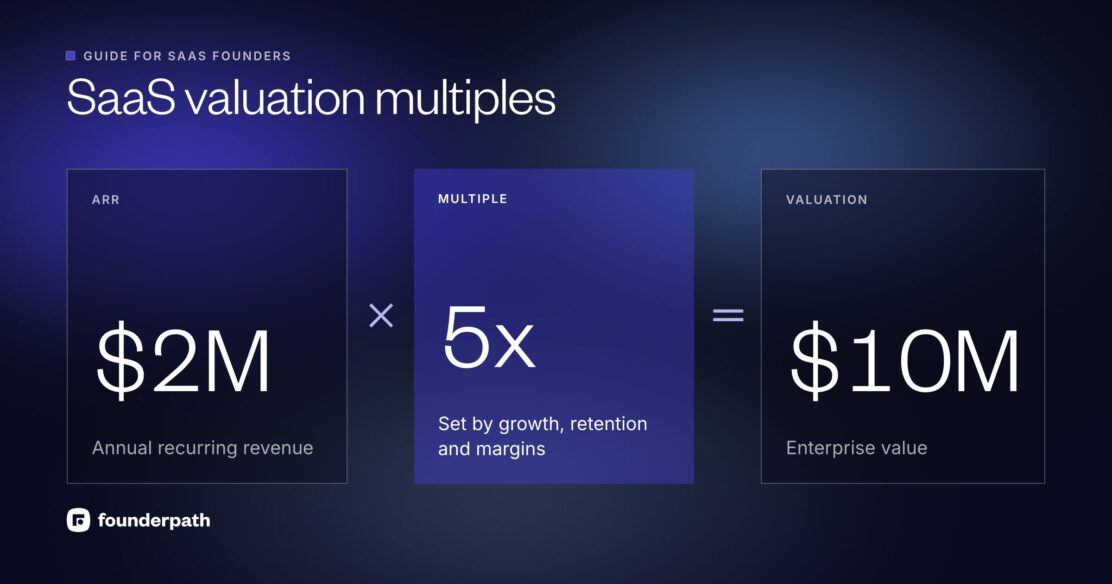

A SaaS multiple is the number a buyer or investor multiplies a software company’s annual recurring revenue (ARR), revenue or EBITDA by to arrive at its value: a company with $2M of ARR valued at 5x ARR is worth about $10M. In 2026, public SaaS companies trade at a median of about 4x revenue (SaaS Capital Index), private SaaS acquisitions close at about 4x revenue (Software Equity Group), and small owner-run SaaS businesses sell for about 4x profit (Acquire.com).
Key Takeaways
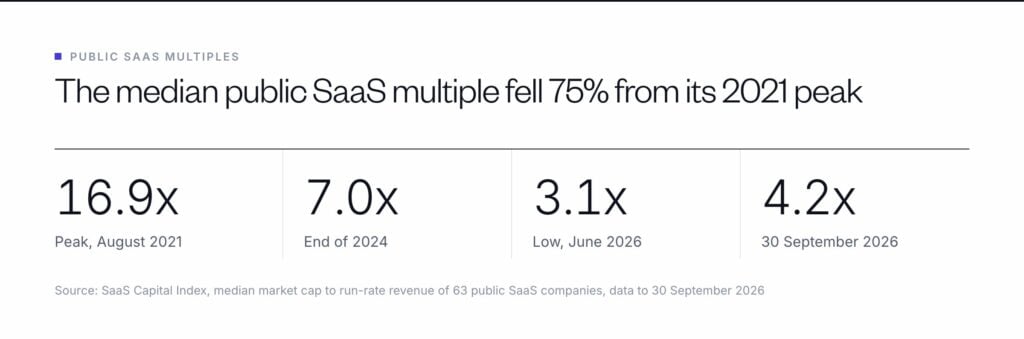
- The median public SaaS company was valued at 4.2x run-rate revenue on 30 September 2026, down from a peak of 16.9x in August 2021, according to the SaaS Capital Index.
- Private SaaS acquisitions closed at a median 4.0x trailing revenue in the second quarter of 2026, according to Software Equity Group.
- Small SaaS businesses valued under $10M sold for a median 3.9x profit in both 2024 and 2025, according to Acquire.com.
- Retention moves the multiple: public SaaS companies with net revenue retention above 110% traded at 8.0x trailing revenue at the end of 2025, against 1.5x for 90% or below, according to Software Equity Group.
- Size changes the method: FE International’s 2026 ranges put businesses under $1M ARR at 2.5x to 4x seller’s discretionary earnings and companies above $20M ARR at 5x to 7x ARR.
What Is a SaaS Multiple?
A valuation multiple is the ratio between what a company is worth and one of its financial numbers. Subscription revenue renews every month or year, so buyers can see most of next year’s revenue in advance. That is why SaaS companies are usually priced on revenue, while most other businesses are priced on profit.
You will meet four kinds of SaaS multiple:
- ARR multiple: enterprise value divided by annual recurring revenue. The standard for subscription businesses with more than a few million dollars of ARR.
- Revenue multiple: enterprise value divided by total revenue, either trailing (the last 12 months) or forward (the next 12 months). It includes services and one-time fees, which buyers value less than subscriptions.
- EBITDA multiple: enterprise value divided by EBITDA. Private equity buyers use it for larger, profitable companies.
- Profit or SDE multiple: the sale price divided by annual profit or by seller’s discretionary earnings (profit plus the owner’s salary and perks). Used for small, owner-run businesses sold on marketplaces.
Which one applies depends mostly on size. FE International’s ranges, shown below, price businesses under $1M of ARR on seller’s discretionary earnings, those from $3M to $10M of ARR mainly on ARR, and larger companies on EBITDA and ARR together.
How to Calculate a SaaS Valuation With a Multiple
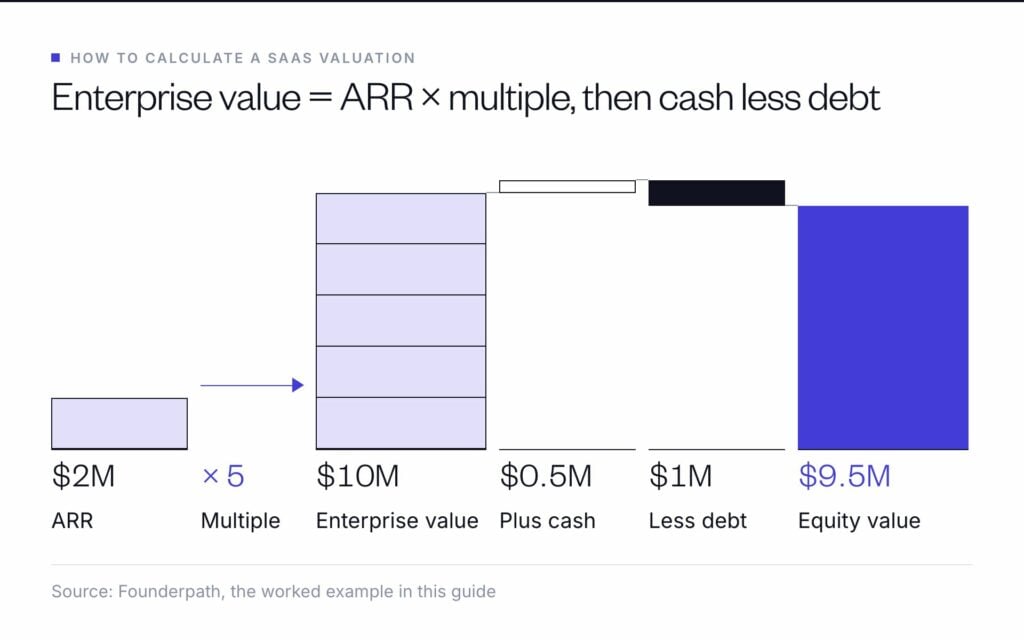
Enterprise value = ARR × multiple
A company with $2M of ARR, valued at 5x ARR, has an enterprise value of $10M. Enterprise value is the price of the whole business. To get the value of the shares (equity value), add the company’s cash and take away its debt. With $0.5M of cash and $1M of debt, the equity is worth $9.5M.
The hard part is choosing the multiple. Compare like with like, because benchmark sources measure different things:
- The SaaS Capital Index divides market capitalization by run-rate revenue (this month’s revenue times 12).
- Clouded Judgement divides enterprise value by forecast revenue for the next 12 months.
- Software Equity Group and Aventis Advisors divide enterprise value by revenue for the last 12 months.
- Acquire.com divides the sale price by the last 12 months of profit.
Then adjust for the metrics in the next sections: growth, retention, margins and concentration. Our free growth rate, net revenue retention and Rule of 40 calculators give you the inputs buyers ask for first.
SaaS Multiples in 2026
Public SaaS Companies
The SaaS Capital Index of 63 public SaaS companies stood at a median of 4.2x run-rate revenue on 30 September 2026. It peaked at 16.9x in August 2021, was 7.0x at the end of 2024 and fell to 3.1x in June 2026, so today’s median is 75% below the peak. SaaS Capital says valuations hit decade-plus lows in the first quarter of 2026 as markets priced in AI as a threat to software companies.
Other trackers agree. Clouded Judgement put the median public cloud company at 4.2x forward revenue on 2 October 2026, and the SEG SaaS Index of 106 companies traded at a median 3.2x trailing revenue in the second quarter of 2026, down from 5.7x a year earlier.
Private SaaS Acquisitions
Private deal multiples have moved less than public ones. Software Equity Group counted a median 4.0x trailing revenue across 2,784 SaaS acquisitions in the 12 months to the second quarter of 2026, and says the median has stayed tightly clustered around 4.0x.
Aventis Advisors tracks SaaS acquisitions with a disclosed multiple. Across 543 deals from 2015 to early 2026, the median was 4.5x revenue, and half of the deals sold for between 2.4x and 8.1x. The yearly median fell to 2.9x in 2024 and recovered to 3.8x in 2025. For the 232 deals with a disclosed EBITDA multiple, the median was 23.0x EBITDA.
Small SaaS Businesses
Below about $10M in value, SaaS businesses usually sell on profit. Acquire.com reports a median sale price of 3.9x profit for SaaS businesses sold through its marketplace in both 2024 and 2025.
FE International, an M&A adviser, publishes ranges by size from more than 1,500 transactions. They are its advisory ranges, not a published dataset:
| ARR | How buyers value it | Typical range |
|---|---|---|
| Under $1M | Seller’s discretionary earnings (SDE) | 2.5x to 4x SDE |
| $1M to $3M | SDE or ARR | 3x to 4.5x SDE (2.5x to 3.5x ARR) |
| $3M to $5M | ARR, checked against EBITDA | 3x to 4.5x ARR |
| $5M to $10M | ARR and EBITDA | 3.5x to 5.5x ARR (8x to 12x EBITDA) |
| $10M to $20M | EBITDA, checked against ARR | 4x to 6x ARR (10x to 14x EBITDA) |
| Above $20M | EBITDA and ARR | 5x to 7x ARR (12x to 16x EBITDA) |
Public Take-Private Deals
Blossom Street Ventures tracked 46 acquisitions of public SaaS companies from December 2020 to May 2025. The 37 that weren’t distressed sold for a median 8.4x trailing revenue. Recent examples:
| Company | Buyer | Announced | Deal value | Revenue multiple |
|---|---|---|---|---|
| Splunk | Cisco | Sep 2023 | $28B (equity value) | 7.5x |
| HashiCorp | IBM | Apr 2024 | $6.4B | 11.0x |
| Smartsheet | Blackstone and Vista | Sep 2024 | $8.4B | 8.4x |
| SolarWinds | Turn/River Capital | Feb 2025 | $4.4B | 5.6x |
| Informatica | Salesforce | May 2025 | $8.0B | 4.9x |
Private equity firms are the most active buyers of profitable SaaS companies. See our list of firms that buy SaaS companies.
What Drives a SaaS Multiple Up or Down
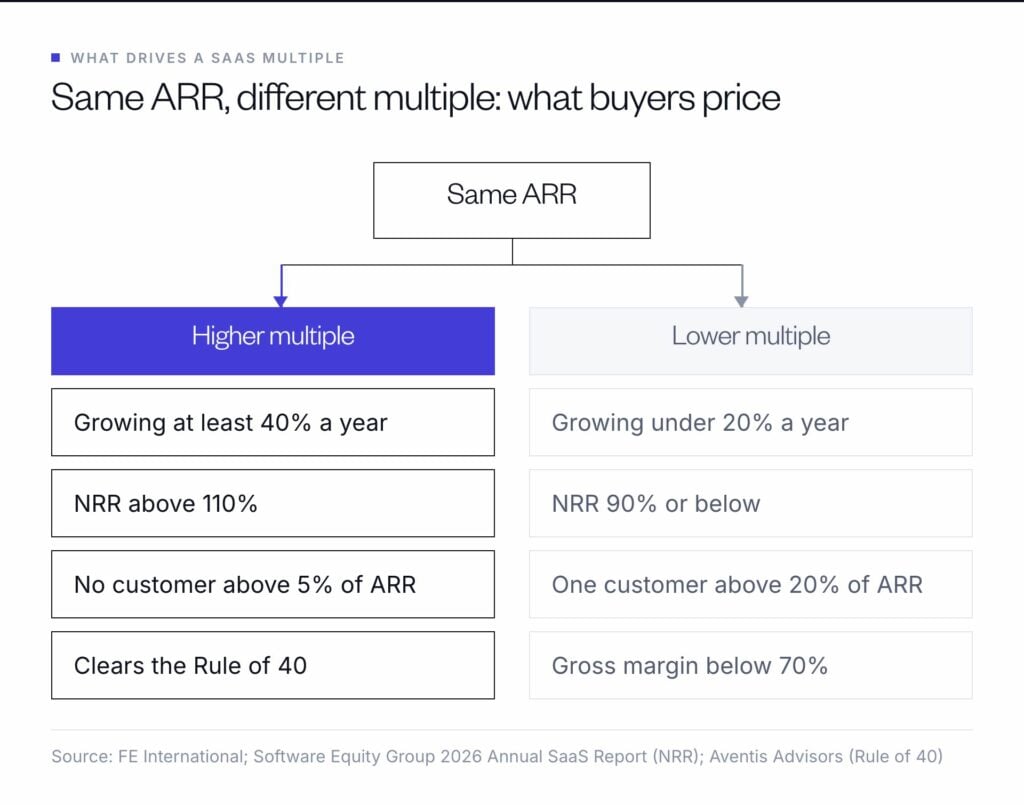
Two companies with the same ARR can sell for very different prices. These are the metrics buyers price.
Growth Rate
For public companies, growth outweighs profitability. Bessemer Venture Partners found in 2024 that a 1-point increase in growth rate had 2.3 times the effect on a public cloud company’s multiple of a 1-point increase in free cash flow margin.
On 2 October 2026, Clouded Judgement’s high-growth group (more than 22% forecast growth) traded at a median 19.4x forward revenue, the mid-growth group (15% to 22%) at 6.8x and the low-growth group (under 15%) at 3.4x.
In private M&A the premium flattens out. Thomas Smale, whose firm FE International draws on more than 1,500 transactions, says buyers stop paying extra past a certain point:
What the data shows is that companies growing at least 40% year on year … will sell for a higher multiple than a business that’s growing at less than 20%. And I think the interesting thing here is, when we looked at the data, when we saw companies growing at say 80% or 100%, there was not necessarily a disproportionate increase in multiple. So once you get to 40% growth rate, you will be at the higher end of premium valuations.
Thomas Smale, CEO, FE International ($39M revenue). Watch at 2:56
To measure yours the way buyers do, see our guide to SaaS growth rate.
Net Revenue Retention
Net revenue retention (NRR) is the share of last year’s revenue you still collect from the same customers today, after churn, downgrades and upgrades. Above 100%, existing customers grow the business on their own.
In Software Equity Group‘s 2026 annual report, public SaaS companies with NRR above 110% traded at a median 8.0x trailing revenue in the fourth quarter of 2025. Companies between 100% and 110% traded at 4.5x, between 90% and 100% at 2.6x, and at 90% or below at 1.5x.
| Net revenue retention | Median EV to trailing revenue |
|---|---|
| Above 110% | 8.0x |
| 100% to 110% | 4.5x |
| 90% to 100% | 2.6x |
| 90% or below | 1.5x |
Bootstrapped companies hold their customers well: SaaS Capital reports a median NRR of 103% in 2026 for bootstrapped SaaS companies with $3M to $20M of ARR.
Gross Margin
Gross margin tells a buyer how much of each subscription dollar is left after hosting and support. The median public cloud company runs a 76% gross margin, according to Clouded Judgement. FE International says buyers start asking which part of the revenue is really services once gross margin falls below 70%, and price that part lower.
The Rule of 40
The Rule of 40 says revenue growth rate plus profit margin should be at least 40%. Aventis Advisors found that only 7 of 46 public SaaS companies (15%) cleared it in the second quarter of 2026, and the median score was 26%. In its data, a 10-point higher score goes with about 1x more EV to revenue.
Customer Concentration
If one customer can sink the business, buyers pay less for it. FE International counts it as a premium when no customer is above 5% of ARR, and as a discount when a single customer is above 20%, especially one out of contract.
Bootstrapped vs VC-Backed: What the Founder Keeps
Headline multiples favour venture-backed companies slightly. SaaS Capital‘s last private-company estimate, from January 2025, put bootstrapped companies at 4.8x run-rate revenue and equity-backed companies at 5.3x. It was made when the public index stood at 7.0x, and there is no 2026 update.
What the founder takes home depends on ownership too. Carta‘s 2026 data shows the median founding team owns 56% of the company after a seed round and 36% after a Series A. Here is the same $2M ARR company in both cases:
| Bootstrapped | VC-backed, after Series A | |
|---|---|---|
| ARR | $2M | $2M |
| Multiple (SaaS Capital, Jan 2025) | 4.8x | 5.3x |
| Company value | $9.6M | $10.6M |
| Founders’ ownership | 100% (example) | 36% (Carta median) |
| Founders’ share of the sale | $9.6M | $3.8M |
The figures are before taxes and before liquidation preferences, which pay investors back first. Rami Essaid raised $60M for Distil Networks before it was sold to Imperva in 2019. He describes how that money came off the top:
What that means for the waterfall is that investors get their money out first before money gets distributed across common, right? And so that means that we raised 60 million dollars … some of that money goes straight off the top before common gets paid out. It also meant that those investors had a different incentive alignment … those big investors pushed us to sell. I actually didn’t want to sell. I wanted to keep going.
Rami Essaid, co-founder, Distil Networks (now SVP, Finmark). Watch at 3:21
For more on staying independent, see our guide to bootstrapping a startup.
How to Increase Your SaaS Multiple
Buyers price the last 12 months, so most of these take a year or more to show. FE International says a focused effort on retention, margins, contract terms and owner dependency typically raises a multiple by 1x to 2x over 12 to 18 months.
Raise Net Revenue Retention
Find the main reason customers cancel and fix it, move monthly customers to annual contracts, and build upgrade paths so existing customers can spend more. Track it with our SaaS KPIs guide.
Grow Without Giving Up Equity
Faster growth lifts the multiple, but selling equity to fund it shrinks your share of the sale. Non-dilutive funding, such as revenue-based financing, pays for growth without changing ownership.
Make the Business Run Without You
Buyers discount a company that depends on its founder. David Hauser describes what a management team was worth when Citrix bought Grasshopper:
At Grasshopper we got out of the business, we had a management team. This was tremendously valuable to the acquirer for so many reasons. First, the transition was easy. They actually paid more because they didn’t have to find expensive positions for me and my co-founder to be in, and stupid titles, right? So they paid more cash up front to not deal with that. And I think this is true [of] most acquirers: if you’re working in the business, it’s a big concern.
David Hauser, co-founder, Grasshopper. Watch at 11:38
Spread Revenue Across Customers
Keep every customer under 5% of ARR where you can, and keep your largest accounts under contract before you start a sale process.
Separate Subscription Revenue From Services
Report recurring subscription revenue on its own line. Services, setup fees and one-time revenue earn a lower multiple, and mixing them in pulls down your gross margin.
Fund Growth Without Selling Equity
A higher multiple pays off only if you still own the company when it is sold.
Founderpath provides non-dilutive capital for B2B SaaS companies with at least $10K MRR. There’s no equity, no warrants, no board seats and no personal guarantees. Connect your billing, banking and accounting data, and most founders see funds within 24-48 hours.
Check what you qualify for. It takes less than 5 minutes.
SaaS Multiples FAQ
What is a good revenue multiple for a SaaS company?
Anything above the market median. In 2026 the median public SaaS company traded at 4.2x run-rate revenue (SaaS Capital Index, 30 September 2026) and private SaaS acquisitions closed at a median 4.0x trailing revenue (Software Equity Group, second quarter of 2026). Public companies forecast to grow faster than 22% a year, or keeping more than 110% of revenue from existing customers, trade well above that.
How much does a SaaS company sell for?
It depends on size. Small SaaS businesses valued under $10M sold for a median 3.9x profit on Acquire.com in 2024 and 2025. FE International puts companies with $5M to $10M of ARR at 3.5x to 5.5x ARR and those above $20M at 5x to 7x ARR. Across 543 disclosed SaaS acquisitions since 2015, Aventis Advisors found a median of 4.5x revenue.
What multiple can I get for my SaaS business?
Start from your size band, then adjust for your metrics. Under $1M of ARR, buyers usually pay 2.5x to 4x seller’s discretionary earnings, and from $3M to $5M of ARR, 3x to 4.5x ARR (FE International, 2026). FE says companies above $20M of ARR can reach 8x ARR and more when they clear the Rule of 40 with net revenue retention above 120%.
What is the Rule of 40 for SaaS valuation?
The Rule of 40 says a SaaS company’s revenue growth rate plus its profit margin should be at least 40%. Only 15% of public SaaS companies cleared it in the second quarter of 2026, and in Aventis Advisors’ data each 10 extra points went with about 1x more EV to revenue.
What is a typical EBITDA multiple for SaaS companies?
Across 232 SaaS acquisitions with a disclosed EBITDA multiple from 2015 to early 2026, the median was 23.0x EBITDA (Aventis Advisors). FE International’s advisory ranges are lower for smaller companies: 8x to 12x EBITDA at $5M to $10M of ARR and 12x to 16x above $20M.
Is a business worth 3 times profit?
For a small SaaS business, about 4 times profit is closer to the market. Acquire.com reports a median sale price of 3.9x profit for SaaS businesses valued under $10M in 2024 and 2025. Larger SaaS companies are usually valued on revenue or EBITDA instead.
How do churn and slow growth affect a SaaS valuation?
Both lower the multiple. Public SaaS companies with net revenue retention of 90% or below traded at 1.5x trailing revenue at the end of 2025, against 8.0x above 110% (Software Equity Group). Companies forecast to grow under 15% traded at 3.4x forward revenue in October 2026, against 19.4x for those above 22% (Clouded Judgement).
Recent Articles

CARR vs ARR: What Contracted ARR Is and How It Differs
CARR is your ARR plus signed contracts that aren't live yet, minus churn notices. How to calculate CARR, how it differs from ARR, bookings and RPO, and how to report it honestly.

What Is a UCC Filing? What It Means When a Lender Files One
A UCC filing is a public notice that a lender has a lien on some or all of your business assets. What a UCC-1 contains, how long it lasts, how it affects new financing and how to remove one.

What Are Debt Warrants? How Venture Debt Warrants Work
Debt warrants give a lender the right to buy shares at a fixed price alongside a loan. How warrant coverage works, what it costs in dilution, and which lenders take warrants.