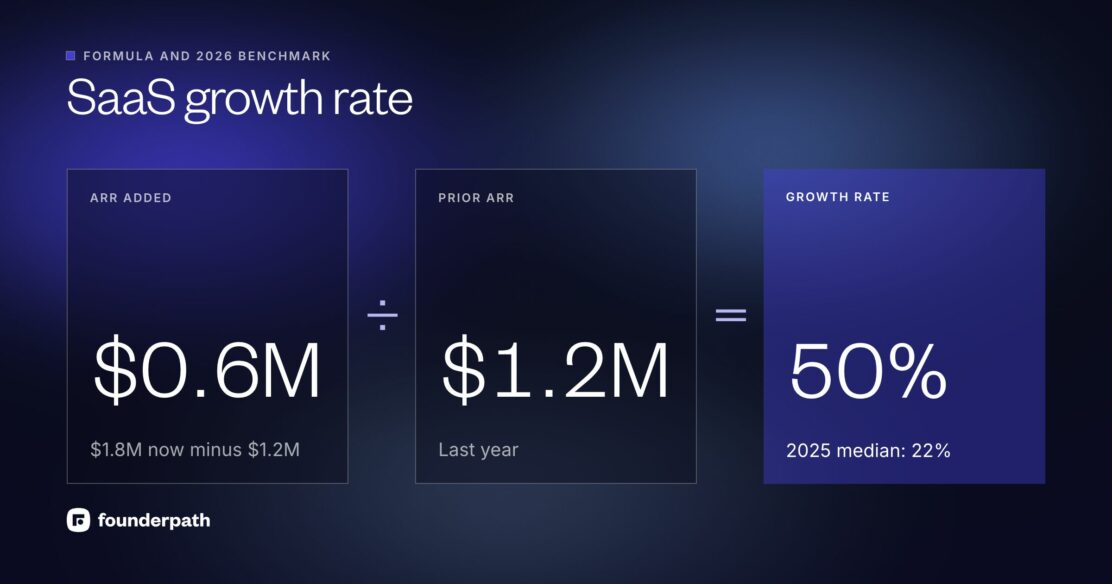

SaaS growth rate is the percentage change in a software company’s recurring revenue over a period, usually annual recurring revenue (ARR) measured year over year: (current ARR − prior ARR) ÷ prior ARR × 100. The median private B2B SaaS company grew 22% in 2025, according to SaaS Capital’s 2026 survey of more than 1,000 companies, so a good growth rate is one that beats the median for your size.
Key Takeaways
- The median private B2B SaaS company grew 22% in 2025, down from 25% in 2024 (SaaS Capital, 2026 survey).
- Growth slows with size: SaaS Capital’s 2024 data puts the median at 40% below $1M ARR and 20% above $10M ARR.
- Bootstrapped companies grew a median 20% in 2025 and equity-backed companies 25%, while equity-backed companies spent 70% more on sales (SaaS Capital, 2026).
- Public SaaS companies grew a median 16% over the last 12 months and are forecast to grow 13% over the next 12 (Clouded Judgement, 2 October 2026).
- Retention moves growth: lifting net revenue retention from 90-100% to 100-110% adds 5 points of growth (SaaS Capital, 2026).
What Is SaaS Growth Rate?
SaaS growth rate measures how fast a subscription software company’s recurring revenue is rising. You can track growth in users or customers too, but founders, investors and lenders compare companies on revenue, so revenue growth is the number that counts.
Recurring revenue comes in two forms. Monthly recurring revenue (MRR) is the subscription revenue you bill in a month; annual recurring revenue (ARR) is that figure annualized. Early-stage companies watch MRR growth month to month, while benchmarks such as SaaS Capital’s survey compare ARR growth year over year. Growth rate also feeds directly into what your company is worth: see SaaS valuation multiples.
How to Calculate SaaS Growth Rate
Year-over-Year (YoY) Growth Rate
Year-over-year growth is the standard measure for established companies and the one most benchmarks use:
YoY growth rate = (current year ARR − prior year ARR) ÷ prior year ARR × 100
Example: if ARR grew from $1.2M to $1.8M, the YoY growth rate is ($1.8M − $1.2M) ÷ $1.2M × 100 = 50%.
Month-over-Month (MoM) Growth Rate
Month-over-month growth is the common measure at an early stage, when a year of data hides too much:
MoM growth rate = (this month’s MRR − last month’s MRR) ÷ last month’s MRR × 100
Example: if MRR grew from $50,000 in January to $55,000 in February, MoM growth is ($55,000 − $50,000) ÷ $50,000 × 100 = 10%.
Small monthly rates add up. Mark Abbott, founder and CEO of Ninety.io, described the company’s month-over-month growth:
We’ve been growing at five to eight percent month over month revenue. … We put our first price increase in last month, February. So we never increased prices … That’s part of the reason our numbers are growing … in the last couple weeks. But we’ve been doing five to eight percent month over month revenue growth for several years now.
Mark Abbott, founder and CEO, Ninety.io. Watch at 12:08
Compounded over a year, 5% a month is about 80% annual growth and 8% a month about 152%.
Compound Monthly Growth Rate (CMGR)
Single months are noisy: one large annual contract or one lost customer can swing MoM growth. CMGR gives the steady monthly rate that would take you from your starting MRR to your ending MRR:
CMGR = (ending MRR ÷ starting MRR)^(1 ÷ number of months) − 1
Example: MRR that grows from $50,000 to $80,000 over 12 months has a CMGR of (80,000 ÷ 50,000)^(1/12) − 1 = 4.0% a month. Founderpath’s free growth rate calculator works out CMGR, annualized growth and doubling time from your starting and ending revenue.
Converting Monthly Growth to Annual Growth
Monthly and annual rates are easy to mix up because growth compounds. The formula is annual growth = (1 + monthly rate)^12 − 1:
| Monthly growth | Annualized growth |
|---|---|
| 2% | 27% |
| 3% | 43% |
| 5% | 80% |
| 7% | 125% |
| 10% | 214% |
| 15% | 435% |
| 20% | 792% |
Average SaaS Growth Rate in 2026
The median private B2B SaaS company grew 22% in 2025, down from 25% in 2024, according to SaaS Capital’s 2026 growth benchmarks, its 15th annual survey of more than 1,000 companies. Only 7.3% of companies reported flat or falling revenue, well below the 13% peak of 2020.
SaaS Growth Rate by ARR
Growth slows as companies get bigger. SaaS Capital’s 2026 breakdown by size is only in a gated report, so the table below uses its 2025 edition, which covers 2024 growth across more than 1,000 companies:
| ARR | Median growth | Top quartile | Top 10% |
|---|---|---|---|
| Under $1M | 40% | 100% | 400% |
| $1M-$3M | 28% | 50% | 132% |
| $3M-$5M | 24% | 40% | 64% |
| $5M-$10M | 24% | 42% | 75% |
| $10M-$20M | 20% | 37% | 60% |
| Over $20M | 20% | 31% | 50% |
Source: SaaS Capital, 2025 Private B2B SaaS Company Growth Rate Benchmarks (2024 data). Top quartile is the 75th percentile, top 10% the 90th.
In SaaS Capital’s words, a $2 million company needs to grow more than 50% a year to be in the top quarter of its peers, while a $20 million company gets there at 31%.
Bootstrapped vs. VC-Backed SaaS Growth Rates
Venture money buys some extra growth, at a cost. In SaaS Capital’s 2026 survey, bootstrapped companies grew a median 20% in 2025 and equity-backed companies 25%. Its 2026 spending benchmarks show equity-backed companies spending 70% more on sales and 100% more on marketing than bootstrapped ones, and 48% of them operating at a loss compared with 17% of bootstrapped companies.
| Measure | Bootstrapped | Equity-backed |
|---|---|---|
| Median growth in 2025 | 20% | 25% |
| Spend on sales | Baseline | 70% more |
| Spend on marketing | Baseline | 100% more |
| Share operating at a loss | 17% | 48% |
The best bootstrapped companies keep pace on milestones. ChartMogul’s 2024 analysis of more than 2,500 companies found top-quartile bootstrapped companies reach $1M ARR in two years, only four months slower than VC-backed ones. Growth does slow at scale: SaaS Capital reported in April 2026 that bootstrapped companies with $3M-$20M ARR grew a median 15%, and the top 10% grew 42.3%.
Public SaaS Growth Rates
Public SaaS companies grew a median 16% over the last 12 months and are forecast to grow 13% over the next 12, according to Clouded Judgement (2 October 2026). Aventis Advisors puts median public SaaS revenue growth at 11.8% in the second quarter of 2026, down from 33% in the second quarter of 2021.
How Long It Takes to Reach $1M and $10M ARR
ChartMogul’s 2025 study of 6,525 software companies shows how rare sustained growth is:
- $1M ARR: almost half of startups get there if they keep going for 10 years after they start charging; 13.4% get there within three years.
- $10M ARR: one in ten.
- $25M ARR: one in fifty within 10 years.
Timing matters too: only 10.1% of companies that started in 2021 reached $1M ARR within three years, the lowest of any cohort. AI-native companies grow faster: Emergence Capital’s 2025 benchmarks put their median ARR growth at 100%, compared with 23% for traditional SaaS.
What Is a Good SaaS Growth Rate?
A good growth rate beats the median for your size. On SaaS Capital’s 2024 data, that means more than 40% a year below $1M ARR, more than 24-28% between $1M and $10M and more than 20% above $10M. Top-quartile growth is 100% below $1M ARR, 50% at $1M-$3M and 31-42% above that.
Measured monthly, ChartMogul’s 2023 report found the median SaaS business grows about 2-2.5% a month throughout its life. The top quartile grows about 5-7% a month early on and 3-5% as it matures, and the top decile 10-17% a month when starting out.
Growth usually slows as revenue climbs, even in strong companies. David Daneshgar, co-founder of the bootstrapped company Whippy, described his own plan when asked where revenue had been a year earlier:
It [revenue a year ago] was about half. So we doubled in the last twelve months. I think … on our roadmap is probably, I would say, … about 70 to 75% this year and maybe 50 the next. But … within the next twenty four months, definitely, we wanna be at 10,000,000 in ARR bootstrapped as well.
David Daneshgar, co-founder, Whippy ($4M revenue). Watch at 20:03
Venture investors expect more. Christoph Janz of Point Nine, quoted in ChartMogul’s 2023 report, says a company at $8M-$15M ARR needs to grow roughly 2x a year to get investors excited, and faster below that.
The T2D3 Rule (3, 3, 2, 2, 2)
T2D3 stands for triple, triple, double, double, double. Neeraj Agrawal of Battery Ventures described it in 2015 as a path for venture-backed SaaS companies once they reach $2M ARR:
$2M → $6M → $18M → $36M → $72M → $144M ARR
Agrawal called it one route, not the only one, and few companies follow it. Some have gone faster: Slack reached $100M ARR about two and a half years after its February 2014 launch (GeekWire), and Sacra estimates that Cursor went from $1M to $100M ARR in about 12 months.
The Rule of 40
The Rule of 40 says a SaaS company’s revenue growth rate plus its profit margin should be at least 40%. Brad Feld popularized it in 2015, after hearing it from a late-stage investor, and used EBITDA margin; McKinsey uses free cash flow margin. A company growing 60% with a −20% margin scores 40, the same as one growing 20% with a 20% margin.
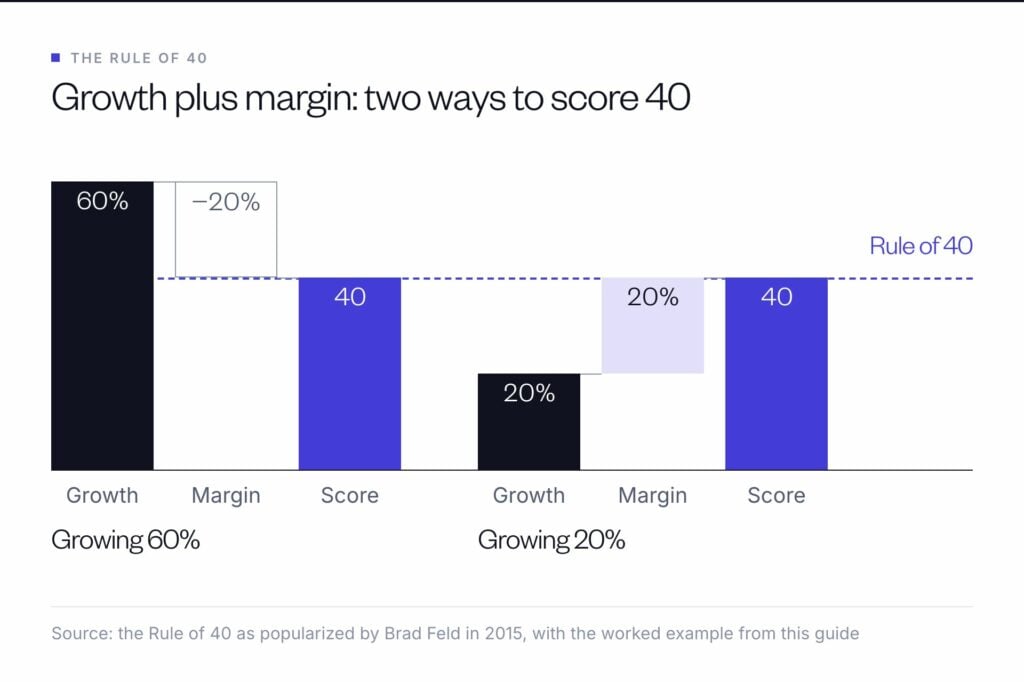
Investors pay for it. McKinsey found in 2021 that companies at or above the Rule of 40 earn consistently higher EV-to-revenue multiples, yet software companies cleared it only 16% of the time. In August 2026, only 15% of the public SaaS companies Aventis Advisors tracked cleared 40, and the median score was 26%. You can check your own score with the Rule of 40 calculator.
Bootstrapped companies can hold it for years. Mark Douglas built LCPTracker without outside debt or equity, to $31M in revenue in 2024 (per GetLatka). In a September 2024 talk he said LCPTracker grew 28% over the previous 12 months and has averaged a Rule of 40 score of 40 since 2018, by keeping its profit margin near 10% and putting the rest into growth (Watch at 4:51).
What Drives SaaS Growth Rate, and How to Increase It
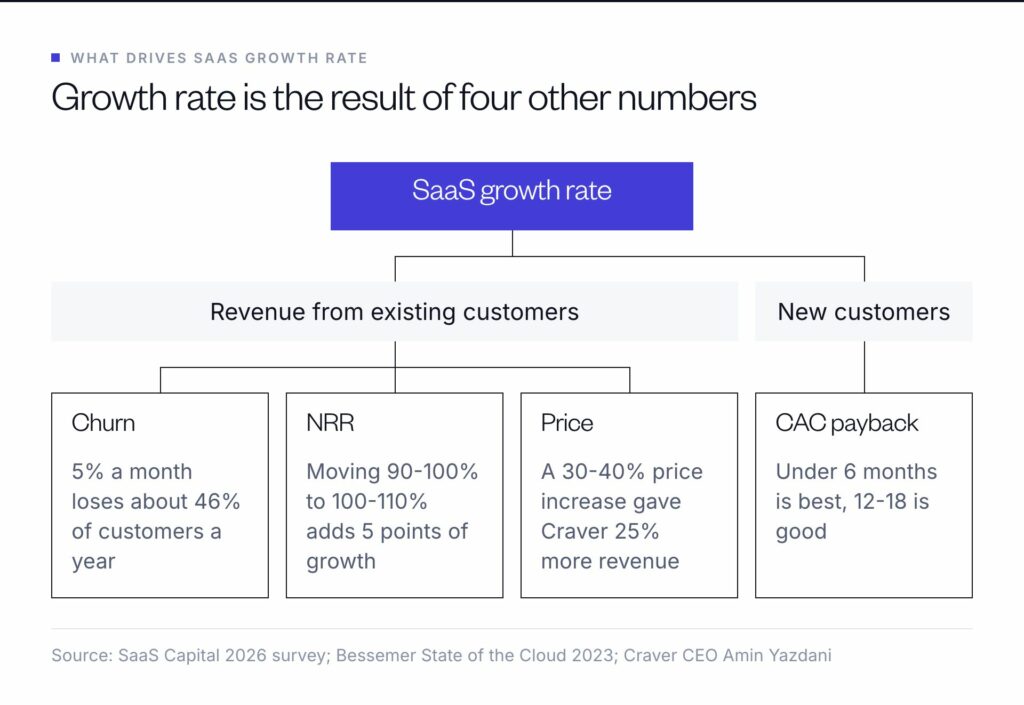
Growth rate is the result of a few other numbers: how much revenue you keep, how much existing customers expand, what you charge and what each new customer costs. Track them alongside growth with the SaaS KPIs that matter.
Keep the Revenue You Have
Churn is subtracted from growth before new sales count. A 5% monthly churn rate loses about 46% of customers in a year. Scott Brandley, CEO of the bootstrapped company ShopperApproved, explained what even low churn costs:
[At] Shopper Approved, our churn rate is 1.31 [percent] per month … So in just one year our cumulative churn rate is over 15 [percent], so that means we have 15 [percent] less cash flow to grow our business if we don’t do something about it. And the other way you can look at that is every single month … the first 15 [percent] of all the sales we make have to go towards offsetting the churn.
Scott Brandley, CEO, ShopperApproved. Watch at 11:27
Grow Revenue From Existing Customers
Net revenue retention (NRR) measures revenue kept from existing customers after churn, downgrades and upgrades. In SaaS Capital’s 2026 survey, moving NRR from 90-100% to 100-110% added 5 points of growth, and companies with the highest NRR grew 173% faster than the median. At 120% NRR, existing revenue grows 2.5x in five years without a single new customer. For reference, the median public SaaS company had NRR of 110% in October 2026 (Clouded Judgement), and bootstrapped companies with $3M-$20M ARR had 103% (SaaS Capital). The NRR calculator works out yours.
Charge What the Product Is Worth
A price increase raises revenue from every customer who stays, which makes it one of the fastest growth levers. Amin Yazdani, CEO of Craver, described the price increase behind a jump in Craver’s revenue chart:
The big … jump that you see in the middle is a price increase. I highly recommend that, because I believe most of you right now are undercharging for your tool. Price increase seems scary, and our price increase was significant, on average about 30 to 40%. The net result of that was 25% increase in revenue for us, but basically we lost customer[s] … we were better off after the price increased, and it also enabled the outbound strategy for us.
Amin Yazdani, CEO, Craver ($20M revenue). Watch at 14:55
Check CAC Payback Before Buying Growth
Spending more on sales and marketing only adds healthy growth if new customers pay back what they cost. Bessemer’s State of the Cloud 2023 rates a customer acquisition cost (CAC) payback of 12-18 months as good, 6-12 months as better and under 6 months as best. The median public SaaS company took 31 months in October 2026 (Clouded Judgement).
How Growth Rate Affects SaaS Valuation
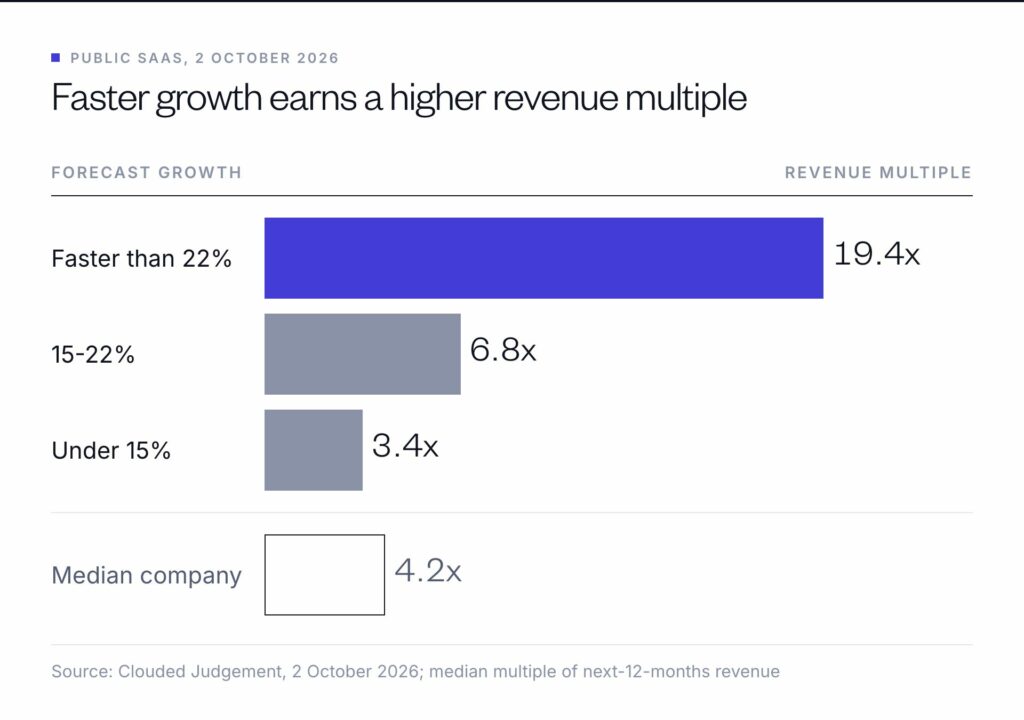
Faster growth earns a higher multiple. On 2 October 2026, Clouded Judgement put the median public SaaS company at 4.2x next-12-months revenue. Companies forecast to grow faster than 22% traded at a median 19.4x, those growing 15-22% at 6.8x and those under 15% at 3.4x. For how private SaaS companies are valued, see SaaS multiples.
Fund Growth Without Selling Equity
Growth usually needs spending before the revenue arrives: a hire, a channel that works, a product launch. Non-dilutive funding, such as revenue-based financing, pays for it without changing who owns the company. Founderpath sets no growth requirement; what doesn’t fit is declining MRR or poor retention.
Founderpath provides non-dilutive capital for B2B SaaS companies with at least $10K MRR. There’s no equity, no warrants, no board seats and no personal guarantees. Connect your billing, banking and accounting data, and most founders see funds within 24-48 hours.
Check what you qualify for. It takes less than 5 minutes.
SaaS Growth Rate FAQ
What is a good growth rate for a SaaS company?
A good SaaS growth rate is one above the median for your size. In SaaS Capital’s 2024 data, the median private B2B SaaS company grew 40% a year below $1M ARR, 24-28% between $1M and $10M ARR and 20% above $10M ARR. Top-quartile growth was 100% below $1M ARR, 50% at $1M-$3M and 31-42% above $3M. A company that also clears the Rule of 40 (growth rate plus profit margin of at least 40%) is strong at any size.
What is the average SaaS growth rate?
The median private B2B SaaS company grew 22% in 2025, down from 25% in 2024 and 30% in 2023, according to SaaS Capital’s 2026 survey of more than 1,000 companies. Public SaaS companies grew a median 16% over the last 12 months and are forecast to grow 13% over the next 12 (Clouded Judgement, 2 October 2026).
How do you calculate SaaS growth rate?
Divide the change in recurring revenue by the starting revenue and multiply by 100: (current ARR − prior ARR) ÷ prior ARR × 100. Use ARR for year-over-year growth and MRR for month-over-month growth. For example, ARR that grows from $1.2M to $1.8M is 50% year-over-year growth. To turn a monthly rate into an annual one, use (1 + monthly rate)^12 − 1, so 5% a month compounds to about 80% a year.
What is a good monthly growth rate for SaaS?
ChartMogul’s 2023 SaaS Growth Report found the median SaaS business grows about 2-2.5% a month throughout its life. The top quartile grows about 5-7% a month early on and 3-5% a month as it matures, and the top decile grows 10-17% a month when starting out.
What is the 3 3 2 2 2 rule of SaaS?
It is T2D3: triple, triple, double, double, double. Neeraj Agrawal of Battery Ventures described it in 2015 as a path for venture-backed SaaS companies: after reaching $2M ARR, grow to $6M, $18M, $36M, $72M and $144M, one step per phase. It describes venture-scale growth, not the median company.
What is the Rule of 40 in SaaS?
The Rule of 40 says a SaaS company’s revenue growth rate plus its profit margin should be at least 40%. A company growing 60% with a −20% margin scores 40, as does one growing 20% with a 20% margin. Brad Feld popularized it in 2015 using EBITDA margin; McKinsey uses free cash flow margin. Only 15% of the public SaaS companies Aventis Advisors tracked cleared 40 in August 2026.
Do bootstrapped SaaS companies grow slower than VC-backed ones?
Slightly. In SaaS Capital’s 2026 survey, bootstrapped companies grew a median 20% in 2025 and equity-backed companies 25%. Equity-backed companies spent 70% more on sales and 100% more on marketing, and 48% of them operated at a loss compared with 17% of bootstrapped companies.
What growth rate do investors look for?
It depends on the investor. Christoph Janz of Point Nine, quoted in ChartMogul’s 2023 SaaS Growth Report, says a company at $8M-$15M ARR needs to grow roughly 2x a year to get venture investors excited, and faster below that. Lenders that fund from revenue care more about steady recurring revenue and retention: Founderpath has no growth requirement, but declining MRR or poor retention is not a fit.
Recent Articles

CARR vs ARR: What Contracted ARR Is and How It Differs
CARR is your ARR plus signed contracts that aren't live yet, minus churn notices. How to calculate CARR, how it differs from ARR, bookings and RPO, and how to report it honestly.

What Is a UCC Filing? What It Means When a Lender Files One
A UCC filing is a public notice that a lender has a lien on some or all of your business assets. What a UCC-1 contains, how long it lasts, how it affects new financing and how to remove one.

What Are Debt Warrants? How Venture Debt Warrants Work
Debt warrants give a lender the right to buy shares at a fixed price alongside a loan. How warrant coverage works, what it costs in dilution, and which lenders take warrants.